

























































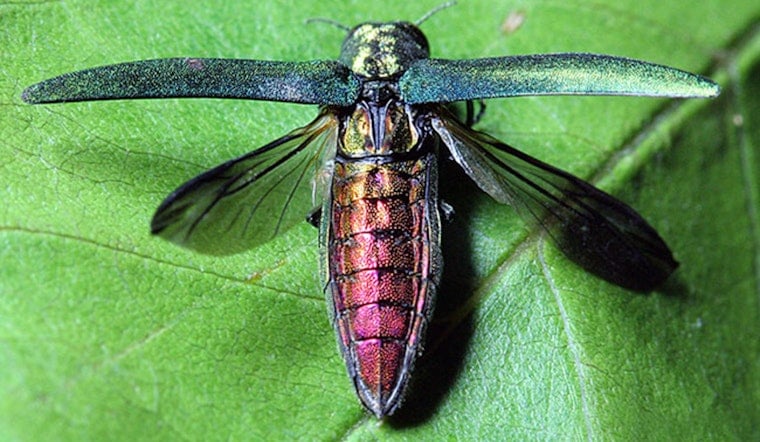
A metallic green beetle spotted on a windshield in Vancouver has been confirmed as Washington state's first emerald ash borer, an invasive pest that has already killed more than 100 million ash trees nationwide since it was first detected in Michigan in the early 2000s. Two Vancouver residents collected the insect on August 3 and reported it to the Washington State Invasive Species Council, setting off an identification process that ended with state and federal agencies confirming the state's worst-feared infestation had arrived.
The Washington State Department of Agriculture and the USDA Animal and Plant Health Inspection Service confirmed the specimen on Wednesday, according to KOMO News. State and federal agriculture officials say the find marks the pest's official arrival in Washington. Sven Spichiger said officials had anticipated the beetle's arrival in the state, per the same report.
Emerald ash borer is native to eastern Asia and was originally introduced to North America via wooden shipping crates in the 1990s, establishing its first confirmed foothold near Detroit in 2002, according to MountainTrue. Since then it has expanded into 36 states and six Canadian provinces, a scale that has led federal officials to consider it the most destructive and expensive forest pest in North American history, per the U.S. Department of Agriculture's Animal and Plant Health Inspection Service.
Washington Now Squeezed Between Two Infestation Fronts
Washington's confirmed case did not arrive out of nowhere. The beetle was first spotted on the West Coast in Forest Grove, Oregon, in June 2022, after being found on trees outside an elementary school, according to the Oregon Department of Agriculture. Just weeks before the Vancouver detection, Oregon forestry officials announced new confirmations across the Willamette Valley in Beaverton, Salem, Silverton, Rock Creek, and along the Banks-Vernonia State Trail — the first detection inside an Oregon state park — bringing the known infestation zone to five counties, as reported by Oregon Public Broadcasting. Hoodline previously reported on that spread south of the border.
To the north, the Canadian Food Inspection Agency confirmed emerald ash borer in Vancouver, British Columbia, in May 2024, the pest's first detection in that province, prompting strict wood movement restrictions across Metro Vancouver. That leaves Washington sandwiched between two established infestation zones, a trajectory a 2025 ecological modeling study led by Washington State University researchers, published in the Journal of Economic Entomology, had predicted: without intervention, the beetle would likely disperse into Washington within two years of establishing in Oregon and could reach California within two decades.
No Known Way to Eradicate the Pest Once It Takes Hold
Officials said there has never been a successful effort to eradicate emerald ash borer anywhere it has become established, per KOMO's reporting. A Washington Department of Natural Resources analysis found that municipalities could lose 90% to 100% of their ash trees within 10 to 12 years of an initial infestation if it goes unmanaged. Oregon ash, the Pacific Northwest's only native ash species, is especially vulnerable since all true ash species are susceptible to the beetle.
The ecological stakes extend well beyond street trees. Oregon ash serves as a dominant canopy tree in wetland floodplains throughout the Willamette and Lower Columbia River basins, and its loss threatens to raise stream temperatures and degrade spawning habitat for endangered salmon and steelhead, according to the U.S. Fish & Wildlife Service. Untreated host trees in already-infested zones face mortality rates exceeding 99%, per Oregon Public Broadcasting's reporting, and protecting a single high-value ash tree with systemic insecticide injections can cost around $400 every two years.
State Firewood Quarantine Took Effect One Day Before Confirmation
A new Washington State Department of Agriculture rule went into effect August 18, one day before the Vancouver confirmation was announced, establishing an exterior firewood quarantine that bars untreated out-of-state firewood from entering the state. Under the rule, imported firewood must be heat-treated to a core temperature of 160 degrees Fahrenheit for 60 minutes, and violations can draw civil penalties of up to $5,000 under state law, according to the Washington State Register.
The state-level quarantine fills a gap left after the USDA's Animal and Plant Health Inspection Service officially deregulated emerald ash borer at the federal level in January 2021, eliminating domestic interstate quarantine enforcement so federal funds could instead go toward biological control efforts such as releasing parasitic wasps. Federal officials had determined that domestic quarantines were failing to stop the beetle's human-assisted spread on firewood, according to the Federal Register.
Vancouver has been preparing for this moment for years. The city adopted a municipal Emerald Ash Borer Management Plan in 2022 that called for inventorying public trees, selectively removing declining specimens, and beginning preventive insecticide injections for high-value street and park trees, according to the City of Vancouver, Washington. The city has held Tree City USA status since 1989 and already treats mature ash trees on a routine maintenance cycle.
Officials Urge Residents to Stop Planting Ash and Report Sightings
Officials are urging land managers and homeowners to stop planting ash trees and to consider replacing affected trees with non-ash species, steps they say can help slow the beetle's spread alongside limiting the transport of firewood. Residents who spot a suspected emerald ash borer are asked to report it to the Washington State Invasive Species Council, the same route that led to the Vancouver confirmation after two residents first spotted the beetle on their windshield earlier this month.





