

























































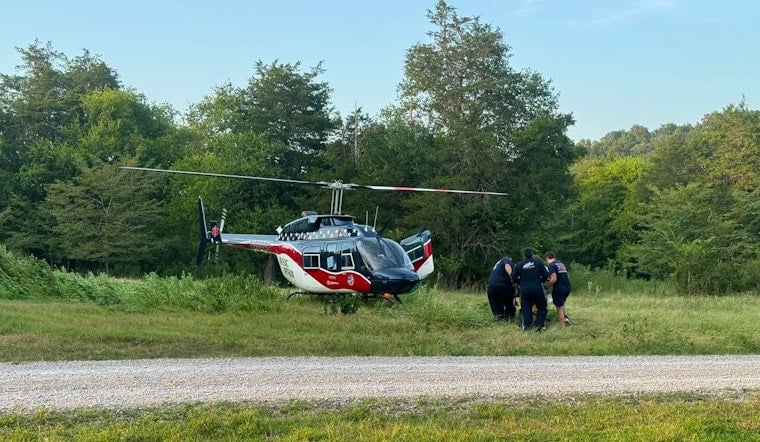
A person fell down a steep embankment along the Duck River near Carpenters Bridge Road on August 15, prompting Maury County Fire Department crews to launch a technical rope rescue to haul the patient back up to level ground. Rescuers secured the fallen individual in a Stokes basket and rigged a 3:1 mechanical haul system to bring them up the steep bank, while other units established a landing zone for an air ambulance in case ground transport wasn't feasible.
According to Maury County Fire Department, units dispatched to the scene included Rescue 21, Truck 21, and Deputy 20. Crews positioned a staff vehicle near the river's edge at Carpenters Bridge Road to serve as a stable anchor point for the haul system, then set up the 3:1 rig to multiply their pulling power as they drew the Stokes basket up the incline. The department also established a landing zone so that Air Evac LifeTeam 09, which operates out of Lewisburg in neighboring Marshall County, could respond if needed.
Why the Terrain Made This a Technical Job
The stretch of riverbank near Carpenters Bridge is notoriously unforgiving for anyone who slips near the water's edge. Public access points along this part of the Duck River feature narrow steps and steep, unpaved natural banks that rise sharply above the waterline, according to Higher Pursuits. That geography is exactly why a simple foot-carry wasn't an option and why crews turned to rope-based haulage instead.
The Duck River runs roughly 270 miles through Middle Tennessee, including a 37-mile segment through Maury County where public access points are spread far apart and often flanked by high limestone bluffs and dense brush, per Localwaters. That combination of remote access and steep terrain has made falls near river crossings a recurring hazard for the county's rescue crews.
The Gear Behind the Haul
A 3:1 mechanical advantage system, often called a Z-rig in the fire service, uses pulleys and rope grabs to multiply a rescuer's pulling force threefold, letting a small crew lift a heavy load up a steep slope without needing dozens of hands, according to Fire Engineering. Paired with a Stokes basket, a rigid, frame-enclosed stretcher built to immobilize a patient during rope-assisted raises, the setup let crews move the injured person up the embankment while limiting further injury.
Anchoring the whole system took a bit of improvisation. Rescuers positioned a staff vehicle near the river's edge to act as the fixed anchor point for the haul line, a tactic the department has used before. Just days earlier, on August 10, MCFD responders used a staff utility vehicle the same way to stabilize and extricate a trapped motorist in an incident on New Lewisburg Highway.
A Department Built on Volunteers
Maury County Fire Department operates 13 stations across the county, relying on a mix of six full-time personnel alongside dozens of live-in and district volunteer firefighters who cover the county's unincorporated rural stretches. That combination model reflects a statewide pattern: roughly 71 percent of Tennessee's fire departments are staffed entirely by volunteers, encompassing more than 12,000 volunteer firefighters, according to state records cited by Main Street Media.
This isn't the first time crews have had to work a rescue at this exact stretch of river. In August 2023, the fire department conducted a similar water and embankment rescue near Carpenters Bridge, deploying a raft from a private ramp to retrieve an injured kayaker. And earlier this summer, on July 23, technical rescue crews responded to a high-angle injury incident at Santa Fe Unit School after someone suffered a serious fall requiring specialized rope handling, showing the same units have been busy with technical rescues throughout the summer.
The department's coordination with Air Evac LifeTeam 09 also reflects a broader regional pattern for Middle Tennessee emergencies. When ground transport looks difficult or trauma appears severe, crews establish a landing zone to rendezvous with air medical units based outside the immediate area, a practice Hoodline also detailed in a bull-trampling case last month that similarly required staging a helicopter landing zone.





