

























































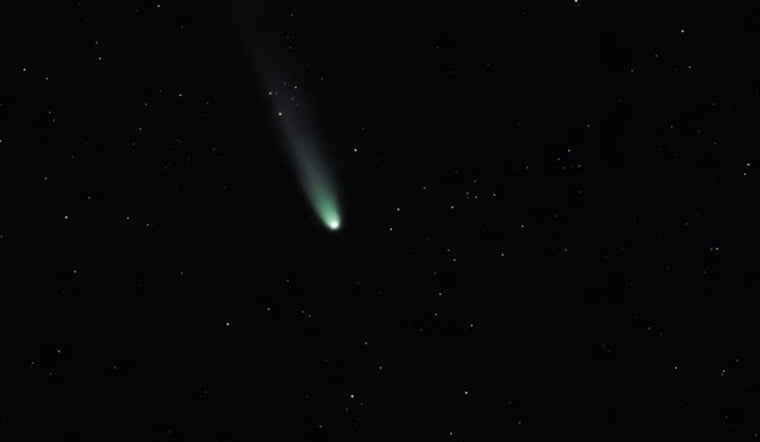
A bright fireball streaked across the sky over the Pacific Northwest Sunday evening, with residents from Washington to Oregon reporting the flash at around 8:50 p.m. Within hours, the American Meteor Society's website had logged dozens of reports from witnesses describing the sudden burst of light.
The sighting was first reported by KATU, which said people across the region saw the bright flash according to social media posts shared Sunday night. The station noted that reports to the American Meteor Society had come in as of 10:30 p.m., and it asked anyone who captured footage of the fireball to send it in through its ChimeIn page. One KATU viewer, Jason Jenkins, had previously captured a meteor on his dash camera, a detail the station cited as an example of how locals often catch these events on their vehicle cameras.
A Pattern of Fireballs This Year
Sunday's sighting is not an isolated event. Just two weeks earlier, on August 14, a 16-inch asteroid fragment weighing roughly 170 pounds tore through the atmosphere over Soap Lake, Washington, traveling at 33,000 mph before fragmenting over Sim's Corner with energy equivalent to about 10 tons of TNT, according to FOX 13 Seattle. NASA confirmed that object was a sporadic meteor, meaning it did not belong to any annual meteor shower and instead originated from a random asteroid fragment colliding with Earth's atmosphere, as reported by KING 5.
Before that, a bright green fireball lit up the sky over Puget Sound and Vancouver Island on April 29, drawing more than 100 witness reports, as Hoodline reported in its earlier coverage of that event. Home surveillance and dash cameras across western Washington caught that brief flash, much as Jenkins's dash camera reportedly captured an earlier meteor sighting in the region.
How Scientists Track These Events
Fireballs are formally defined by the American Meteor Society as meteors bright enough to reach an apparent visual magnitude of -4 or better, making them at least as bright as Venus in the night sky, according to the Robert Ferguson Observatory. Because apparent magnitude works on a logarithmic scale, lower and negative numbers indicate brighter objects. NASA and the European Fireball Network estimate that hundreds of thousands of fireballs enter Earth's atmosphere every year, though most go unnoticed because they burn up over oceans or during daylight hours, the observatory notes.
To pinpoint where a fireball traveled and whether any fragments might have reached the ground, the American Meteor Society relies on crowdsourced details from witnesses, including compass heading, duration in seconds, any terminal bright flashes, and the object's estimated angular height above the horizon. That data is then combined with satellite observations and Doppler radar signatures to help triangulate a trajectory, per the observatory. Infrasound sensors that the U.S. Geological Survey maintains across Cascade volcanoes, including Mount Rainier, Mount St. Helens, Mount Adams, Glacier Peak, and Mount Hood, can also pick up low-frequency shockwaves from high-altitude meteor explosions, since those acoustic waves fall below human hearing but travel hundreds of miles through the atmosphere, KING 5 reported.
Not Every Fireball Is Natural
Fireball-like sightings do not always turn out to be meteors. A widely reported light display across Washington and Oregon in March 2021 was initially suspected to be a meteor, but experts later identified it as the uncontrolled atmospheric re-entry of a SpaceX Falcon 9 rocket upper stage, according to Live Science. That 2021 debris broke apart more slowly and at lower speeds than a natural meteor entry typically would.
Because high-altitude airbursts occur between roughly 25 and 50 miles above the ground, a single fireball can be visible across hundreds of miles, prompting simultaneous sighting reports from Oregon, Washington, Idaho, and British Columbia, as Modern Diplomacy has noted regarding the region's recent fireball activity. It remains unclear whether NASA or the American Meteor Society will formally classify Sunday's object as a sporadic meteor, and whether radar or infrasound networks recorded any associated shockwave or ground-level meteorite fragments from the event.




