

























































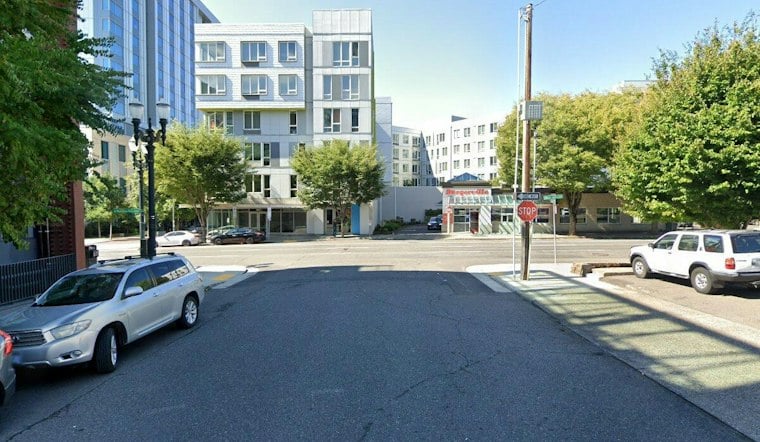
Isaac Q. Ellis was ordered to serve nearly 10 years in prison Friday after a jury convicted him in a crash that left Portland State University graduate student Mitchell Carlson with a traumatic brain injury. Ellis was driving without a license and under the influence of alcohol when he struck Carlson near the Lloyd Center early Jan. 18, 2025. Ellis left the scene, but witnesses stopped him and held him until police arrived.
Carlson was pushing a Lime scooter across a street near the Lloyd Center when Ellis hit him, according to court records cited by OregonLive. Ellis drove at least a block before pulling over and walking back. Prosecutors said at sentencing that he did not check on Carlson or call 911. When Ellis tried to leave again, bystanders physically stopped and held him until officers arrived and arrested him.
The collision was serious enough to draw an immediate police response. The Portland Tribune reported that North Precinct officers responded at 2:36 a.m. that night to a crash in the 400 block of Northeast Hassalo Street. Officers arrested Ellis, then 47 and living in Portland, and booked him into the Multnomah County Detention Center on charges including second-degree assault and driving under the influence of intoxicants.
Jury Convicted Ellis in May
A jury convicted Ellis at trial in May on charges stemming from the crash, which included second-degree assault, failing to perform the duties of a driver, DUII, reckless driving and reckless endangerment. Carlson was rushed to the hospital for neurosurgery after suffering a traumatic brain injury in the collision, per the same OregonLive account.
Carlson was pursuing dual master's degrees in public health and urban planning at Portland State University at the time of the crash. His mother, Michele Buda-Carlson, told the court, as reported by OregonLive, that he made a remarkable physical recovery but was mentally changed forever. She said he would be unable to finish school or pursue the career in public service he had planned.
Family Describes Lasting Toll
As OregonLive reported from the sentencing hearing, Carlson's family said he continues to struggle with post-traumatic stress disorder and other mental and physical symptoms from the crash. His family attributed a seizure in August to the brain injury. His parents have permanently moved to Portland from out of state to care for him.
Prosecutor Alec Hess said Ellis had taken “precious years” from Carlson's life, OregonLive reported. The Multnomah County District Attorney's Office sought a prison term of more than 11 years; the judge imposed a sentence of nearly 10 years.
Sentencing Breakdown and License Suspension
Under the sentence, Ellis will consecutively serve 72 months for second-degree assault and 45 months for failing to perform the duties of a driver. His sentences for DUII, reckless driving and reckless endangerment will run concurrently with those terms. Once he is released from prison, Ellis will also have his license suspended for eight years.
The case echoes another recent Portland DUII sentencing, though the underlying facts and charges differed. In June, a jury convicted 62-year-old Richard Epton of first-degree manslaughter, failure to perform the duties of a driver to an injured person and DUII after he hit and killed Victoria Jacob-Springer in a 2024 hit-and-run; Epton was later sentenced to 10 years in prison, according to OregonLive's reporting on that case.
Crash data and other Oregon cases
KOIN reported that the Portland Bureau of Transportation counted 198 people who suffered serious injuries, such as brain damage or paralysis, in Portland alcohol-involved crashes from 2015 to 2019. That is a citywide figure, not a count for Carlson's crash, and the reported total does not specify how many injured people were using scooters.
A separate 2024 road-rage crash on Oregon Route 18 near Grand Ronde seriously injured another driver. The Oregonian/OregonLive reported that Christopher Jamie Current, who was under the influence of meth, pleaded guilty to DUII and third-degree assault and was sentenced to 2 years and 4 months. That case, like the fatal hit-and-run case described above, involved different circumstances and charges from Ellis's case, so its sentence is not a direct comparison.





