

























































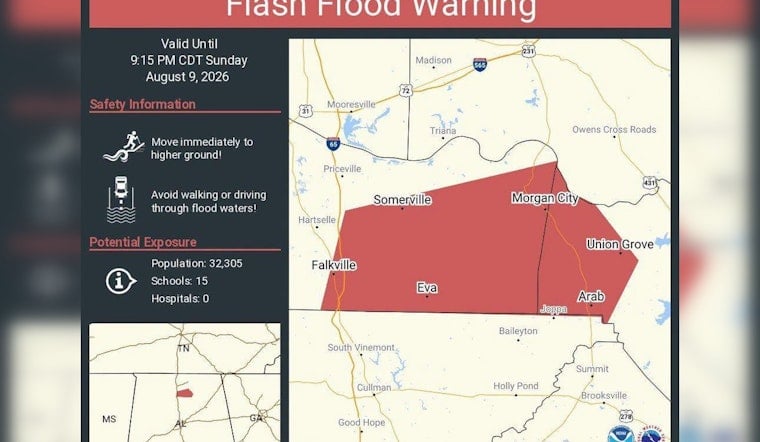
A Flash Flood Warning covering Arab, Falkville, Somerville and more than a dozen other North Alabama communities put over 32,000 residents at risk before expiring at 9:15 PM CDT Sunday. The alert, which stretched across parts of Morgan, Marshall and Cullman counties, exposed 15 schools to potential flooding as heavy rain moved through the region.
The warning, posted by the Morgan County Sheriff's Office on Facebook, listed a broad swath of towns on its hazard map, including Madison, Mooresville, Priceville, Hartselle, Somerville, Morgan City, Union Grove, Falkville, Eva, Arab, Joppa, South Vinemont, Cullman, Good Hope, Baileyton, Holly Pond, Summit, Brooksville and Blountsville. Officials urged residents inside the warning area to move immediately to higher ground and to avoid walking or driving through flood waters. No hospitals fell within the warned zone, according to the same posting.
A Pattern of Storms Across the Tennessee Valley
Sunday's warning did not arrive in isolation. Two days earlier, on August 7, the National Weather Service in Huntsville issued a separate Flash Flood Warning for southern Limestone, northwestern Morgan and northeastern Lawrence counties after thunderstorms dumped 1 to 2.5 inches of rain in a short window, according to the National Weather Service in Huntsville. The following day, the same office documented flash flooding along Avalon Avenue in Muscle Shoals, in neighboring Colbert County, where floodwaters reached two-thirds of the way up vehicle tires, per a preliminary storm report from the National Weather Service.
That sequence of storms had already saturated soils across the Tennessee Valley heading into the weekend, heightening runoff risks when Sunday's rain arrived. The pattern also echoed earlier in the summer: on June 7, the Huntsville weather office issued a rare Flash Flood Emergency for parts of Madison and Jackson counties after slow-moving thunderstorms dropped between 5 and 9 inches of rain, according to North Alabama Weather.
Why Driving Through Floodwater Is So Dangerous
The danger behind the “avoid driving through flood waters” warning is grounded in physics. National Weather Service safety guidance states that 6 inches of fast-moving water can knock an adult off their feet or cause a driver to lose control, while 12 inches is enough to float a small passenger car. Water reaching 18 to 24 inches can sweep away larger vehicles, including trucks and SUVs, per the National Weather Service.
Those thresholds matter because vehicles are where flood deaths most often happen. Public health data from the Centers for Disease Control and Prevention and National Weather Service hazard statistics show that more than half of all flood-related fatalities in the United States occur inside motor vehicles, according to research published by MDPI. That statistic underlines why officials pair flash flood warnings with blunt instructions to seek higher ground rather than attempt to drive through standing water.
How Local Residents Get the Alert
Morgan County residents can also receive localized severe weather alerts through MorganALert, an opt-in emergency notification system and mobile app run by the Morgan County Emergency Management Agency that works alongside the county's outdoor warning sirens. The system is designed to push warnings like Sunday's directly to residents' phones rather than relying solely on broadcast alerts.
The towns named in Sunday's warning vary widely in size and geography. Arab, which lies primarily in Marshall County with portions extending into Cullman County, had a population of 8,461 at the 2020 Census and sits at roughly 1,040 feet elevation on the Brindlee Mountain plateau, terrain that can accelerate surface runoff during downpours, according to Wikipedia. Morgan County itself, home to county seat Decatur, reached an estimated population of 126,483 in 2025, making it the ninth-most populous county in Alabama, per U.S. Census Bureau estimates cited by USAFacts.
Open Questions After the Warning Expired
Smaller communities swept into the warning zone, including Somerville and Falkville, reflect the rural character of much of Morgan County; U.S. Census Bureau economic profile data lists individual median incomes of $34,600 in Somerville and $25,500 in Falkville, communities that often lean on county emergency services for road clearing and rescue operations. A First Street Foundation risk assessment has separately projected that operational flood risks to social and public facilities in Alabama will keep rising over the next three decades, with Morgan County identified as facing notable operational flood risk to its government and social infrastructure.
As of the warning's expiration at 9:15 PM CDT, it remained unclear whether specific county roads suffered severe washouts, whether high-water rescues were needed, or what exact rainfall totals fell across Morgan and Marshall counties Sunday evening. Those details had not been reported as of this writing.





