

























































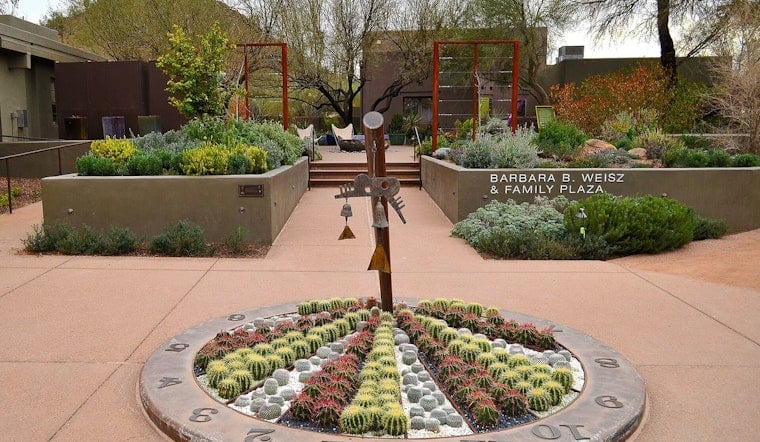
Flashlight beams are sweeping across the Desert Botanical Garden's trails later into the year than ever before, as Flashlight Nights continues through September for the first time since the series began in 1988. Held every Saturday evening since the start of June, the after-dark event lets families dodge the Valley's brutal daytime heat while getting a rare look at desert wildlife that only comes out once the sun goes down.
According to Axios, reporter Zach Buchanan attended Flashlight Nights with his first-grader and watched a puppet show about desert animals, saw three different owl species up close, and made pendants with pitch paint during the visit. The garden, located at 1201 N. Galvin Parkway, runs the event from 7 p.m. to 9:30 p.m., and visitors are encouraged to bring their own flashlights, though loaners are available for those who forget. Members get in free, while non-members pay $18.95 for adults and $14.95 for children, per the same report.
Volunteers are central to making the night run, teaching visitors about saguaros on the trails and showing off scorpions glowing under blacklight. That fluorescence isn't a trick of the light show — scorpions turn a vivid cyan under ultraviolet light because compounds in the hyaline layer of their exoskeleton absorb the invisible UV radiation and re-emit it as visible light, a property that persists even in preserved specimens, according to HowStuffWorks. It's a fitting party trick for the Arizona bark scorpion, the most venomous species in North America, which stays hidden through the day's heat and only roams freely after sunset from late spring through late summer, per Wikipedia. Its sting causes acute pain, though fatalities in the U.S. are extremely rare.
Owls, Telescopes and a Roller Disco
Beyond the puppet shows and scorpion hunts, Flashlight Nights gives visitors a chance to view the moon and stars through a telescope, per the Axios report. The garden's 12 LED light installations illuminate the trails, and the calendar has some standout theme nights left before the season winds down: a book market this Saturday, a carnival with LED light performers and an outdoor roller disco on September 5, Grandparents' Night on September 12, an animal-focused event on September 19, and a survivor-themed event closing things out on September 26.
Andrea Bailey, the garden's senior director of volunteer services, oversees a team of roughly 80 volunteers who keep the event running, many of them senior citizens. Labor Day weekend tends to be the busiest stretch for Flashlight Nights, the report notes, as families squeeze in one more cool-weather outing before school schedules tighten up.
Why Phoenix Moves Its Fun After Dark
The nighttime shift isn't just about scorpions and stargazing — it's survival strategy for a city where summer temperatures can still hover near 95 degrees at 9 p.m. in July, according to Aviator PPG, even as afternoon highs regularly climb past 105 degrees. That reality has pushed venues across the Valley to move outdoor family programming into the evening hours, and the Desert Botanical Garden's five thematic trails, including one dedicated to how Indigenous communities such as the Akimel O'odham, Tohono O'odham, and San Carlos Western Apache used desert plants for food and survival, are easier to explore once the heat breaks.
That same nighttime cooling is also the subject of serious research at the garden. Saguaro cacti depend on cooler overnight hours to open their pores and absorb carbon dioxide, but prolonged heat waves with elevated nighttime temperatures disrupt that recovery cycle and stress the plants severely, Hoodline previously reported. Garden scientists lead community monitoring efforts tracking saguaro heat mortality across urban Phoenix, work that runs alongside the institution's broader involvement in the city's upcoming 122° Conference on extreme heat resilience.
A Garden Born From a 'Save the Desert' Fight
The Desert Botanical Garden's mission has deep roots in a decades-old fight over how Phoenix should look. It was founded in 1939 by the Arizona Cactus and Native Flora Society, a group that formed in 1934 under the slogan “Save The Desert” to push back against a 1920s civic campaign encouraging residents to swap desert flora for lawns and Eastern trees, according to Salt River Stories. Phoenix leaders had backed that competing “Do Away With The Desert” campaign back in 1926.
Today the 140-acre garden in Papago Park holds more than 50,000 plant specimens across over 4,000 species, roughly a third of them native to the Sonoran Desert, and is one of only 44 U.S. botanical gardens accredited as a museum. The land itself has its own layered history, having first been set aside as Papago-Saguaro National Monument by President Woodrow Wilson in 1914 before Congress stripped that designation in 1930 and handed the land to local stewardship; the garden was formally dedicated there in February 1939.
For now, Flashlight Nights offers a simple, low-tech way for kids and adults alike to explore that desert after dark, whether they are chasing glowing scorpions with a borrowed flashlight or just watching the moon rise over the cactus-studded trails. With five events left on the calendar, the Axios report frames this as the last real chance this year to catch the series before it wraps up at the end of September.





