

























































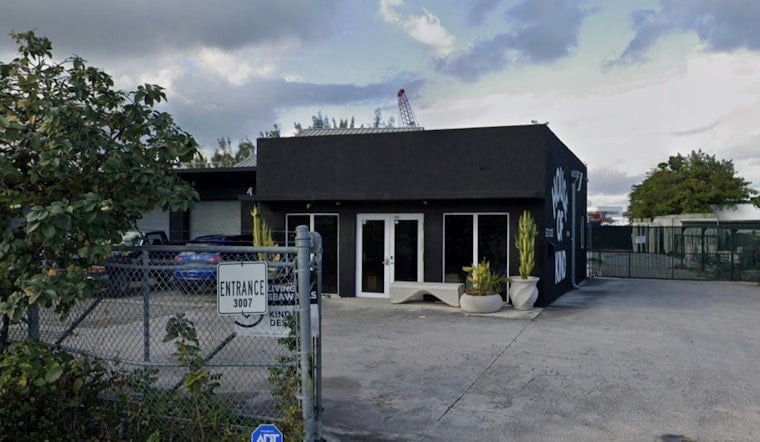
A Miami startup is fighting Florida's rising seas with concrete panels designed to act more like a reef than a wall. Kind Designs, launched in 2024, has installed 16 living seawalls across Florida, serving residential, commercial and government clients as fossil fuel emissions continue driving up global temperatures and sea levels.
Founder Anya Freeman left her full-time job as a lawyer in 2024 to start the company, according to WSVN 7News. Freeman herself experienced storm surge flooding risk in Miami Beach and was unable to obtain flood insurance, an experience that shaped her push to rethink how shorelines are protected. The station reports that Kind Designs now plans to expand into California and New York, and per Freeman, the company also plans to fortify coastal bases for the U.S. Navy.
That defense work is already underway. Kind Designs secured a $2 million contract with the U.S. Navy, part of a broader commercial push that included $1 million in 2025 revenue, $10 million in contracted revenue, and an active project pipeline of $175 million, according to Fundraise Insider. The traction helped the startup close an oversubscribed $10 million Pre-Series A round in July at a $70 million valuation, bringing its total capital raised to $21.5 million from investors including Mark Cuban, NBA forward Kyle Kuzma and former Washington, D.C. Mayor Adrian Fenty, per VoxelMatters.
Panels Designed to Mimic Mangrove Roots
Unlike a flat concrete bulkhead, Kind Designs' panels are built to mimic natural coastal features such as mangrove roots found in South Florida, with caves built into the structure for native species to hide from predators. The company manufactures the panels using large-format 3D concrete printing technology from CyBe, which prints panels up to 20 times faster than conventional poured-concrete casting, VoxelMatters reports.
The ecological payoff has already been measured. A Florida International University study at Kind Designs' initial installation site on Pine Tree Drive in Miami Beach found more than 1,000 oysters had attached to the living seawall within nine months, filtering an estimated 50,000 gallons of water daily, while an adjacent traditional seawall built in 1993 attracted zero oysters, according to a report by Refresh Miami. The seawalls also embed water-quality sensors that stream live data on 15 parameters, including pH and salinity, to a central dashboard, eliminating the need for manual beaker sampling by county staff, per The Invading Sea. The technology's profile has grown accordingly: Kind Designs' 3D-printed living seawalls were named one of TIME magazine's Best Inventions of 2025 in the Sustainability category.
Fort Lauderdale's Answer: A Park Built to Flood
While Kind Designs tackles the water's edge panel by panel, Fort Lauderdale has taken a broader approach with DC Alexander Park, a 1.2-acre space that WSVN 7News describes as serving double duty as both public space and flood infrastructure. The park was transformed from a former parking lot after the city's commission approved a $9 million agreement with Shiff Construction & Development in July 2022 to build it as the fourth and final phase of the Las Olas Oceanside Parks master plan, according to The Loop.
Designed by architecture firm Brooks + Scarpa, the park applies botanized asphalt principles, replacing impervious pavement with vegetated dunes and tropical hardwood hammocks meant to absorb storm surge and heavy rainfall, Architectural Record reports. Its native maritime forest absorbs rainfall and saltwater flooding while also offering recreational space and habitat for local species. A 25-foot artistic overlook built into the park provides shade on hot days as South Florida contends with extreme heat alongside its flooding risks.
A Region Bracing for Decades of Change
Florida Atlantic University professor and architect Jeffrey Huber, who authored the 2024 design manual Salty Urbanism, said South Florida has already accepted a certain amount of extreme flooding and extreme heat. Huber said DC Alexander Park demonstrates how communities can thrive under climate challenges, framing it within a broader argument that coastal cities should treat sea-level rise as a design condition to build around rather than simply wall off, per Florida Atlantic University.
The stakes behind that philosophy are laid out in regional projections. Sea levels across Miami-Dade, Broward, Palm Beach and Monroe counties are projected to rise 10 to 17 inches by 2040 and 21 to 54 inches by 2070 relative to 2000 baselines, according to guidance from the Southeast Florida Regional Climate Change Compact cited by Miami-Dade County. South Florida's coastal cities remain vulnerable to flooding, saltwater intrusion and worsening storms, and the region's built environment is expected to change extremely over the next 100 years as climate change continues to threaten coastal communities around the world.



