

























































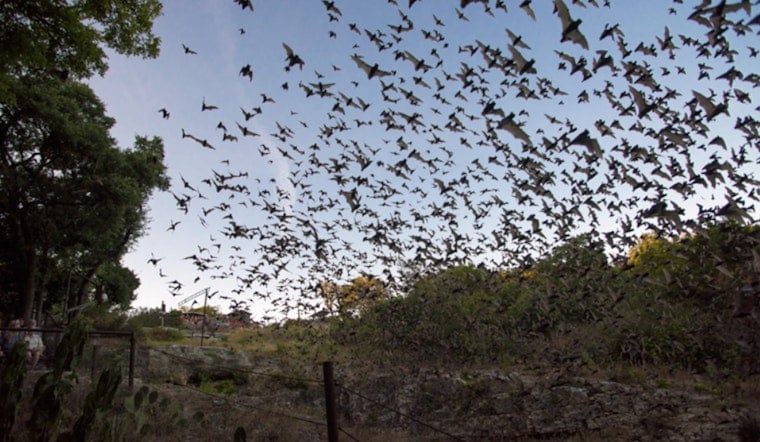
At sunset near Fredericksburg, a 920-foot railroad tunnel packed with roughly three million Mexican free-tailed bats erupts into the sky in a fluttering upward spiral, and right now, in the heart of August and September, that colony is at its biggest size of the year. Old Tunnel State Park, tucked on a limestone ridge between Fredericksburg and Comfort, is officially the smallest park in the entire Texas state park system, yet it hosts one of the state's most staggering wildlife spectacles every summer.
The bats emerge from what was once an active railroad tunnel, and the timing of their August peak comes down to basic bat biology. As reported by MySA, female Mexican free-tailed bats leave the colony earlier in the summer to give birth elsewhere, then return with their juveniles by early August, swelling the tunnel's population through mid-August. According to the Texas Parks and Wildlife Department, biologists classify Old Tunnel as a “pseudo-maternity colony” because the open-ended tunnel's unstable temperature and humidity make it unsuitable for nursing pups, forcing pregnant females to give birth in nearby caves or bridges before bringing their young back to the roost.
A Century-Old Tunnel Turned Wildlife Refuge
The tunnel itself dates back over a century. Workers hand-bored the 920-foot limestone passage in 1913 for the San Antonio, Fredericksburg, and Northern Railway to cut through the steep “Big Hill” ridge, and the line operated until it was dismantled in 1941 for World War II material needs, per the same agency. Local residents reported bats moving into the empty structure shortly after the tracks were removed in 1942, according to the department. The state acquired the abandoned tunnel in 1991 to run it as a Wildlife Management Area before shifting full administrative control to the State Parks Division in 2012.
Alongside the flagship free-tailed bats, the tunnel also shelters 1,000 to 3,000 cave myotis bats from May through October, according to the wildlife department. Both species leave the tunnel from May through October and typically migrate back to Mexico in late October, per MySA's reporting on the park's seasonal cycle. During the nightly emergence, the bats climb in a counter-clockwise upward spiral to gain speed and altitude while dodging red-tailed hawks from above and raccoons hunting from the ground, the department notes.
What the Bats Do for Hill Country Farms
The spectacle isn't just visual theater. The colony consumes more than 25 tons of agricultural pests nightly — including corn earworm, cutworm, and webworm moths — with individual bats flying at altitudes up to 10,000 feet and ranging as far as 60 miles from the tunnel in search of food and water, according to the Texas Parks and Wildlife Department. Statewide, insect-eating bats are estimated to save Texas agricultural producers roughly $1.4 billion annually in reduced crop damage and pesticide costs, the department reports.
The Mexican free-tailed bat carries some official weight in Texas too. The state legislature designated it the official state flying mammal on May 25, 1995, and Central Texas is now believed to host around 100 million of the bats each summer across 32 native species, as Hoodline reported in its coverage of Austin's bat signage push ahead of Merlin Tuttle Day. Old Tunnel's three million bats are dwarfed by nearby Bracken Cave Preserve in Comal County, less than 20 miles from San Antonio, which holds more than 15 million Mexican free-tailed bats and is managed as a 1,458-acre sanctuary by Bat Conservation International — making Old Tunnel one node in a much larger regional bat corridor.
Tight Ticket Limits and No Walk-Ups
Anyone hoping to catch the show in person needs to plan ahead. Per MySA's report, anyone entering the park after 5 p.m. needs a ticket, including children, and the lower bat viewing area — which offers a close-up look at the tunnel as bats stream out — costs $5 per person, while the upper viewing area runs $2 per person. Park staff recommend arriving by 6 p.m., and children age three and under are not permitted on the tour due to their sensitivity to the noise, MySA reports.
The Texas Parks and Wildlife Department caps nightly capacity at 100 visitors on the upper deck and 70 on the lower viewing area, with reservations required as much as 60 days in advance and no tickets sold on-site. Because cell service is unreliable in that stretch of Hill Country, officials advise visitors to screenshot their digital tickets before they arrive. Visitors can purchase tickets ahead of the nightly emergence, but availability during the current peak season is limited given the strict caps.
Other Central Texas bat colonies have drawn similar attention this year. Hoodline previously reported on the crowds gathering for a colony at an I-2 overpass in Mission's freeway bat show, while a separate story examined how I-35 construction threatens a bat roost between Round Rock and Georgetown. As MySA's Boerne reporter Mia Valdez, a University of Houston graduate who previously worked at KIII-TV 3News in Corpus Christi and at Spectrum News in San Antonio from 2019 to 2022, put it in describing the nightly flight, it unfolds as the sun begins to set, with the bats forming what has been described as a huge, fluttering upward spiral as they fan out across the sky searching for food and water.


