

























































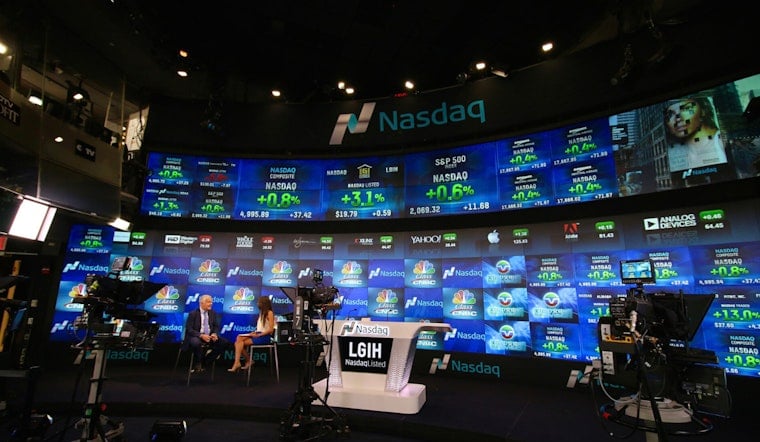
Shares of French quantum-computing company Pasqal surged around 60% on their first day of trading on the Nasdaq Stock Market Thursday, capping a SPAC merger that left the company with roughly $360 million in cash to chase a notoriously difficult technology bet: building quantum processors that can reliably outperform ordinary computers.
Pasqal's ordinary shares and warrants began trading under the ticker symbols PSQL and PSQLW after the company closed its business combination with special purpose acquisition company Bleichroeder Acquisition Corp. II on Wednesday, according to GlobeNewswire. Bleichroeder shareholders had approved the deal at an extraordinary general meeting two days earlier. The rally, described by Reuters as a signal of strong investor appetite for one of the sector's newest public companies, came even though the merger itself delivered far less cash than Pasqal originally expected.
Redemptions Cut Into the War Chest
Public shareholders of Bleichroeder redeemed 26,039,602 Class A ordinary shares before the merger closed, shrinking Pasqal's gross proceeds from an anticipated $500 million down to the roughly $360 million in cash the company ended up with, per The Next Web. Even reduced, that sum represents nearly a third of the €1.05 billion raised across Europe's entire quantum-computing sector in 2026, the outlet notes. The transaction valued Pasqal at about $2 billion before the new funding, according to Reuters, a figure TNW's report pegs against 2025 revenue of just €16.5 million — a price-to-sales multiple of roughly 100 times that the outlet says illustrates how steep valuations have become for quantum hardware makers even as widespread commercial traction for the technology remains uncertain.
France is backing Pasqal through its state investment bank Bpifrance, which participated in financing tied to the merger, Reuters reports. That government relationship carries into the public markets: France's Ministry of the Economy retains statutory veto authority over significant non-French and non-EU equity stakes in Pasqal, the same TNW report states, preserving Paris's oversight even though the company now trades on a U.S. exchange. France classifies quantum technology as critical infrastructure vital to national security, according to the same account.
Atoms Trapped by Lasers, Not Cooled by Cryogenics
Founded in 2019 in Palaiseau, France, as a spin-out from the Institut d'Optique, Pasqal is led by Chief Executive Officer Wasiq Bokhari and a nine-member board chaired in a non-executive role by co-founder and 2022 Nobel physics laureate Alain Aspect, per Pasqal. Aspect won his Nobel Prize for pioneering experiments demonstrating quantum entanglement. The company builds its processors using a neutral-atom architecture, trapping individual atoms in two- and three-dimensional laser arrays via optical tweezers to run analog simulations and digital computations inside standard data-center environments — a design that, unlike competing superconducting or trapped-ion systems, operates at room temperature without heavy cryogenic infrastructure.
Pasqal has deployed seven quantum processing units in the field with three more in production, serving more than 25 commercial and research clients including Saudi Aramco, LG Electronics, Crédit Agricole CIB, CMA CGM, OVHcloud, Thales, IBM, and Sumitomo, TNW's reporting shows. Reuters notes that Pasqal plans to deploy additional processors and expand production as it pursues fault-tolerant quantum computing — the long-sought milestone at which quantum machines could reliably outperform classical computers on real-world problems. The processors under development across the industry are aimed at specialized challenges in drug discovery, financial modeling, and materials science, Reuters reports, though quantum systems generally still carry persistent errors that limit their reliability at scale.
A Crowded Field Chasing U.S. Capital and Subsidies
Pasqal is the second European quantum hardware company to list on Nasdaq via SPAC merger in 2026, following Finnish superconducting quantum maker IQM Quantum Computers, which debuted on July 2 under the ticker IQMX at a $1.9 billion valuation after raising €198 million in net proceeds, according to Dealroom.co. IQM has since arranged a dual listing on Nasdaq Helsinki, the report adds — underscoring a broader pattern of European quantum champions seeking American liquidity while still answering to national oversight back home.
Reuters reports that Pasqal is not among the nine quantum companies that received preliminary incentives from the U.S. Commerce Department, which in August signed roughly $2 billion in agreements with domestic quantum firms — including a $1 billion allocation for IBM subsidiary Anderon — as Hoodline previously reported. Reuters also notes that President Donald Trump has ordered federal agencies to accelerate quantum technology development, part of a broader U.S. push to secure domestic supply chains for quantum optics and silicon foundries.
That push has fueled aggressive expansion among Pasqal's neutral-atom rivals on American soil. Infleqtion, a U.S.-based neutral-atom competitor, built a 7,500-square-foot innovation hub in downtown Chicago and opened its global neutral-atom headquarters in Louisville, Colorado, this year while targeting a 2027 fault-tolerant deployment in Illinois. Infleqtion went public earlier in 2026, raising roughly $550 million in capital. Pasqal's Nasdaq listing puts it in direct competition with that well-capitalized American rival even as it now answers to shareholders on a U.S. exchange while remaining tethered to French state oversight at home.



