

























































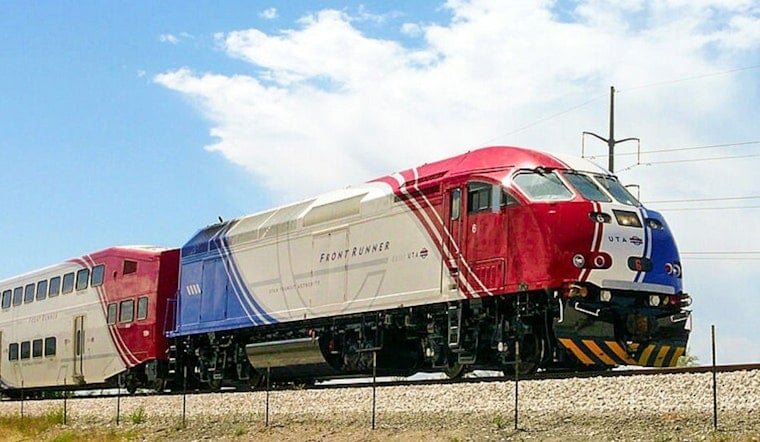
Federal regulators have cleared FrontRunner 2X to enter the engineering phase of the Capital Investment Grants program, a milestone that puts Utah transit officials on track to secure nearly $1.3 billion in federal funding for a long-promised overhaul of the state's commuter rail system. The approval from the Federal Transit Administration allows the Utah Department of Transportation and Utah Transit Authority to advance the project's design, continue early procurement, and complete remaining federal requirements before locking in a full funding agreement.
The project, a partnership between UDOT and UTA, aims to add 26.1 miles of double track across 11 locations along the FrontRunner corridor, according to FOX 13 News Utah. FrontRunner currently runs along an 82-mile corridor with 16 stations between Ogden and Provo, but its largely single-track design caps peak service at 30-minute intervals and stretches off-peak waits to an hour, according to the Federal Transit Administration. Once double-tracked, the line is expected to support 15-minute service during peak periods and 30-minute service throughout the rest of the day.
A $3.2 Billion Price Tag Behind the Federal Milestone
While the FTA's engineering-phase approval and the nearly $1.3 billion federal grant target are the headline numbers, they represent only part of a larger financial picture. The full FrontRunner 2X program carries an estimated $3.2 billion price tag, with state officials pursuing between $2.1 billion and $2.4 billion in total federal grant funding alongside an $840 million state funding commitment, per project documents cited by Utah Transit Authority. That gap between the single grant milestone and the full program cost underscores how much financing work remains even after Tuesday's federal sign-off.
FrontRunner already carries more than 3.7 million riders annually and routinely runs at 80% to 90% capacity during peak hours, according to Utah Transit Authority. Officials project that double-tracking could boost total system ridership by 53%, a jump tied directly to relieving the bottlenecks created by the current single-track layout. FTA Acting Deputy Administrator Matthew Cahill said the milestone shows Utah leadership cares about its citizens by investing in transit for generations. UDOT Commissioner Carlos Braceras called the project a major step forward for Utah, saying it requires a balanced transportation system that goes beyond highways.
New Trains, a New Station, and a 2034 Olympic Deadline
FrontRunner 2X will add 10 new trainsets and a new maintenance facility to the system. UDOT selected Swiss manufacturer Stadler under a $328.3 million contract to build those trainsets at its expanded 62-acre plant in Salt Lake City, as Draper Herald reported — a detail Hoodline previously explored in its look at Stadler's SLC plant growth. Beyond the new trains, project scope includes a new diesel multiple unit maintenance facility at Beck Yard in Salt Lake City and a track realignment at Warm Springs Yard, according to Utah Transit Authority documents.
The lone new station under the plan will rise in Bluffdale at The Point, the site of the former Utah State Prison now slated for 3,300 residential units and 2.6 million square feet of commercial space, per Utah Transit Authority planning materials. Federal and state leaders have also tied the engineering-phase approval to transit preparation for the 2034 Olympic and Paralympic Winter Games that Utah will host, according to the Federal Transit Administration.
Provo Property Owners Face Eminent Domain Questions
Not every consequence of the expansion is welcome news for everyone along the route. UDOT planned eminent domain proceedings affecting properties belonging to dozens of Provo residents, a step tied to the double-tracking work. UDOT and UTA held public outreach sessions in September 2025 specifically addressing potential property acquisition near Provo's Mountain View Condominiums and Meadow Park Apartments, according to Provo City meeting records — a reminder that the corridor's capacity gains carry real costs for residents living closest to the tracks.
UTA Executive Director Jay Fox said more frequent and reliable FrontRunner service will make transit practical along the Wasatch Front. Officials describe the goal in simple terms: shorter waits, more frequent trains, and more dependable trips as trains run more frequently and reliably alongside the state's growing population, officials claim. Construction on FrontRunner 2X, originally scheduled to begin this year, is now slated to run from 2027 through 2030.
Why Double-Tracking Matters Beyond the Commute
The stakes extend well past daily ridership counts. Regional demographic forecasts show the Wasatch Front population growing by 1.1 million residents by 2050, with Salt Lake and Utah counties expected to absorb two-thirds of all future job growth in the state, according to Utah Transit Authority projections. Planning models estimate that by 2050, FrontRunner 2X train travel could be 17% faster than driving on Interstate 15 during peak hours, generating an estimated $9.6 billion annually in regional time and mileage savings.
The urgency behind double-tracking has also been on display in recent months, as single-track vulnerabilities have repeatedly disrupted service. Hoodline has reported on incidents including a trackside fire that triggered a bus bridge in Roy, downed power lines that trapped Utah County commuters before dawn, and a runaway horse that brought trains to a standstill between Farmington and Woods Cross. Those episodes illustrate why UTA and UDOT frame double-tracking not merely as a capacity upgrade, but as a structural fix meant to prevent single points of failure from repeatedly halting service across the entire Wasatch Front line.





.jpg)