

























































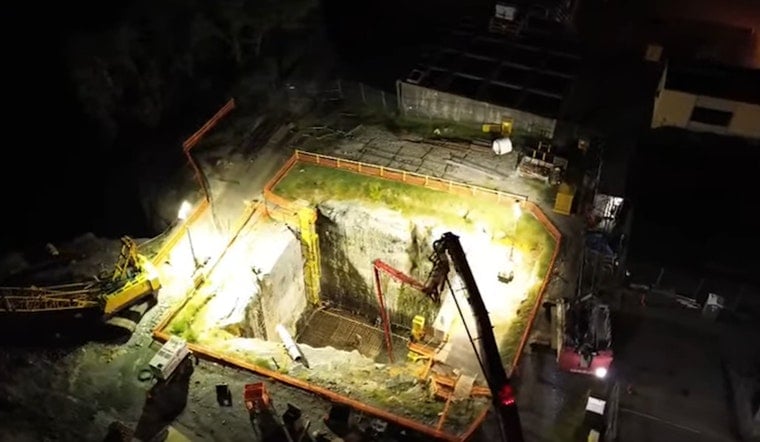
Crews with Gallatin Public Utilities poured concrete on Thursday night at the base of a new raw water intake structure rising along the Cumberland River, marking a major construction milestone for a project designed to secure the city's water future. The pour formed the base of a concrete-lined wet well roughly 50 feet deep, a centerpiece of the effort to boost Gallatin's raw water intake capability to 24 million gallons per day.
The concrete work, completed at the site of Gallatin Public Utilities' Water Treatment Plant, was announced in a video posted by Gallatin City Government on Facebook. Once finished, the new intake will connect to the existing treatment plant and is intended to strengthen the reliability of the Cumberland River as a regional water source, according to the same post. City officials say the broader project will strengthen Gallatin's water infrastructure as the area continues to grow.
A Contract Years in the Making
The wet well pour follows a construction timeline that stretches back more than a year. In July 2025, the Gallatin City Council recommended awarding a $17,469,000 construction contract, known as Contract 125, to Reynolds Construction for the raw water intake project, following a competitive bid process that began in May 2025, according to a City of Gallatin City Council agenda. Before any concrete could be poured, crews first had to clear the ground itself. In December 2025, Gallatin Public Utilities conducted scheduled controlled blasting at the Water Treatment Plant site to excavate rock, an early step in preparing the deep excavation required along the riverbank.
Why Gallatin Needs More Raw Water
The upgrade addresses a growing gap between the city's current infrastructure and its expanding population. Gallatin Public Utilities' treatment facility currently has a finished water capacity of 16 million gallons per day and produces an average of just 6 to 8 million gallons daily depending on seasonal demand, per the utility's own figures. Pushing raw water intake capacity to 24 million gallons per day gives the city room to expand treatment capacity down the road, since raw intake must lead any future plant upgrades.
That planning is driven by numbers that have shifted quickly. U.S. Census Bureau estimates cited by Main Street Media of Tennessee show Gallatin's population grew from 44,431 at the 2020 census to 52,489 in 2024, a 15% jump in just four years. That kind of suburban expansion in the Nashville metro area has put pressure on a utility network that includes about 337 miles of water distribution mains, five storage tanks holding 13 million gallons total, and two pumping facilities serving roughly 16,000 customer accounts, according to Gallatin Public Utilities.
A Regional Water Grid Takes Shape
Gallatin's raw water expansion isn't just about the city itself. As of November 2025, construction was 25% complete on a 23-mile regional pipeline meant to extend Cumberland River water service to Westmoreland, Portland, and Castalian Springs, positioning Gallatin as a primary wholesale water provider for northern Sumner County. That regional buildout is backed by a $28 million funding package combining $19 million in state American Rescue Plan grant funds with $9 million in county funds, intended to support drought mitigation and emergency interconnectivity across multiple municipalities.
The utility has also been tackling wastewater capacity alongside its drinking water push. Gallatin Public Utilities built a 10-million-gallon wastewater equalization basin off Maple Drive designed to store excess flow during heavy storms and prevent raw sewage discharges into Town Creek, addressing a problem where heavy rains had previously threatened system capacity.
Industrial Demand Under Scrutiny
The water intake project comes as large industrial users draw fresh attention to the city's water math. City records released this month revealed that Meta's data center in Gallatin used an average of 165,000 gallons of water per day during the first five months of 2026, representing about 2% to 3% of the city's daily water production. That figure has factored into local discussions about data center growth and zoning limits as the city weighs how much industrial demand its system can absorb.
Despite the added scrutiny, Gallatin Public Utilities maintains an active water quality testing regimen, conducting a minimum of 553 water quality tests each month across 81 sampling locations to verify compliance with Tennessee Department of Environment and Conservation and U.S. EPA drinking water standards. With the wet well's concrete base now in place, the raw water intake project moves closer to connecting with the treatment plant it was built to support, a step city officials say is foundational to both near-term reliability and the region's long-term water security.



