

























































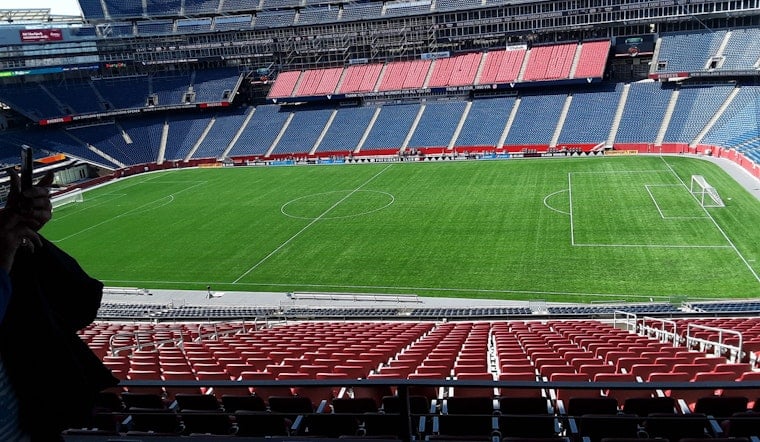
Gillette Stadium's grounds crew has less than a week to tear out and replace an entire football field after the newly installed artificial turf failed joint NFL-NFLPA laboratory testing, putting Thursday night's Patriots preseason opener against the Indianapolis Colts in a race against the clock. The surface had already passed on-field tests conducted separately by the NFL and MLS, but it still fell short of the league and players union's laboratory standards.
According to the New York Post, the discrepancy came down to how the turf system was tested versus how it was actually built at Gillette Stadium. As reported by TSN, the lab evaluated the turf and its rubber “E-layer” shock pad over a concrete base, but Gillette Stadium's field sits atop stone dust rather than concrete, and the E-layer was never installed there at all. That mismatch between lab conditions and real-world construction is what triggered the noncompliance finding, even though the turf and E-layer had been laid over concrete for testing back in March 2026.
A Four-Day Sprint Before Kickoff
The emergency field replacement began immediately after the New England Revolution's MLS match Saturday night, leaving stadium operations crews roughly four days to strip the field, lay new turf, and get it approved before the Patriots host the Colts Thursday at 7:30 p.m. Kraft Sports + Entertainment COO Jim Nolan said the crew is installing the newest version of the FieldTurf model the Patriots played on during the 2025 season, telling ESPN it would give players consistency with the surface they used last year. That new field is the latest version of the one removed from Gillette Stadium in January, when it was pulled to make way for temporary natural grass required for World Cup play.
Nolan's account, relayed by the same outlet, frames the fix as straightforward from an operations standpoint even as the timeline stays tight. The new installation is scheduled to be finished in time for Thursday's game, though the turnaround leaves little room for delay given how labor-intensive laying a full stadium field typically is.
Why the World Cup Complicated Things
Gillette Stadium's turf troubles trace directly back to the 2026 World Cup. FIFA required the stadium to swap its synthetic turf for natural grass to host seven tournament matches between June 13 and July 9, including a quarterfinal, according to Hoodline's earlier coverage of the tournament's arrival in Foxborough. That back-and-forth left the stadium needing to install grass, then rip it back out and reinstall synthetic turf, all within a matter of weeks. Gillette Stadium originally converted from natural grass to artificial FieldTurf in 2006 and has kept a 20-year relationship with the manufacturer, most recently installing FieldTurf CORE in March 2024, per SportsField Management.
The stakes around field hardness aren't just bureaucratic. Article 39 of the NFL-NFLPA Collective Bargaining Agreement requires pre-game surface hardness testing with a Clegg Impact Tester and sets a mandatory maximum threshold of 100 Clegg units, a standard overseen by a joint committee established under the CBA. Independent sports surface research has found that between 10% and 15% of concussions in American football come from head-to-surface contact rather than player collisions, underscoring why regulators treat field hardness testing as a safety issue rather than a formality.
A History of Field-Related Game Disruptions
Unacceptable field conditions have derailed NFL preseason games before. The 2016 Hall of Fame Game in Canton, Ohio, was scrapped due to congealed field paint, and a 2001 Ravens-Eagles game in Philadelphia was called off over uneven turf cutouts, both cited by the same NBC Sports report detailing the Gillette Stadium scramble. League rules allow inspectors or union representatives to halt games if a playing surface poses a safety hazard, which is part of why the four-day turnaround at Gillette Stadium carries real weight beyond scheduling logistics.
The turf saga also lands amid a broader labor dispute over playing surfaces. The NFL Players Association has repeatedly pushed for all 32 teams to play on high-quality natural grass, pointing to player safety data showing higher rates of non-contact lower-extremity injuries on artificial turf. Calls from players for grass fields reportedly grew louder during the World Cup, when several NFL venues briefly hosted the tournament on natural grass surfaces.
What's on the Line Thursday Night
If the new field passes inspection, the Patriots will open their preseason slate at home against the Colts Thursday before visiting the Seattle Seahawks in their Week 1 regular-season matchup, a rematch of the Super Bowl the Patriots lost to Seattle. Eleven days later, New England's regular-season home opener will bring the Pittsburgh Steelers to Gillette Stadium on September 20. Foxborough's stadium has leaned on major recent infrastructure investment to handle its packed event calendar; the MBTA completed a $35 million overhaul of Foxboro Station, as Hoodline previously reported, building elevated platforms designed to move up to 20,000 transit riders per event.
For now, the open question is whether the freshly laid turf will clear Clegg hardness testing in time for kickoff, and what happens if it doesn't. Neither the NFL nor the NFLPA has detailed contingency plans publicly, leaving Gillette Stadium's grounds crew working against a deadline with no public backup plan in place.





