

























































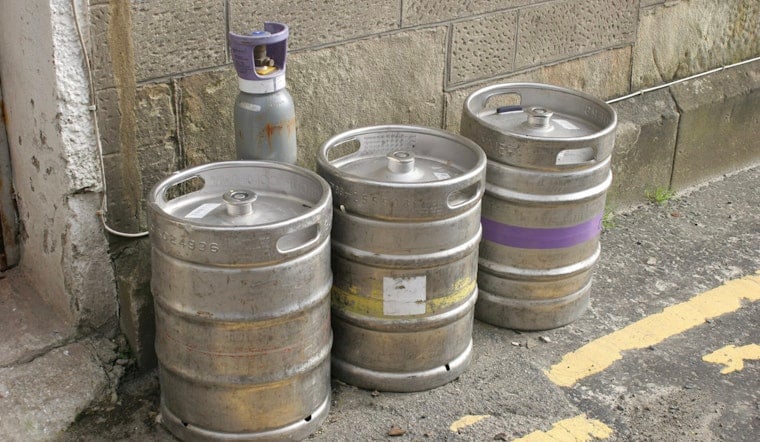
A Hamilton Heights elementary school gym teacher says he was injured when a keg exploded on the second floor of Bar Fiasco, the neighborhood beer and wine bar on Broadway, and he's now suing over it. Steven Garrand, 42, filed the lawsuit claiming the keg blew up while he was at the bar in October 2022, seeking unspecified damages.
Garrand was at Bar Fiasco in Hamilton Heights when the keg allegedly exploded on the bar's second floor, according to the lawsuit as reported by the New York Post. Bar Fiasco sits above street level at 3604 Broadway between West 148th and West 149th Streets, according to Atly, and the venue is known for its craft beer and natural wine offerings. Neither Bar Fiasco nor Garrand's attorney returned requests for comment, per the same report.
Garrand teaches physical education at PS 368 The William Lynch School, which sits in the same Hamilton Heights neighborhood as the bar, according to the school's own staff listing. He previously completed a leadership fellowship through Columbia University's Summer Principals Academy, per Teachers College records. The lawsuit does not specify what type of injuries Garrand suffered, only that he is demanding unspecified damages.
A Neighborhood Spot With Deep Local Roots
Bar Fiasco was opened by Christy Stewart-Jenkins, a 2017 Columbia College graduate, and her husband Evan, who previously worked at the location's predecessor bar, Beer Run Harlem, according to Columbia College Today. The couple transformed the space into a spot specializing in craft beer and natural wine, the outlet notes. It's unclear from available records whether the keg involved was a traditional stainless steel vessel or one of the lighter plastic kegs increasingly used by craft bars, an open question in the case so far.
Why Keg Explosions Happen
Draft beer systems are typically designed to run at a modest 10 to 15 pounds per square inch of applied gas pressure, just enough to push beer from keg to tap without over-carbonating it, according to Micro Matic. The carbon dioxide cylinders that feed those systems, however, store gas at roughly 800 to 850 psi, and if a primary pressure regulator fails or is misadjusted, that force can flow straight into a keg built to handle far less, per the Library of Congress's federal record on the hazard.
Plastic kegs used across the craft brewing industry carry documented rupture thresholds as low as 33 to 90 psi, making them considerably more fragile under a pressure spike than old-fashioned stainless steel kegs, according to Brewbound. Federal safety records reviewed by the Library of Congress found that CO2 over-pressurization caused at least six keg explosions resulting in five deaths and one injury over a 14-year stretch, underscoring that regulator failure has long been a recognized fatal risk in beverage dispensing.
The Brewers Association's safety guidelines call for draft facilities to install secondary, non-mechanical pressure relief valves and to conduct routine regulator inspections in order to prevent the kind of catastrophic energy release a failed regulator can unleash. It's not yet known whether Bar Fiasco's gas regulators or line couplers malfunctioned in the October 2022 incident, or whether any equipment manufacturer or gas supplier could be named as an additional defendant.
A Pattern of Fatal Keg Incidents
The Post's reporting placed Garrand's case alongside a string of past keg explosion tragedies. In 2012, Redhook Ale Brewery employee Ben Harris was killed while pressure-cleaning an exploding plastic keg in Portsmouth, New Hampshire, and federal OSHA inspectors fined parent company Craft Brew Alliance $63,500 for workplace safety violations tied to the incident, according to NPR. Harris's family was later awarded $1.2 million in a wrongful-death lawsuit, per the Associated Press.
Other incidents cited include the 1971 death of 31-year-old William Orlosky, who police said died from severe head injuries after being flung 150 feet into the air while pumping gas into a keg at a Long Island country club, as reported by the New York Times. In 2006, a keg thrown into a bonfire in Milford, Connecticut, exploded and killed Sean Caselli while injuring seven others, according to News Channel 10. And in 2021, 43-year-old Gilson do Nascimento died in Brazil after an exploding beer dispenser sent sharp metal shards into his head at his own birthday party.
Statute of Limitations and What Comes Next
New York's Civil Practice Law and Rules § 214(5) generally gives negligence-based personal injury claims a three-year window from the date of the incident, according to Richman Law. That framework helps explain the gap between the October 2022 incident and the lawsuit's 2026 filing, since claims filed past that statutory window can face an immediate motion to dismiss. Garrand's lawsuit remains pending, and it is unclear what specific injuries he sustained or whether Bar Fiasco plans to respond to the claim.





