

























































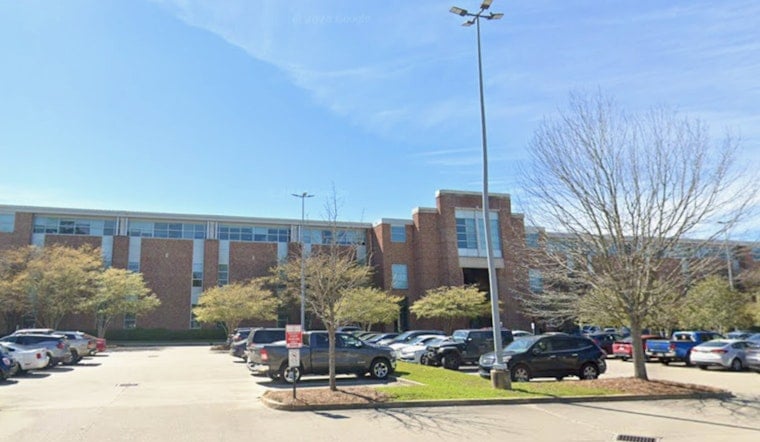
A judicial robe worn by a Louisiana judge at the Nuremberg trials is now the centerpiece of a new museum opening on Southeastern Louisiana University's Hammond campus. The HIPS Military Museum, housed in the Patricia A. Ahrens Gallery on the second floor of Fayard Hall, will officially welcome the public on August 26 with a collection of more than 1,000 catalogued military artifacts spanning centuries of global conflict.
The opening date and the scope of the founding gift were detailed by WBRZ, which reported that Southeastern President William Wainwright accepted a foundational donation of more than 500 military antiques in late 2025, a gift that has since grown to over 1,000 items ahead of the opening. As New Orleans CityBusiness reports, the collection includes firearms, swords, uniforms and other items, with large portions donated by Ralph Shaw and Al Freyder, and additional pieces contributed by Southeastern alumni. The museum, free to visitors, was developed with support from university administrators, an anonymous donor and the Patricia A. Ahrens estate, according to the outlet.
A Louisiana Judge's Nuremberg Legacy
The museum's inaugural exhibit, titled The Nuremberg Trials and the Search for Justice, marks the 80th anniversary of the International Military Tribunal's verdict and features more than 100 artifacts examining Adolf Hitler's rise to power, the Holocaust, World War II and the international legal principles surrounding war crimes, genocide and crimes against humanity, per the same account. That tribunal, per the National WWII Museum, delivered its landmark verdicts against 22 major Nazi political and military leaders on October 1, 1946, sentencing 12 defendants to death by hanging.
Among the exhibit's centerpieces is a judicial robe worn by Justice Paul M. Hebert, loaned to the museum by the LSU Law Center and LSU Law Library, the New Orleans CityBusiness report notes. Hebert, the former LSU Law Dean, served from August 1947 to July 1948 as one of four judges presiding over the IG Farben Trial in Nuremberg, known as Case Six, where he authored a lone dissenting opinion arguing against the acquittal of 15 corporate executives accused of using concentration camp slave labor, according to the LSU Law Center.
IG Farben, the German chemical conglomerate on trial, held a 42.5 percent ownership stake in Degesch, the company that held the trademark for Zyklon B, the cyanide-based pesticide used in mass extermination at Nazi death camps, according to a summary on Wikipedia. The trial concluded in July 1948 with 13 defendants receiving prison sentences ranging from 1.5 to 8 years and 10 defendants acquitted, according to the Wollheim Memorial. Before arriving in Hammond, Hebert's robe was loaned by the LSU Law Library in October 2024 to Louisiana's Old State Capitol museum in Baton Rouge for an American Bar Association traveling exhibit titled Lawyers Without Rights, which documented how the Third Reich revoked the rights of Jewish lawyers in Germany before the war.
Hands-On History for Students and the Public
Southeastern Associate Professor of Military History Sam Cavell, who directs the new museum, said many of the artifacts will be available for visitors to handle rather than viewed only behind glass, per New Orleans CityBusiness. “The museum is small, but its story is impactful,” Cavell said, adding that it highlights a critical moment when the United States led an international effort for accountability and justice, the outlet reports.
Cavell worked with students Andrew Worthy, Abbey Hynes and Haley Creith to catalogue the collection and develop the inaugural exhibit, according to the same report. Bill Robison, head of Southeastern's History and Political Science Department, said students across many disciplines can help design a museum, maintain its collections and support community outreach, per the outlet. Southeastern students will take part in exhibit design, collections management and community outreach as the museum continues to grow.
Cavell also directs The Veterans of Recent Wars Project, an online oral history archive at Southeastern that records and transcribes stories from Iraq and Afghanistan war veterans, according to the International Journal of Naval History. She earned her PhD from the University of Exeter and specializes in 18th- and 19th-century naval history, teaching both undergraduate and graduate military history courses at Southeastern. In 2025, Cavell received the College of Arts, Humanities, and Social Sciences Excellence in Teaching Award and holds the Woman's Hospital Endowed Professorship in the Humanities.
Where to Find It
The HIPS Military Museum sits inside Fayard Hall on Southeastern's Hammond campus, a state-owned academic building completed in 2000 and designed by Holly & Smith Architects that also houses departments within the College of Arts, Humanities, and Social Sciences. The museum will be open 10 a.m. to 3 p.m. Monday through Thursday, excluding holidays, and is open to students, faculty, staff and the public, per New Orleans CityBusiness.
The new gallery sits roughly 50 miles north of New Orleans, home to The National WWII Museum, which opened in 2000 as The National D-Day Museum before receiving a congressional designation as the official national WWII museum and now occupies a seven-acre campus in downtown New Orleans. Southeastern's smaller, campus-based collection offers a different kind of access, giving students and visitors a chance to handle artifacts directly as part of a hands-on learning resource built into a working university department.



