

























































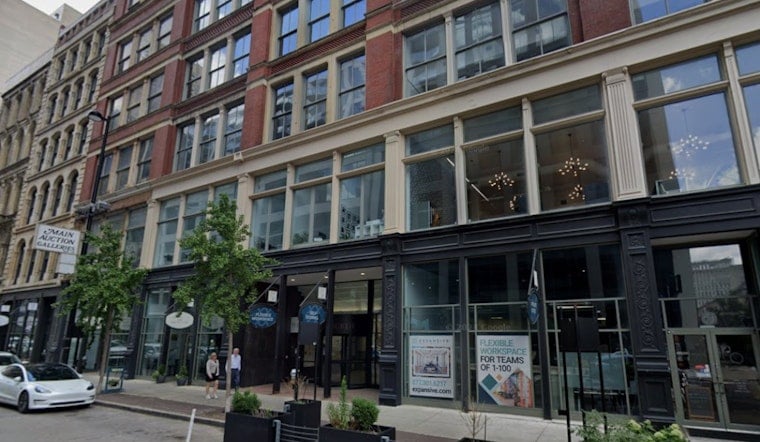
A 133-year-old office building on West Fourth Street in downtown Cincinnati has new residents for the first time in its history. Textile Lofts, a 102-unit apartment conversion inside the historic Hooper Building at 141 W. Fourth St., welcomed its first tenants in July 2026 following a $33.6 million adaptive reuse project.
The building was designed by famed Cincinnati architect Samuel Hannaford, according to Local 12 News. Hannaford's firm was the most prominent architectural practice in 19th-century Cincinnati, responsible for more than 300 regional structures including Music Hall and Cincinnati City Hall, per Friends of Music Hall. The building itself was constructed in 1893 for sheet music publisher John Church Company and named for company president William Hooper, according to background compiled from Wikipedia's entry on the structure.
The project was carried out by The Bernstein Companies, a national developer headquartered in Washington, D.C., which took on the 15-month adaptive reuse effort, the station's report notes. Bernstein acquired the property through the entity Hooper Cincy LLC in 2024 before launching the transformation, according to city of Cincinnati filings.
A Preserved Past Inside a Modern Shell
The building earned a spot on the National Register of Historic Places in March 1980 and stands as a contributing property within downtown Cincinnati's West Fourth Street Historic District, designated in August 1976. Those federal and local designations shaped the preservation standards guiding the conversion, per the National Register documentation.
Inside, the finished units retain 15-foot ceilings, exposed hallway architectural details, and arched historic windows on the seventh floor, according to listings from RentCafe. The building also now includes a tech gym, sauna, and pet park, blending Victorian-era bones with amenities aimed at modern renters.
This is not Bernstein's first run at adaptive reuse on the same block. The developer previously converted the 12-story, 1906 Gustave Drach-designed Textile Building at 205 W. Fourth St. into 282 units known as Textile Apartments, completed in 2023. The similarly named projects sit roughly a block apart, and both draw their branding from Cincinnati's textile and garment manufacturing history downtown.
A Convention Hotel Rises Across the Street
Textile Lofts now sits directly across from an under-construction 700-room Marriott convention headquarters hotel at Fourth and Elm streets. Construction on that $543 million, 21-story project began in 2026 and will eventually include 62,000 square feet of meeting space and a skybridge connecting to the convention center, according to WVXU. The hotel is part of a broader overhaul exceeding $800 million across Cincinnati's Convention and Fountain Districts.
The timing places Textile Lofts squarely inside one of the busiest stretches of urban transformation in the city's downtown. A late-2024 report from CBRE found Cincinnati ranked second nationally for office-to-residential conversions, with more than 9% of its central office inventory converted or in development, according to The Port — a rate more than four times the national average of 1.7%. Post-pandemic office vacancy near 20% has pushed the city to lean heavily on housing incentives for downtown towers.
Part of a Citywide Conversion Wave
Textile Lofts joins a growing list of Fourth Street projects reshaping the corridor. In July, developer Model Group advanced a $76 million plan to convert upper floors of the 20-story Atrium One tower at 201 East Fourth Street into roughly 190 apartments and an on-site childcare center, as Hoodline previously reported. Elsewhere downtown, real estate analytics firm CoStar highlighted the March 2026 completion of Sky Central, a $99 million, 281-unit conversion of a 31-story former office tower, as the largest adaptive-reuse project in Cincinnati's history.
Together, the projects illustrate how quickly downtown Cincinnati's office towers and historic commercial buildings are being reimagined as housing. For Textile Lofts, that shift means a 19th-century sheet music publisher's headquarters is now home to residents watching a half-billion-dollar hotel take shape just across the street.





