

























































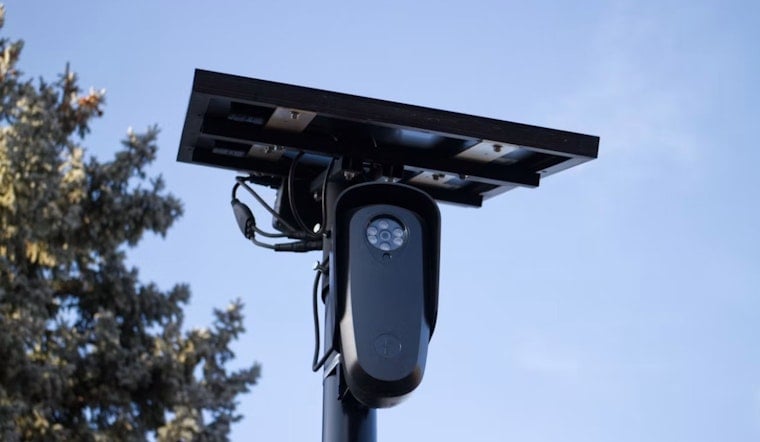
Weber County's 10 automated license plate reader cameras have been searched more than 5 million times since early 2022, and the vast majority of those queries came from law enforcement agencies outside Utah. That figure has become the centerpiece of a new push by a Utah advocacy group urging state lawmakers to tighten the rules governing who can access the data and how.
According to public records obtained by the group Utah Civic Compact from the Weber County Sheriff's Office, 96.6% of the roughly 5.1 million searches performed on the county's Flock Safety cameras between February 2022 and July 2026 originated from agencies outside Utah, as reported by the Standard-Examiner. The Houston Police Department alone accounted for more than a third of all queries, making it the most prolific searcher of Weber County's camera network, per public records cited by KSL NewsRadio. The Weber County Sheriff's Office owns all 10 of the cameras in question.
Clark Dice, speaking about the release of the county's public data, described it as “striking,” per KSL NewsRadio's report. He said large amounts of camera data can be used to track people's movements, behaviors, and whereabouts. Utah Civic Compact used the figures to renew its call, made at the Capitol on August 13, for lawmakers to tighten Utah code so that out-of-state agencies must follow Utah's own rules when accessing and using Flock camera data.
Sheriff's Office Says Searches Require Documented Justification
Colby Ryan, representing the Weber County Sheriff's Office, described the camera searches as manual, officer-initiated queries that require documented justification tied to an active criminal investigation, an outstanding warrant, a missing person case, or a stolen vehicle. Ryan said monthly audits conducted by the sheriff's office showed that Houston Police Department's requests were tied to active investigations, and that the office is constantly reviewing and re-evaluating its processes.
Utah Civic Compact has said there is currently no evidence that out-of-state agencies violated Utah law, but the group noted that individual audits of specific searches would be necessary to know for certain whether any violations occurred. Police officials broadly tout Flock cameras as effective tools for finding suspect vehicles and investigating crimes, and law enforcement officials have said the readers make investigations more efficient and accurate, according to reporting from the Davis County News. Opponents, meanwhile, characterize the cameras as government surveillance and an invasion of privacy.
Statewide Camera Count Puts Utah Mid-Pack Nationally
Weber County's cameras are part of a much larger network. Between 30 and 50 law enforcement agencies across Utah operate license plate readers, and independent mapping projects have identified at least 944 total ALPR cameras statewide as of this month, ranking Utah 28th nationally in total camera deployment, the Standard-Examiner reports. Flock cameras are located along the Wasatch Front and in other parts of the state, and Flock Safety itself owns many of the automatic license plate reader cameras in use.
Locally, Ogden City is the largest municipal investor in Flock Safety cameras in Utah, having spent $123,000 to deploy 41 active cameras across city streets, according to The Signpost. State law currently permits government entities to retain captured license plate reader data for up to nine months before deletion under Utah Code § 41-6a-2004, unless the data is preserved for an active criminal investigation, warrant, or court order.
Reform Bills Have Repeatedly Stalled at the Capitol
Efforts to tighten that framework have struggled in the Legislature. A 2025 automatic license plate reader bill passed the Utah House by a 64-2 vote but failed to clear the Utah Senate before the session ended. A related 2026 bill received no hearing at all, and separate legislation, House Bill 327, which would have established tighter encryption mandates, mandatory reporting, and a 150-day retention cap on ALPR data, died in committee in March, according to BillTrack50.
Republican state Rep. Mike Kennedy has opposed the spread of Flock cameras across the United States, saying government overreach should not become the norm. The Utah State Privacy Commission is now conducting a formal study on law enforcement ALPR usage and is scheduled to release official policy recommendations by the end of September, per the Davis County News.
Salt Lake City and Millcreek Grapple With Local Fallout
Salt Lake City is considering its own ordinance specifying how automatic license plate readers can be used and who can access the collected information. A draft version introduced in July would require officers to tie database searches to active case numbers, ban facial recognition integration, and mandate quarterly audits, a move that followed more than 6,400 police ALPR queries logged by the city, according to a Salt Lake City Council staff report.
Elsewhere in the state, officials in Millcreek discovered an unauthorized Flock camera installed on city property this month without a municipal contract, an incident that prompted state lawmakers to call for greater transparency around camera installations, MotorBiscuit reported.
Flock Safety Tightens Its Own Rules Amid National Pushback
The controversy in Weber County lands amid a broader reckoning for Flock Safety nationally. On August 13, the company announced it will require law enforcement agencies to implement an auditing tool designed to catch unusual search behavior, according to the Associated Press. The changes reduce the company's default data retention window from 30 days to seven days and make misuse audit tools mandatory for law enforcement clients by January 1, 2027, following nearly 50 documented cases of officer misuse nationwide, per TNW.
The American Civil Liberties Union has also launched a national “Get the Flock Out” campaign, organizing communities ahead of a National Week of Action Against ALPRs scheduled for August 16 through 22, aimed at pushing local governments to cancel camera contracts and pressing for stricter legislative limits. For Weber County residents, the debate now hinges on whether state lawmakers will revisit ALPR legislation in the next session, or whether local ordinances and vendor-driven changes will set the rules first.





