

























































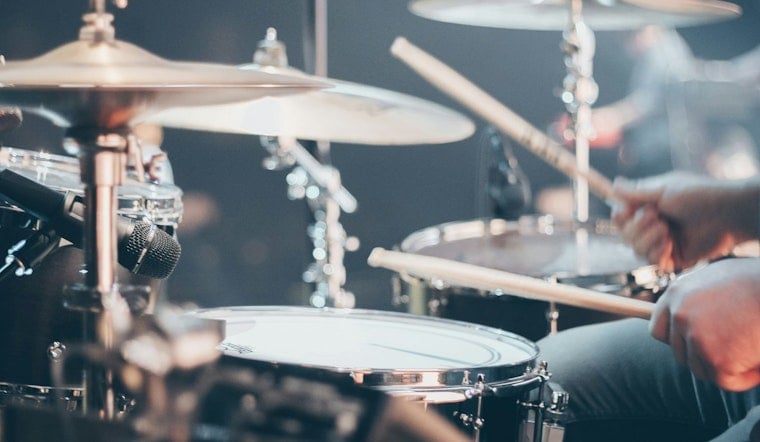
Sixteen-year-old Oliver Mendoza spent his weekend playing congas in front of thousands of people at Ravinia Festival, sharing a stage bill with international superstar Ricky Martin. Just months earlier, the Chicago High School for the Arts junior was fighting a very different battle: helping lead the effort to keep his own school from shutting down.
Mendoza, who serves as student body president at Chicago High School for the Arts, performed with young musicians and a salsa band as part of a set that opened for Martin's official Ravinia debut on Thursday at the Hunter Pavilion in Highland Park, according to CBS Chicago. The performance came together through the Latin Music Project, which was created by the Puerto Rican Arts Alliance and selected Mendoza to perform ahead of the singer known as the King of Latin Pop. Martin's Ravinia stop followed a high-profile appearance at Super Bowl LX earlier this year and marked his first time performing at the Highland Park venue, per Ravinia Festival.
For Mendoza, the moment capped years of discipline. He plays Latin percussion instruments and has practiced up to nine hours on weekend days and up to three hours daily during the school week, the CBS Chicago report notes. His mother, Linda Serrano, said he takes breaks only when called to eat, and she and her husband told the outlet they are very proud of how far his commitment has taken him. Mendoza said his interest in music began at age three, and he described the Ravinia set as a big step in his career, adding that he was surprised and happy when he learned he would get to perform.
A Percussionist Already on Elite Radar
Mendoza's path to Ravinia did not start with this booking. He had already been named a Ravinia Scholar and was being actively scouted by post-secondary music programs including UC Berkeley and the Manhattan School of Music, according to CBS News. He has a solo in the Ravinia performance and told CBS Chicago he anticipates future performances alongside other prominent names, hoping to eventually perform as a major name on world-renowned stages himself.
The instruction that shaped that ambition came from Chicago High School for the Arts itself, where the conservatory-style schedule runs from 8 a.m. to 5 p.m. and pairs five hours of core academics with three hours of daily arts instruction, according to education reporting from City Bureau. Roughly 80 percent of the student body identified as Black or Hispanic during the 2025–2026 academic year, per data cited by Illinois Policy, underscoring what was at stake when the school's future came into question.
The Fight to Keep ChiArts Open
That future looked uncertain in 2025, when Chicago High School for the Arts faced funding shortfalls that threatened to close the school. Mendoza, along with fellow students and parents, pushed back against that outcome, and the effort succeeded: the Chicago Board of Education voted in November 2025 to take over operation of the school and run it directly as a district-managed public school, a shift that took effect July 1, 2026, after the school's private contract operator declined to renew amid mounting deficits, according to American School & University.
The transition has not fully settled the questions surrounding the school. City Bureau's reporting notes that parents, staff and students have expressed concern over whether district management will preserve the full three-hour daily arts instruction that has defined the conservatory model. Chicago Public Schools also folded the Humboldt Park campus, located at 2714 W. Augusta Blvd., into its Sustainable Community Schools initiative as one of 15 additional campuses added this month, a move Hoodline previously reported.
Grassroots Roots Behind the Big Stage
The organization that put Mendoza on the Ravinia bill has deep ties to the neighborhood surrounding his school. The Puerto Rican Arts Alliance was founded in a Humboldt Park basement in 1997 and now reaches roughly 30,000 participants annually through cultural and music education across three Chicago community centers, according to the organization's own history. Chicago was home to 93,193 residents of full or partial Puerto Rican heritage as of the 2020 U.S. Census, about 3.3 percent of the city's population, a demographic backdrop that helps explain the cultural resonance of a program like the Latin Music Project.
Ravinia's own community outreach runs on a similarly large scale. The festival's Reach Teach Play initiative provides free music education and instrument access to more than 20,000 public school students across Cook and Lake Counties each year. The Hunter Pavilion stage where Mendoza and Martin performed is itself the product of a $75 million Setting the Stages capital campaign that Ravinia announced in February 2025 to renovate its Highland Park grounds, a project Hoodline covered when it was first unveiled.
For Mendoza and his family, Thursday's set was less an ending than a milestone along a path they expect to keep climbing. His mother and stepfather have watched him build his practice routine year over year, and Mendoza himself has said he wants to keep performing on major stages alongside other prominent names in the years ahead.



