

























































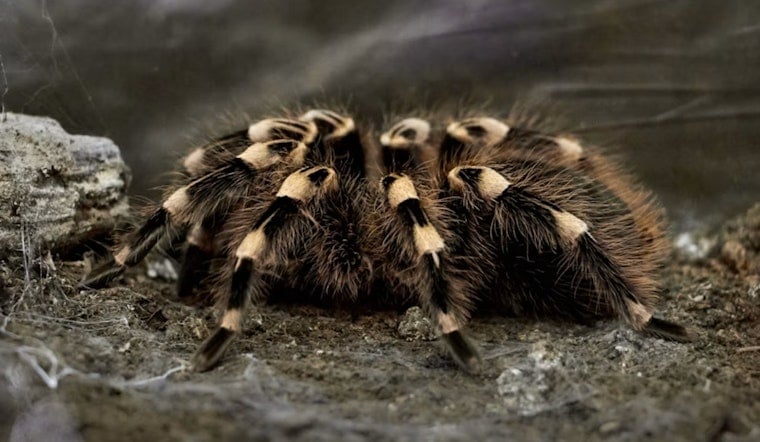
A travel journalist hiking one of Big Bend National Park's most popular trails found herself surrounded by hundreds of large, hairy spiders crawling across the path, climbing rocks, and emerging from the desert floor around her. The creatures were Texas brown tarantulas, deep into their annual autumn search for mates, and despite their startling numbers, they posed no real danger to the hiker who stumbled into their path.
Tamara Mc, a travel journalist who has been published in more than 90 outlets and was named a Lowell Thomas Travel Journalist of the Year bronze recipient, described the scene after driving six hours from the El Paso airport into far West Texas, according to BBC Wildlife Magazine. She had hoped to spot a black bear on her trip into Big Bend National Park, which the outlet notes is one of the least visited national parks in the country despite spanning more than 3,200 square kilometers. Instead, on the Lost Mine Trail, she encountered hundreds of tarantulas crawling across the trail itself.
A 7.5-Kilometer Trail Turns Into a Spider Gauntlet
The Lost Mine Trail is a 7.5-kilometer out-and-back route, per the outlet's reporting, and climbs through the Chisos Mountains. The National Park Service describes the same trail as gaining roughly 1,100 to 1,200 feet over its 4.8-mile round trip, topping out near 6,850 feet as it winds through a transition zone of oak, pine, and juniper — terrain that made for an unlikely backdrop to a mass tarantula encounter.
What Tamara Mc walked into was not random. Texas brown tarantulas cross Big Bend National Park each autumn as part of an annual mating hunt, and the spiders she saw moved slowly and steadily rather than lunging or jumping, the outlet reported. The species, scientifically known as Aphonopelma hentzi, is one of the largest spiders in North America, with hairy brown bodies and a legspan of about 12 centimeters.
Why Male Tarantulas Wander in Search of Mates
The tarantulas seen crossing trails and roads each fall are almost exclusively males, who can cover miles while searching for females. Female Texas brown tarantulas remain in their burrows for nearly their entire lives, spending up to 40 years underground, while males spend eight to 10 years underground before emerging to find a mate. Once a male locates a burrow, he taps the entrance with his legs to signal his presence — a female interested in mating may emerge, but according to the outlet, an uninterested female may eat the male instead. Even a successful mating comes at a cost: male Texas brown tarantulas typically die within a few weeks afterward, having produced a new generation of spiderlings before their short window above ground ends.
Seasonal mass appearances like the one Tamara Mc encountered are triggered by warmer spring temperatures and rainfall earlier in the year, which spur the insect availability males and future offspring depend on, according to AgriLife Today. After mating, female tarantulas lay clutches of 100 to 1,000 eggs in silk-lined sacs inside their burrows, where the eggs incubate for 45 to 60 days before spiderlings hatch, per the Texas A&M AgriLife Extension Service.
Harmless, Reclusive, and Legally Protected
Despite their size and sudden numbers, Texas brown tarantulas are harmless to humans, with venom weaker than a bee sting, according to the BBC Wildlife Magazine account. The spiders are typically reclusive and prefer to retreat rather than bite when threatened. Their bodies are covered in specialized hair that helps them sense vibrations, detect threats, and navigate their environment, while silk lining their burrow entrances helps them detect movement nearby.
Beyond biting, the spiders have another defense: flicking barbed urticating hairs off their abdomens with their hind legs, which can cause skin, eye, or respiratory irritation, according to Texas Parks & Wildlife Magazine. That same defense doesn't always work against their most significant natural predator, the tarantula hawk wasp, which paralyzes tarantulas with a sting and drags them into a burrow to host its larvae — a sting considered among the most painful delivered by any insect in North America.
Federal regulations under Title 36, Section 2.2 of the Code of Federal Regulations prohibit disturbing, touching, capturing, or harassing any wildlife within National Park Service boundaries, a rule that applies just as much to tarantulas as to bears or bighorn sheep. Visitors who ignore it can face federal misdemeanor charges or fines. Hoodline previously reported that federal border wall plans have already stirred conflict over Big Bend's protected lands, underscoring how closely the park's wildlife and landscape are regulated.
Part of a Bigger Desert Picture
Big Bend's tarantula population fits into an ecosystem the park is famous for protecting: more bird, bat, butterfly, ant, and scorpion species than any other national park in the country, along with roughly 3,600 insect species and 56 reptile species, according to the National Park Service. In West Texas communities near the park, including Terlingua, tarantula sightings tend to peak near sunset and early morning along low-elevation roads such as Ross Maxwell Scenic Drive and Old Maverick Road, according to Terlingua Ghost Town Rentals, which recommends slow driving during autumn to avoid crushing wandering males.
The spiders also serve a quiet ecological function beyond their unnerving fall migrations. Hoodline has previously reported that tarantulas act as key pest regulators, hunting nocturnal insects like grasshoppers, crickets, caterpillars, and cicadas, while their burrowing aids soil aeration and water infiltration across Texas desert ecosystems. It's a pattern that has repeated for years across the state, from Central Texas mating displays to the sightings Tamara Mc walked into on the Lost Mine Trail — startling to encounter, but by every account a sign of a desert working exactly as it should.





