

























































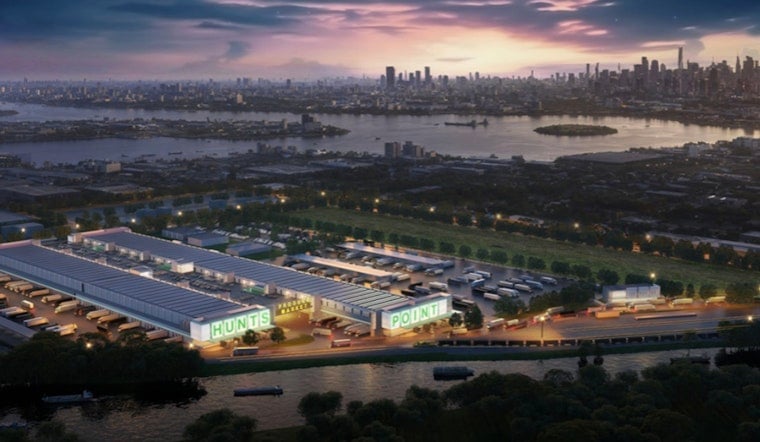
A long-planned overhaul of the Hunts Point Produce Market that would have turned the sprawling South Bronx wholesale hub into an all-electric distribution center has stalled after the city and the cooperative that runs the market failed to reach a lease agreement. The collapse leaves more than $400 million in allocated funding in limbo and keeps nearly 1,000 diesel-powered refrigeration trailers idling around the clock in a neighborhood already burdened with some of the city's worst air quality.
The breakdown was first reported by Spectrum News NY1, which detailed how the two sides could not close the gap on rent terms for the site. Bronx City Council Member Justin Sanchez said the Hunts Point Cooperative and the city were separated by several million dollars in negotiations, with the cooperative's originally negotiated rent of $18 million later reduced to $14 million before talks still fell apart. Sanchez said the cooperative, which operates the market and represents 26 businesses onsite, failed to reach an agreement with the city on a site lease despite that concession.
Robert Leonard, a spokesperson for the Hunts Point Cooperative, disputed that framing, denying that the lease price was what caused the project to fall apart. Leonard said instead that the proposed redevelopment plan itself was the real issue, arguing the design would have taxed the cooperative's ability to supply customers and consumers with fresh produce. The cooperative said it still plans to work with the city on new development plans going forward.
A $405 Million Deal Already in Motion
The stalled lease threatens to delay a project that had already reached a formal milestone. New York City's Economic Development Corporation had conditionally selected the joint venture Aurora-Primus, a partnership between Aurora Contractors LLC and Primus Builders Inc, to lead design and construction under a $405 million public funding agreement announced in December 2025, according to NYCEDC. That figure sits well below earlier projections; the Bronx Times reported in 2023 that the full modernization was expected to cost roughly $650 million, split between $130 million each from the city and state, federal infrastructure grants, and up to $250 million in private developer equity and financing.
The Economic Development Corporation said the Mamdani administration remains committed to working with the Hunts Point Cooperative and union workers, and that it is committed to addressing environmental concerns and reducing truck traffic at Hunts Point, per the same NY1 report. Sanchez said he plans to introduce legislation aimed at reducing emissions from truck refrigeration units regardless of the lease outcome.
A 59-Year-Old Hub Still Feeding the City
The market has operated at its current 105-acre South Bronx site since 1967, when it relocated from Manhattan's Washington Street Market, according to NYCEDC. It has grown into a wholesale cooperative processing more than 2 billion pounds of produce annually and generating over $2 billion in sales, and the city says it currently supplies roughly 25 percent of New York City's fresh produce. The redevelopment project was intended to reduce pollution for an estimated 13,000 Bronx residents living near the site, where the Cross Bronx Expressway, the Sheridan Expressway, and other highways converge.
Nearly 1,000 diesel-powered trailer units currently run 24 hours a day, seven days a week at the market, and the stalled overhaul had targeted roughly 1,000 diesel trucks for relocation to a new facility as part of the broader plan. Public health data reported by the Red Hook Star-Revue shows South Bronx neighborhoods around Hunts Point see childhood asthma emergency room visits and hospitalizations at rates up to double the Bronx average and more than ten times higher than wealthier Manhattan neighborhoods, a disparity that has earned the corridor the nickname Asthma Alley.
Infrastructure Pieces Already Delivered While the Lease Stalls
Even as the lease talks collapsed, several major surrounding infrastructure investments have already been completed or funded. New York State finished its $1.7 billion Hunts Point Access Improvement Project in November, building new highway ramps that connect the peninsula directly to the Bruckner and Sheridan expressways and route freight traffic away from residential streets, according to the Office of Governor Kathy Hochul. Hoodline covered that project's completion in November.
The U.S. Department of Transportation had already awarded the market a $110 million Infrastructure for Rebuilding America grant back in 2022 to upgrade refrigerated warehouse facilities and support a shift to zero-emission transport, as reported by CityLand at the time. More recently, the city and the MTA allocated $15 million in congestion pricing toll revenues in April to replace stationary diesel transport refrigeration units with hybrid and electric models, a step Hoodline detailed in its coverage of that funding. NYCEDC also secured a separate $15 million federal Charging and Fueling Infrastructure grant in 2024 to build a freight-focused electric vehicle charging depot at the broader Hunts Point Food Distribution Center, which the agency says is the heaviest commercial trucking destination in New York State.
A Broader Revitalization Effort Still Moving Forward
The produce market's troubles are just one piece of a larger Hunts Point revitalization effort that also includes a nearby city-run grocery store, a project city officials describe as separate from the produce market redevelopment. Both the grocery store and the produce market projects are intended to bring health benefits to an underserved area, according to the NY1 report. Neighboring facilities within the same 329-acre food distribution complex have continued to advance: the City Council allocated $25 million in municipal capital funding in August to modernize the adjacent Fulton Fish Market, a project Hoodline reported would open the hub to locals.
The market's workforce has its own history of labor tension tied to conditions on the site. In January 2021, more than 1,400 unionized workers represented by Teamsters Local 202 staged a week-long strike over wages and healthcare benefits before ratifying a new agreement, a dispute chronicled by Vice Motherboard that drew national attention to essential supply chain workers during the pandemic. With the lease unresolved, it remains unclear how soon construction under the Aurora-Primus agreement could begin, or whether the federal grants tied to the project's timeline could face new risk.



