

























































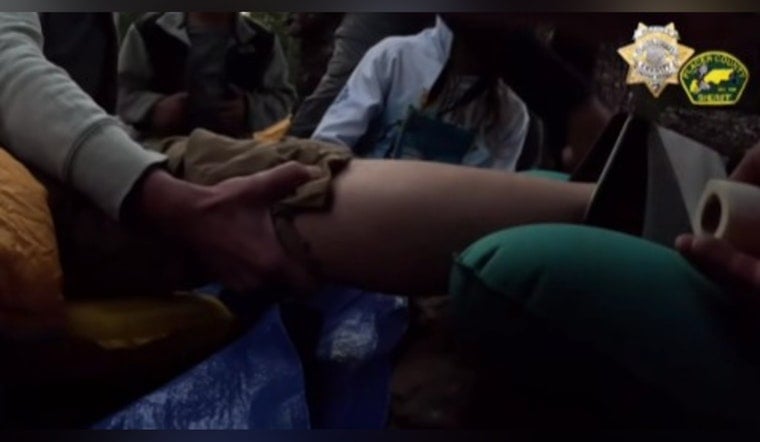
A hiker with a serious foot injury was stranded above 8,000 feet near Needle Lake, above Granite Chief in the Olympic Valley area, unable to walk out on his own as evening set in Wednesday. The Placer County Sheriff's Office received the report of the injured man and dispatched its Falcon 30 helicopter crew, which reached him within an hour of his injury.
According to Placer Sheriff, the agency's official account for the Placer County Sheriff-Coroner-Marshal's Office, the crew located the hiker and completed the rescue safely even as darkness closed in. A Falcon 30 crew member descended to splint the man's injured foot before helping him into the helicopter, and the aircraft then flew him to the Palisades Tahoe parking lot, where an ambulance was waiting to transport him to Tahoe Forest Hospital.
Why This Terrain Demands a Helicopter
Needle Lake sits in a subalpine glacial cirque above 8,000 feet near Needle Peak, reachable mainly by rugged, off-trail ridgeline scrambles connected to the Pacific Crest Trail, according to the U.S. Forest Service. The lake lies within the Granite Chief Wilderness, a 28,374-acre stretch of glacially carved backcountry inside the Tahoe National Forest that Congress protected under the California Wilderness Act of 1984, per Wilderness.net. Federal wilderness rules bar motorized ground vehicles from the area, meaning an aerial extraction was effectively the only option once the hiker could no longer move on his own.
That geography is exactly what Falcon 30 was built to handle. The aircraft is an Airbus H125 / Eurocopter AS 350 B3 AStar powered by an 871-horsepower Turbomeca Arriel-2B1 turbine engine, capable of speeds up to 135 mph, a 20,000-foot service ceiling, and roughly a 250-mile operational range, according to Placer County. That kind of high-altitude engine performance matters at elevations like Needle Lake's, where thinner air makes hovering and hoist maneuvers far more demanding.
A Hoist Rescue in Fading Light
As night fell, Falcon 30's crew relied on training and equipment built for exactly this scenario. Air Operations missions divide labor between a System Operator, who conns the pilot and runs the rescue hoist cable, and a Rescue Specialist, who descends to evaluate, splint, and package patients for retrieval, the county notes. During night operations, crews fly with ANVIS 9 Pinnacle night vision goggles, which let pilots and operators spot hazards and keep visual reference over unlit wilderness even in total darkness.
The crew's speed wasn't unusual for the unit. In January 2024, Falcon 30 located and hoisted three stranded off-roaders from remote Placer County terrain in under two hours, as reported by Police1. The crew also trains for these exact conditions; in July 2025 it ran joint hoist-rescue drills with local fire departments, practicing personnel insertions and retrievals in both dense tree cover and open terrain.
Part of a Busy Stretch for Placer County Rescue Teams
The Needle Lake rescue caps a demanding few weeks for Placer County's search and rescue apparatus. Earlier in August, Falcon 30 was deployed alongside ground crews, K9 units, and drones to ferry searchers into rugged canyons during a multi-day effort near Auburn to find a missing hiker, a case Hoodline covered in its report on the Auburn canyon search.
Falcon 30 doesn't operate alone. The sheriff's office backs its aviation unit with specialized volunteer teams — including Mountain Rescue, Four-Wheel Drive, Mounted, and Communications units — that stay on call around the clock across a jurisdiction stretching from the Sacramento Valley to Lake Tahoe, according to Placer County. The hiker was ultimately delivered to Tahoe Forest Hospital in Truckee, which the Sierra-Sacramento Valley Emergency Medical Services Agency has designated a Level III Trauma Center offering round-the-clock advanced trauma evaluation, per Tahoe Forest Health System.





