

























































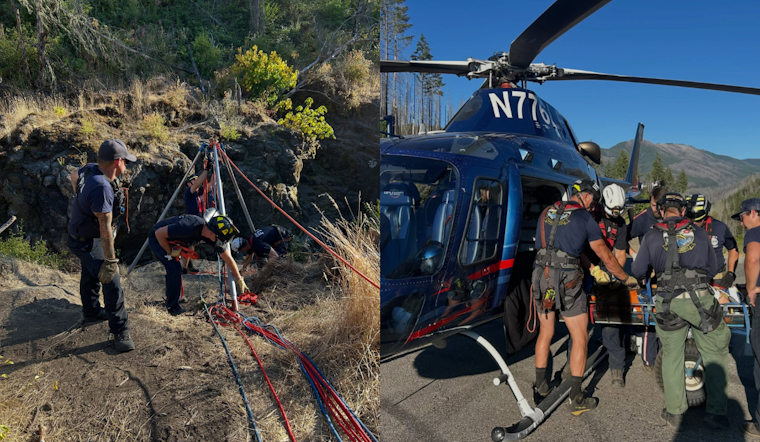
Molalla Fire crews raced to the Molalla River swimming spot known as the Log Jam early Sunday after a report of an injured swimmer, kicking off a rescue that would stretch across four agencies and end with a helicopter flight to Portland. The patient, pulled from the water with a possible head injury and torso trauma, was hoisted up a steep canyon wall using rope rigging before being handed off to a waiting air ambulance crew.
According to Clackamas Fire, Molalla Fire crews first rescued the swimmer from the water and began treatment on scene. Clackamas County Sheriff's deputies assisted during the rescue, and citizens at the popular swimming hole also pitched in to help, the department said. Clackamas Fire then took over, using a vertical rope rescue to move the patient up to a nearby landing area suitable for helicopter access.
From there, the Life Flight Network flew the patient by helicopter directly to Legacy Emanuel Medical Center in Portland, where the patient was being treated for multiple injuries, including a potential head injury and torso trauma. Legacy Emanuel operates one of only two Level 1 trauma centers in Oregon and has run dedicated helipads for regional air ambulance transports since the hospital first established the Life Flight Network in 1978, according to Legacy Health. That network, believed to be the first hospital-based emergency air medical transport system on the West Coast, now runs helicopter bases across Oregon, Washington, Idaho, and Montana.
A Canyon With No Cell Signal
Part of what made the rescue complicated was where it happened. The Molalla River Recreation Area, home to the Log Jam swimming site, has no cellular phone service anywhere along the corridor, forcing recreationists and emergency crews alike to lean on satellite links or radio relays whenever something goes wrong, per the U.S. Bureau of Land Management. That gap in coverage is why the Oregon Department of Forestry stepped in during Sunday's rescue, relaying information to Clackamas County 911 dispatchers when direct communication was limited.
The workaround wasn't just about dead zones. Structural fire departments in Clackamas County typically operate on 800 MHz radio frequencies, while wildland agencies like the Oregon Department of Forestry rely on Very High Frequency bands instead, according to the Clackamas Wildfire Collaborative. That mismatch means cross-agency responses in rural stretches of the county often depend on pre-arranged relay protocols just to keep everyone talking to each other.
Technical Rope Rescues Aren't New To This Terrain
Clackamas Fire District #1 maintains a dedicated Technical Rescue Team trained specifically for high-angle rope rescues, along with structural collapse and confined-space extrications, deploying specialized heavy rescue apparatus when calls like this come in. It's a skill set the district has put to work nearby before: in May, the same Technical Rescue Team executed a low-angle rope rescue in Molalla to pull a man up from a 60-foot fall along South Butte Creek Road.
The Molalla River corridor has also seen its share of hazardous debris in recent months. In February, the Bureau of Land Management issued a safety advisory after a 150-foot logjam blocked the Molalla Wild and Scenic River, the result of dead timber from the 2020 Labor Day wildfires continuing to wash downstream. Congress designated a 21.3-mile stretch of the river as a National Wild and Scenic River back in March 2019, placing the free-flowing waterway under federal management.
A River With A Troubled Recent History
Sunday's rescue is the latest in a string of serious incidents on the Molalla River. Emergency water calls in the area draw on the Clackamas County Water Rescue Consortium, an interagency network pooling rescue boats, swift-water technicians, and dive teams from Clackamas Fire District 1, the Clackamas County Sheriff's Office, Tualatin Valley Fire & Rescue, and American Medical Response, according to the Clackamas County Sheriff's Office.
That kind of coordinated response has been tested repeatedly. Hoodline reported on a fatal drowning near Canby Community Park in which a 24-year-old swimmer died despite a rapid multi-agency rescue effort, underscoring how fast currents, submerged basalt ledges, and cold water make the Molalla River dangerous even when help arrives quickly. A separate Salem man drowned in the river in August 2025 despite a swift rescue response, according to prior Hoodline coverage.
The exact circumstances that led to Sunday's injuries at the Log Jam have not been detailed, and the patient's condition and long-term prognosis at Legacy Emanuel remain unknown. What is clear is that the rescue leaned on nearly every layer of Clackamas County's emergency response system at once — water extrication, technical rope rigging, cross-agency radio relays, and air transport — to get one injured swimmer out of a canyon with no cell service and into a Level 1 trauma center more than 30 miles away.





