

























































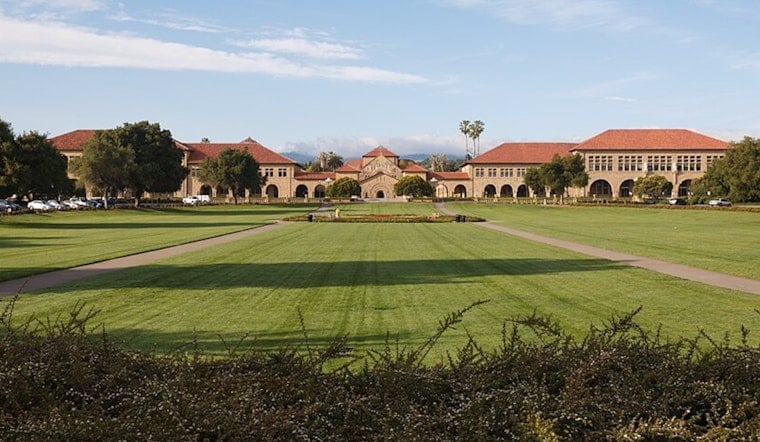
The U.S. Justice Department plans to investigate Stanford University over its foreign funding and foreign student policies, with officials specifically flagging concerns about money flowing to campus labs from countries including China, Russia, North Korea, and Cuba. Assistant Attorney General for Civil Rights Harmeet Dhillon said Stanford has not faced the same level of scrutiny as its peer institutions, even as the university sits among the top recipients nationally of funding tied to nations Washington designates as security risks.
According to the Palo Alto Daily Post, Dhillon said she is particularly concerned about foreign funding supporting professors' work and laboratories that may handle sensitive national security information. Dhillon added that Stanford is not being passed over because of its virtue, but because her office is still staffing up, per the same report. Federal data underscore why Stanford has drawn attention: Department of Education disclosures covering 1986 through December 2025 show the university received over $418 million from sources in designated countries of concern, ranking fourth among U.S. universities behind Harvard, MIT, and NYU, according to the U.S. Department of Education.
A Long History of Foreign Gifts Under the Microscope
Stanford's overall foreign funding footprint is substantial. Federal Section 117 transparency portal data released in February 2026 shows the university has reported $2.2 billion across 5,314 foreign gift and contract transactions since 1986, with donors from China accounting for the largest share at $413.2 million, as reported by The Stanford Daily. That places Stanford sixth overall among U.S. higher education institutions for total foreign gift disclosures since 1986, the student paper reported. In 2025 alone, Stanford reported receiving more than $775 million in foreign gifts and contracts, making it the third-highest university recipient nationwide that year behind Carnegie Mellon University and MIT.
Stanford has said it applies enhanced scrutiny to foreign sources, particularly those from countries of concern, and conducts rigorous due diligence on all philanthropic gifts and sponsored research, per the Palo Alto Daily Post. The university also maintains it has the right to decline gifts when their funding sources raise ethical or legal concerns, according to the same report. The scrutiny is not new: in October 2023, Stanford agreed to pay $1.9 million to resolve Justice Department allegations under the False Claims Act that 12 faculty members failed to disclose foreign research support on 16 federal research grant proposals submitted to five federal agencies, including military branches and NASA, according to the Department of Justice.
Executive Order Fuels Broader Federal Push
The current push traces back to Executive Order 14282, which President Trump signed in April 2025, establishing robust enforcement of Higher Education Act Section 117 as administration policy and authorizing federal agencies to pursue civil actions, criminal penalties, and loss of federal student aid for noncompliant universities, according to The White House. The order cited previous federal reviews that had uncovered billions of dollars in previously unreported foreign gifts. Section 117 itself, part of the Higher Education Act of 1965, requires domestic institutions receiving federal financial assistance to publicly report foreign gifts or contracts of $250,000 or more within a calendar year, a requirement that applies semiannually to accredited institutions offering bachelor's degrees or higher, per CASRAI.
In February 2026, the U.S. Department of Education entered an interagency agreement under the Economy Act with the U.S. Department of State to co-administer Section 117 reporting and share campus funding data for national security review purposes, according to Ropes & Gray LLP. The partnership leverages State Department resources for information collection and compliance enforcement, the law firm noted. The Trump administration has targeted elite universities including Harvard and Columbia over allegations of antisemitism and discriminatory admissions practices, per the Palo Alto Daily Post, making Stanford the latest institution to draw formal federal attention.
Admissions Probe and Donor Disputes Add to the Pressure
The foreign funding inquiry lands alongside a separate Justice Department investigation into Stanford's admissions practices. The department opened an inquiry in March 2026 into whether race was a factor in admissions at the Stanford School of Medicine, and threatened to withhold federal funding if the university failed to provide seven years of admissions records, with compliance required by April 24, according to The Stanford Daily. Hoodline previously reported on a related probe into UCLA's medical school under Dhillon's Civil Rights Division, which also cited ongoing inquiries at Stanford and UC San Diego.
Campus tensions over foreign donors have also flared closer to home. In June 2026, Stanford's Hoover Institution publicly disputed a student newspaper report alleging a $3 million 2025 donation to the institution originated from a high-ranking Chinese political figure linked to state influence operations, according to Newsweek. Hoover Institution leadership requested a retraction and characterized the report as a case of mistaken identity, per the same report.
Court Ruling Signals Limits on Federal Enforcement
Not every federal effort targeting elite universities has held up in court. A federal judge in Boston ruled that the government's Title VI antisemitism lawsuit against Harvard, which had claimed the university failed to address campus antisemitism, was thrown out in August 2026, per the Palo Alto Daily Post. Federal prosecutors failed to prove ongoing civil rights violations following formal administrative notification, according to Poets&Quants, with the ruling emphasizing that Title VI enforcement is designed to encourage voluntary compliance rather than penalize past actions.
That ruling offers a preview of the legal terrain Stanford could face if the foreign funding inquiry escalates into formal litigation. For now, the Justice Department's plans remain in an early stage, with Dhillon framing the scrutiny as a matter of catching up on enforcement rather than singling out Stanford for wrongdoing. Whether the university's existing due-diligence practices satisfy federal investigators, or whether this becomes another courtroom test of Section 117 enforcement, remains to be seen.



