

























































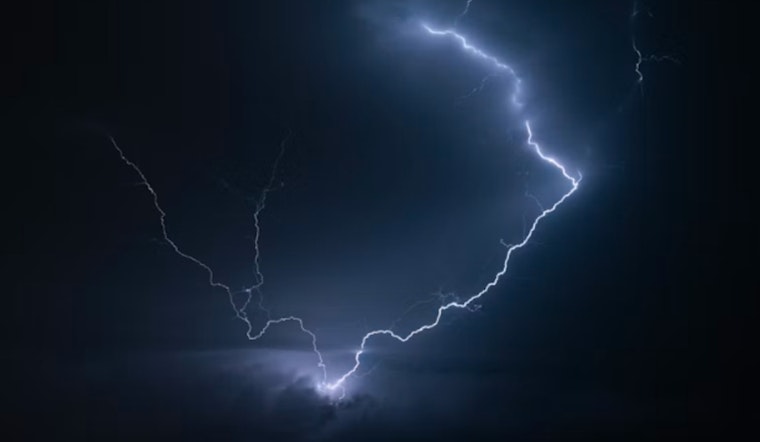
A lightning strike came down so close to a Miami-Dade home that it shook the entire house, knocked down a tree, and left the resident checking on his dog before he even understood what had happened. Jameson Rodriguez was lying on his couch when the bolt struck just steps away from his home, and he described the moment as feeling like an explosion.
“Everything was white, and I knew lightning had hit,” Rodriguez said, according to NBC 6 South Florida. The force of the strike was strong enough to shake the whole house and even move a camera inside the home, the station reported. Rodriguez said his first instinct afterward was to check whether his dog was okay.
A Tree Splits Apart in an Instant
The strike knocked down a tree near the house, and Rodriguez said the tree crackled in the moments after impact. The violent, explosive quality of that sound has a scientific explanation: lightning heats the surrounding air to temperatures up to 50,000 degrees Fahrenheit, roughly five times hotter than the surface of the sun, according to the National Weather Service. That extreme heat causes rapid air expansion, producing acoustic shockwaves powerful enough to shake homes, and it can vaporize moisture inside a tree trunk so quickly that the tree bursts apart.
Rodriguez isn't the only South Florida resident to describe watching a tree explode this summer. The report notes that a witness saw a massive tree split into pieces in Miami-Dade, an image that fits the same physics behind the house-shaking boom Rodriguez experienced. Experts say the odds of being struck by lightning in Florida run about one in 500,000, per the same account.
A Deadly Reminder From Nearby Margate
The close call in Miami-Dade comes just days after a lightning strike proved fatal in nearby Margate, where a mother and her 2-year-old child were killed. According to CBS News Miami, 31-year-old Kenya Glasgow and her 2-year-old daughter Kennedy Glasgow died on August 23 when they were struck on a sidewalk while trying to reach a relative's house during a sudden afternoon storm.
That tragedy underscores why officials keep repeating the same warnings during Florida's stormy summer months. Florida has logged at least 98 lightning fatalities since 2006, more than double the total of any other U.S. state, according to National Weather Service tracking. Nationally, 12 people had died from lightning strikes through late August 2026, and Florida accounted for four of those deaths, the agency's data shows.
Why Florida Leads the Nation in Lightning Risk
Florida recorded the highest lightning density in the country in 2025, averaging 305 lightning events per square mile statewide, according to Vaisala Xweather. The Miami–Fort Lauderdale–West Palm Beach metro area ranks among the top five urban regions nationwide for lightning density and human exposure risk, meaning dense population centers across South Florida face heightened danger during the summer storm cycle.
July and August represent the peak months for lightning casualties and fatalities in the state, driven by frequent, intense afternoon thunderstorms that form along coastal sea-breeze fronts. An average cloud-to-ground strike carries roughly 30,000 amperes of electrical current and up to 300 million volts, according to WUFT News — about 2,000 times the power capacity of a standard 15-amp kitchen outlet.
Safety Guidance for Storm Season
Federal health officials warn that lightning risk doesn't disappear once you're inside. The Centers for Disease Control and Prevention notes that roughly one-third of lightning-strike injuries occur indoors, where current can travel through wiring, plumbing pipes, and metal reinforcement in concrete walls or floors, meaning residents should avoid corded appliances, running water, and exterior doors during a storm.
People who hear thunder or see lightning should go indoors as soon as possible, and should never stand in an open field or under trees. Officials also advise staying away from water, including the ocean or swimming pools, during active storms. Analysis by the National Lightning Safety Council found that 85% of Florida lightning fatalities over the past two decades were male, a pattern largely tied to outdoor work and water recreation, per WUFT's reporting.
For Rodriguez, the storm has become a reminder of how quickly a routine afternoon can turn dangerous. His house is still standing and his dog is fine, but the sound of that strike — and the tree it split apart — isn't something he's likely to forget soon.



