

























































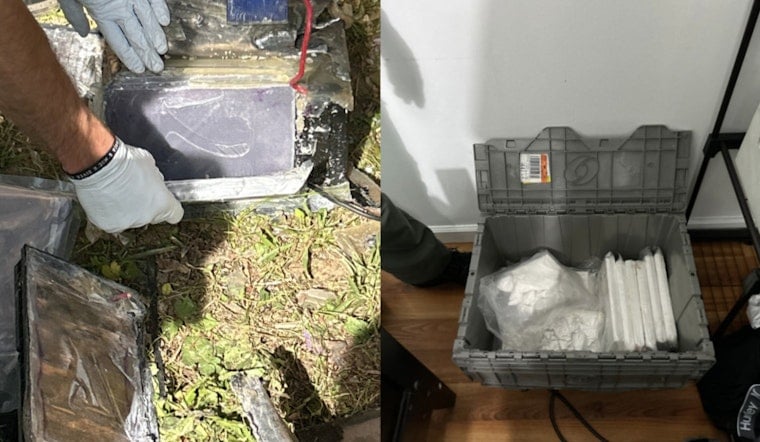
A federal judge in Atlanta sentenced a 46-year-old Lawrenceville man to nine years in prison Wednesday for trafficking fentanyl and methamphetamine after investigators raided a Lilburn home and found roughly 25 kilograms of fentanyl and cocaine, some of it hidden inside vehicle batteries. Gabriel Ojeda Murguia, who prosecutors say went by the street alias Taliban, pleaded guilty in May to three federal drug charges and will also serve five years of supervised release once he leaves prison.
According to 95.5 WSB, investigators searched the Lilburn home in April 2025 and found at least 15 kilograms of fentanyl concealed inside vehicle batteries, along with the rest of the roughly 25 kilograms of fentanyl and cocaine recovered from the property. Ojeda Murguia was arrested at the scene along with another man. The U.S. Department of Justice says federal prosecutors also disclosed that Ojeda Murguia had a prior Georgia criminal record for battery and family violence battery.
Court information cited in the case shows that between April 2024 and April 2025, Ojeda Murguia sold a kilogram of methamphetamine for $2,700 and offered cocaine at $18,000 per kilogram in Gwinnett County. Those same court records describe deals involving more than 100 grams of fentanyl powder and more than 2,000 fentanyl pills, according to the station's report. Law enforcement officers moved in on the Lilburn residence after surveillance teams watched Ojeda Murguia enter the home, leading directly to his arrest.
Officials Warn of the Scale of the Threat
U.S. Attorney Theodore S. Hertzberg said the fentanyl Ojeda Murguia possessed posed a significant threat to public health and public safety, and warned that the drugs could have ended tens of thousands of lives had they reached the street. Hertzberg also credited coordinated teamwork among federal, state, and local law enforcement partners working under the Homeland Security Task Force for building the case.
DEA official Marlo Graham said Ojeda Murguia was moving an extraordinary amount of fentanyl into communities for profit, and added that the investigation and sentencing demonstrated the impact of coordinated law enforcement work. The FBI and DEA investigated the case, with assistance from the Gwinnett County Police Department and the Georgia State Patrol, per the same account from 95.5 WSB.
The prosecution was led by Assistant U.S. Attorneys Thomas M. Forsyth III and Sara Lim under the Homeland Security Task Force initiative established by Executive Order 14159, according to the Justice Department. DEA Atlanta Field Division Special Agent in Charge Jae W. Chung said multi-agency operations under that task force are focused on dismantling cartel pipelines to work toward what he called a “Fentanyl-Free America.”
Hollowed-Out Batteries a Recurring Smuggling Tactic
Hiding fentanyl inside vehicle batteries is not an isolated method in the region. In June 2025, federal agents in Georgia intercepted 10 kilograms of fentanyl concealed in vehicle batteries tied to a Mexico-based drug trafficking organization, arresting courier Rodrigo Morales-Figueroa in Gainesville after an undercover sting involving fake fentanyl, according to the Justice Department. Open questions remain about which cartel network supplied Ojeda Murguia and whether federal agencies are pursuing higher-level leadership tied to that pipeline.
State health data help explain why officials are treating cases like this one with such urgency. Georgia Department of Public Health figures compiled by the GASPS Data Warehouse show fentanyl-related overdose deaths per 10,000 Georgia residents climbed from 0.39 in 2019 to a peak of 1.57 in 2022, before easing slightly to 1.49 in 2023. Research published in late 2025 identified metro Atlanta as a regional distribution hub where synthetic opioids are frequently pressed into counterfeit prescription pills or mixed with stimulants, raising overdose risks compared with rural parts of the state.
Gwinnett's Escalating Fentanyl Prosecutions
The case adds to a string of major fentanyl prosecutions Hoodline has tracked across Gwinnett County. Under Georgia's Austin's Law, signed by Governor Brian Kemp in 2024, prosecutors in the county can charge drug distributors with aggravated involuntary manslaughter when illicit fentanyl sales lead to fatal overdoses — a statute Hoodline detailed after a Snellville man's manslaughter charge tied to a Lawrenceville overdose death.
Other recent cases show a similar pattern of concealment and scale. Hoodline previously reported on the sentencing of an Arleta man to nearly 20 years for a trafficking operation that also hid fentanyl and methamphetamine inside vehicle components, and on a GBI-led crackdown that resulted in 24 arrests across Gwinnett County last September. A 2024 operation separately charged 47 people in a gang-linked fentanyl and methamphetamine bust across the county.



