

























































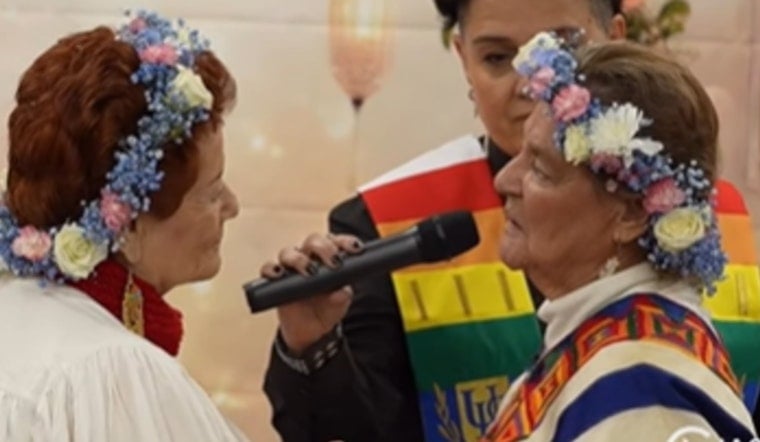
Ellie Aguilar, 83, and Andi Seagal, 80, met through senior programming at the Long Beach LGBTQ Center and fell in love, a romance the couple shared publicly this week after holding a commitment ceremony this summer. Their story, first shared in a video posted by Los Angeles County Supervisor Janice Hahn, is being celebrated as a rare and heartening example of late-in-life connection within Long Beach's LGBTQ+ community.
The pair's love story was shared on Supervisor Janice Hahn's Facebook page, which posted the video Wednesday. Hahn, who represents the Fourth Supervisorial District that includes Long Beach, has her own history with the organization that brought Aguilar and Seagal together: she received the Political Icon Award at the center's 11th Annual Black & White Ball in June 2024, according to the same account provided by the center.
Aguilar and Seagal connected through Older Adult Services at the LGBTQ Center Long Beach, based at 2017 E. Fourth Street, which also houses health, mental health, legal, and youth programs under one roof, per the center's own materials. The senior programming that brought the couple together did not spring up overnight. It grew out of a volunteer-led LGBTQ+ Senior Advisory Commission that began with monthly Saturday socials and watercolor classes before expanding into the formal Older Adult Services division that exists today.
A Grassroots Voice in the Community
Aguilar is not new to public life within Long Beach's LGBTQ+ circles. She served as a featured “Activist Elder” speaker at the 2025 Long Beach Dyke March, an annual grassroots gathering celebrating lesbian and LGBTQ+ history, where she offered reflections on community memory and generational resistance.
That kind of visible, long-running civic engagement mirrors the broader mission of the center where she met Seagal. The LGBTQ Center Long Beach has been expanding its own capacity in recent years, buoyed in part by a $2.3 million grant from philanthropist MacKenzie Scott awarded in April 2024 as part of an open-call funding initiative for high-impact nonprofits. The board appointed Ellie Perez as executive director that July, following a six-month national search, to help oversee the organization's growing footprint.
Why Senior Programs Matter for LGBTQ+ Elders
The romance lands against a backdrop of research showing both promise and persistent struggle for LGBTQ+ seniors. Los Angeles County is home to roughly 665,000 LGBTQ adults, nearly 9% of the county's total adult population, according to a June 2024 report from the Williams Institute at UCLA School of Law and the LA County Department of Public Health.
A November 2024 statewide survey of more than 4,000 LGBTQIA+ older adults, conducted by the California Department of Aging, found that 86% rated their overall quality of life as high, even as 23% reported fair or poor physical health. The survey was California's first comprehensive look dedicated specifically to aging LGBTQIA+ residents.
National research paints a starker picture of isolation risk. Advocacy group SAGE projects that the national population of LGBTQ adults aged 50 and older will hit 7 million by 2030, and the organization's research indicates LGBTQ seniors are twice as likely to live alone as their heterosexual peers. A separate August 2024 national survey by AARP found that 63% of transgender and nonbinary older adults, along with a substantial share of sexual minority seniors, experience social isolation — a finding that points directly to community center programs as vital interventions.
Community Roots Amid Organizational Change
The center's senior programming exists within an institution that has faced its own internal turbulence. Hoodline previously reported on staff tensions under the current leadership, even as the center has continued to serve as an anchor institution for LGBTQ+ residents across Long Beach and the South Bay. That same anchor role has also shown up in expanding healthcare infrastructure nearby, including APLA Health's Long Beach facility expansion reported last year.
For Aguilar and Seagal, though, the headline this week is simpler: two people who found each other later in life, through a program built specifically to keep LGBTQ+ elders connected rather than isolated. Their commitment ceremony this summer capped a relationship that began, by their own account, in the kind of everyday senior gathering that community advocates say is increasingly essential as the population of older LGBTQ+ adults continues to grow.




