

























































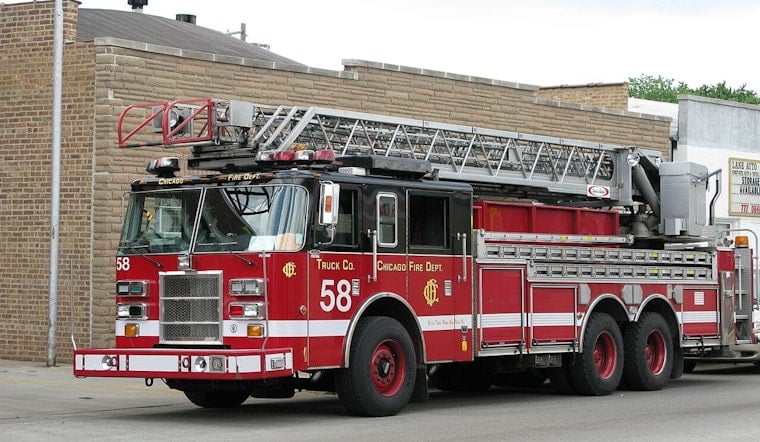
A 62-year-old man was found dead of severe burns Thursday afternoon in the courtyard of the Mission of Our Lady of the Angels in Chicago's Humboldt Park neighborhood, at an address forever tied to one of the city's most devastating tragedies. Chicago police officers and firefighters responded to 3808 W. Iowa St. around 3:05 p.m. after reports of a rubbish fire and a burning tree, and found the man's body once the flames were out.
The man suffered burns from his knees through his upper torso and was pronounced dead at the scene at 3:15 p.m., according to the Chicago Sun-Times. Ring doorbell video reportedly showed the man walking alone into the courtyard earlier in the day, though his name has not been formally released. Witnesses familiar with the man have identified him, per the same report, and Area 4 detectives — who oversee violent crime and death investigations across Chicago's West Side, including Humboldt Park — are now handling the case.
An Address Haunted by 1958
The location carries a wrenching historical echo. During the catastrophic Our Lady of the Angels school fire of 1958, which killed 92 children and three nuns, the first alarm mistakenly reported the fire's location as the rectory at 3808 W. Iowa Street rather than the actual school entrance on Avers Avenue — the same courtyard address where Thursday's fatal burning occurred, according to background compiled from Wikipedia's account of the disaster. That misplaced initial report cost crucial rescue minutes during one of the deadliest school fires in American history.
The 1958 fire didn't just devastate a neighborhood — it reshaped fire safety nationwide. In the disaster's aftermath, the National Fire Protection Association updated its Life Safety Code to mandate enclosed stairwells, automatic alarms wired directly to fire departments, noncombustible building materials, and sprinklers in multi-story schools, as detailed by fire-safety writer Susan DeGrane. Those code changes remain part of the regulatory backbone of modern school construction nearly seven decades later.
From Abandoned Parish to Active Mission
The campus sat dormant for 15 years after the Archdiocese of Chicago closed the parish in 1990, before Cardinal Francis George invited Father Robert Lombardo to the site in 2005 to establish the Mission of Our Lady of the Angels — a move that led to the 2010 canonical founding of a new religious order, the Franciscans of the Eucharist of Chicago. Following years of volunteer-driven restoration, the church was formally rededicated in April 2012 by Cardinal George, 22 years after its original closure, according to Chicago Catholic. Lombardo, who has led the outreach since its founding, was appointed an auxiliary bishop for the Archdiocese of Chicago by Pope Francis in September 2020, becoming the first Franciscan ordained a bishop in Chicago, per Fra Noi.
The bond between the site and Chicago's fire department runs deeper still. In May 2022, the Chicago Fire Department led a lights-and-sirens procession to return the historic Blessed Mother memorial statue — originally dedicated after the 1958 fire — to the mission campus at 3814 W. Iowa Street from Holy Family Church, where it had been kept safe during the rebuilding years, according to the Sisters of Charity of the Blessed Virgin Mary. The rectory building at 3808 W. Iowa Street, where Thursday's incident occurred, now serves as the friary and men's formation house for the Franciscans of the Eucharist of Chicago and as the administrative headquarters for the mission's community outreach, per the order's own account.
A Lifeline in a Struggling Neighborhood
That outreach matters acutely in West Humboldt Park, where local community figures estimate that half the population lives below the federal poverty line. The Mission supplies emergency food and supplies to more than 4,000 families each month, according to the Archdiocese of Chicago, making the campus far more than a historical landmark — it functions as a critical social safety net for one of Chicago's most economically challenged West Side communities.
Investigation and Pending Autopsy
The Cook County Medical Examiner's Office has scheduled an autopsy for the man, a standard step under county protocols for fatal burn victims, which are used to determine whether death resulted directly from thermal injury, smoke inhalation, or trauma sustained before the fire. It remains unresolved whether Thursday's fire was accidental, self-inflicted, or connected to any other cause — a question investigators have not yet answered publicly.
The Archdiocese of Chicago said it is cooperating fully with local authorities investigating the man's death near the mission and expressed condolences, adding that it will continue to pray for the repose of the man's soul and for the health and safety of community members. The circumstances of how the fire started, and who the man was, remain under investigation by Area 4 detectives.





