

























































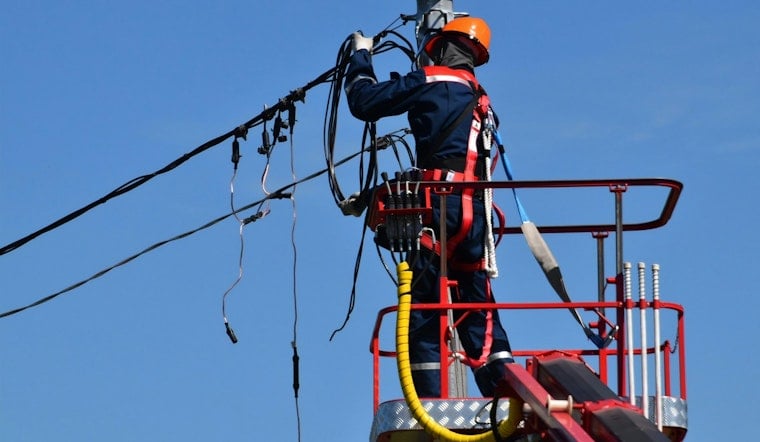
Power went out across a swath of Mansfield, Massachusetts on Thursday morning, with residents reporting disruptions stretching from Fairfield Park to local schools and homes along East Street through the Back Bay area. The outage began at 7:08 a.m., and the town's municipal electric department moved quickly to respond.
The Mansfield Police Department posted the initial public alert Thursday morning, noting that Mansfield Municipal Electric Department (MMED) crews were already responding to the disruption and expected to restore service within the hour. It makes sense that police handled the announcement: emergency and off-hours outage reports in Mansfield are systematically routed through the police dispatch center, which then alerts MMED's on-call lineworkers directly, according to the Mansfield Municipal Electric Department's own protocols.
MMED is a small operation with an outsized reputation for reliability. The town-owned utility serves roughly 10,500 customer accounts and buys its bulk wholesale power through membership in the Massachusetts Municipal Wholesale Electric Company, a nonprofit corporation that manages power contracts for 20 municipal light plants statewide. Tracking data compiled by Electricity Local shows Mansfield customers typically experience an average of just 0.11 outages per year, lasting about 9.66 minutes on average — a stark contrast to national averages of 1.44 outages per consumer and outage durations averaging 123.49 minutes.
A Century-Old Public Power System
Mansfield's ability to move fast on outages traces back more than a century. Town voters established the municipal electric utility on June 25, 1903, issuing $40,000 in bonds to build a power plant on West Church Street — a site that still houses the department's operations garage today. That local, publicly owned structure means line crews are stationed in town rather than dispatched from a regional utility's distant service center.
The exact physical cause of Thursday's outage — whether equipment failure, a fallen tree limb, or something else along the affected feeders — has not been specified in the town's public notice, and that detail remains unclear. What is known is that the outage zone along East Street overlaps with infrastructure the town has already targeted for upgrades. Mansfield's FY 2026 Capital Authorization Budget set aside $400,000 for a new underground feeder project on East Street and another $450,000 for expansions at the Bird Substation, both aimed at improving reliability along that same corridor.
Grid Investments and Growing Scrutiny
MMED's broader finances show why grid reliability carries real weight for the utility. Its FY 2026 operating budget projected $32.6 million in total revenue, with wholesale power purchases representing its single largest expense at more than $14.1 million annually. S&P Global Ratings has assigned MMED an ‘A+’ issuer credit rating, citing strong liquidity, low business risk, and a stable customer base in Bristol County — a rating that helps the utility borrow cheaply for projects like the East Street feeder work.
Town officials and voters have also taken steps to guard against strain on the local grid from large new electrical loads. At Mansfield's Annual Town Meeting in May, voters approved Article 23, capping new data centers at a maximum electrical demand of 2 megawatts specifically to prevent heavy industrial users from compromising system reliability, as Hoodline reported at the time. That local cap has since been cited in broader regional coverage of data center power impacts, including a Lowell case in which a judge blocked a data center's diesel generator expansion.
Mansfield also leans on modern demand-management tools to keep its substations from being overloaded during high-usage periods. The town participates in NextZero's Connected Homes program, an automated demand-response system that manages enrolled smart appliances during peak grid load events to ease stress on equipment. Regionally, Mansfield's distribution grid ties into higher-voltage transmission through infrastructure such as the Gilbert Street Substation, which underwent equipment upgrades converting 115 kV transmission power down to the 13.8 kV level used for neighborhood distribution feeders.
As of Thursday morning, MMED had indicated it expected power to be restored within the hour of the initial outage report, though no follow-up update confirming full restoration has been detailed. Residents in the affected neighborhoods, from Fairfield Park through the Back Bay and East Street corridor, were advised to watch for updates as crews worked the outage.





