

























































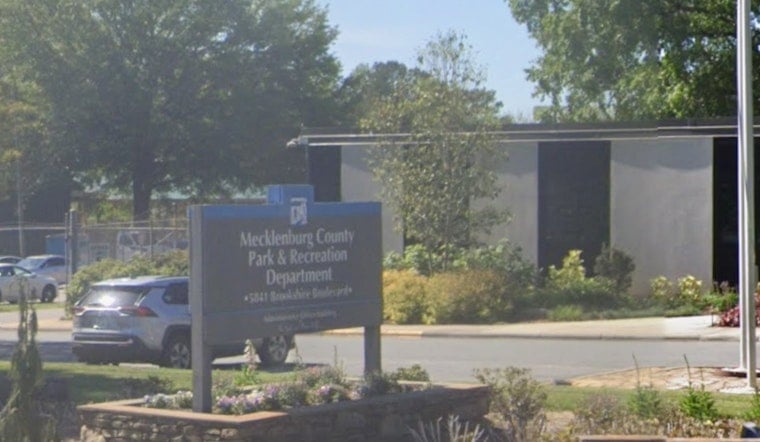
A herd of roughly 200 goats is spending this summer working its way through a Mecklenburg County Park and Recreation natural area, stripping leaves and vines off the forest floor to knock back an invasive wisteria infestation that's been strangling native trees. The animals belong to Grateful Grazing Crew, an eco-friendly land management business run by Huntersville resident Jodi Rubright, who describes herself as a recovering addict and says the current wisteria job is expected to take about a month.
Rubright's operation, which she leads and which serves residential, commercial and public properties across the region, started nearly four years ago after she ended up with more goats than she could handle, according to the Charlotte Observer. She told the paper that some friends asked to borrow her fence-jumping goats to clear their own overgrown land, and the requests kept coming until it turned into a business. The crew now uses portable electric fencing to move the herd from property to property, which the Observer notes both keeps a steady supply of fresh forage in front of the goats and helps reduce their exposure to parasites.
Why Wisteria Is a Threat to Mecklenburg's Old Trees
The vine at the center of this job is non-native Chinese wisteria, and it does real structural damage to the forest. According to the N.C. Cooperative Extension, the vine wraps tightly around tree trunks to girdle them and can add thousands of pounds of weight to a mature canopy, which can cause host trees to snap during winter ice storms. That's part of why the goat crews are cutting thick wisteria vines climbing into trees as they work through the preserve, per the same report from the Observer.
Among the trees at stake are native umbrella magnolias growing in the project area, according to the Observer's account. The species, known scientifically as Magnolia tripetala, features leaves up to 24 inches long and bowl-shaped white flowers roughly 10 inches across, and it belongs to an ancient plant lineage that predates flying insects, relying primarily on beetles for pollination, per the North Carolina Extension Gardener Plant Toolbox. Goat grazing and vine cutting helps weaken the invasive wisteria while protecting native species like the magnolia, the Observer reports.
How the Goats Actually Clear the Land
The biology behind why goats work so well on broadleaf invasives comes down to where the plants store their growth. Broadleaf invasive weeds carry their growing buds at the top and side stems, so goat defoliation directly destroys those growing points and forces the plant to exhaust its root reserves, according to Washington State University Extension. Rubright told the Observer that her goats can eat all day long, and the animals strip leaves and vines from the forest floor as they move through a site.
There's also a food-safety angle that addresses a common worry about spreading weeds by accident. A goat's multi-compartment digestive tract destroys plant seeds during consumption, which prevents invasive weeds from reproducing through droppings in new locations, according to research highlighted by the University of Minnesota's MITPPC program. That same research cautions that goats browsing in damp underbrush face health risks from Parastronguloides tenuis, a parasite carried by snails and slugs, which is why herd managers rely on strict rotational fencing to keep animals moving. A separate multi-year field study from North Carolina State University researchers found that rotational goat grazing eliminated all invasive multiflora rose bushes over four seasons and significantly suppressed heavy kudzu growth, according to findings published on ResearchGate.
Rescued Goats, a Guardian Dog and QR Codes
The herd itself includes goats rescued from owners who could no longer care for them or who had medical issues, the Observer reports. A livestock guardian dog named Buck, an Akbash breed, watches over the goats while they work. Grateful Grazing Crew also introduced QR-code ear tags for its animals, which display a goat's photo, name and other information when scanned.
Beyond brush clearing, the business has built out a roster of community-facing offerings: goat yoga, baby goat snuggle sessions, and mobile petting zoos. The Grateful Grazing Crew visits assisted living communities and facilities serving people with physical or developmental disabilities, and Rubright told the Observer that giving back to the recovery community is one of her goals. She said she hopes to eventually create agricultural training and meaningful work opportunities for people in recovery, and that goats simply bring joy to people.
A Wider Shift Away From Herbicides and Heavy Machinery
Mecklenburg County Park and Recreation manages more than 8,300 acres of nature preserves, part of a broader roughly 19,000-acre portfolio of public land where active management is needed to keep non-native species in check, according to Mecklenburg County Park and Recreation. Using goats instead of mowers or herbicide sprayers reduces the need for heavy equipment or chemicals on that land, per the Observer's reporting.
The approach fits a pattern showing up across the state. In June, the City of Raleigh deployed nearly three dozen goats along the Rocky Branch Greenway at Dix Park to clear steep, inaccessible trails without heavy machinery, according to ABC11 WTVD. Commercial goat rental for brush control isn't new to the Charlotte area either — local farm owners were offering targeted grazing services with $200 site setup fees for residential lots as far back as 2017, according to a report from WCNC Charlotte. On a national scale, USDA targeted grazing guidelines report that prescribed livestock browsing can reduce understory fuel loads by 71% to 83% in sensitive environments where chemical or motorized clearing is restricted, underscoring why land managers keep turning to hooves over herbicide.



