

























































Marcos Gaspar-Da Silva walked out of Immigration and Customs Enforcement custody in Mesa on August 13 with no phone, no driver's license, and more than 26 pounds lighter than when ICE picked him up outside his home in Maine seven months earlier. An immigration judge had just made him a lawful permanent resident. ICE dropped him off anyway at a church parking lot with nothing but the clothes on his back.
Gaspar-Da Silva, a Brazilian national who had been living in Maine, was taken into custody in January after missing an immigration court hearing on his way to work, according to Phoenix New Times. He had a pending asylum case at the time, and ICE officers handcuffed him before beginning what would become a seven-month journey through detention facilities scattered across the country. His wife, Alessia Da Silva, a U.S. citizen, had already filed a Form I-130 spousal petition on his behalf, a filing that would ultimately determine how his case ended.
That petition mattered because of a quirk of immigration law. Under the Immigration and Nationality Act's Section 245 and related federal regulations, once someone is in active removal proceedings, the power to grant a green card shifts away from U.S. Citizenship and Immigration Services and lands with the immigration judge overseeing the case, according to the Department of Justice's Executive Office for Immigration Review. That is the legal mechanism that let Immigration Judge Victoria Levin grant Gaspar-Da Silva an adjustment of status based on his wife's approved petition, making him a legal permanent resident through court paperwork rather than a standard USCIS filing.
A Week Sleeping on a Freezing Floor
Before he ever reached a courtroom, Gaspar-Da Silva spent about a week at the Arizona Removal Operations Coordination Center, a staging facility at Phoenix-Mesa Gateway Airport, per the same Phoenix New Times account. He told the outlet he slept on a freezing floor without a blanket and that staff denied him a shower or a change of clothes. An overflowing toilet, he said, left the floor covered in fecal matter.
The AROCC facility opened in 2010 as a short-term staging hub designed to hold up to 157 detainees awaiting deportation or transfer flights, according to KJZZ. It was never meant for stays like his. Reporting from the Arizona Mirror found that average detainee stays at AROCC climbed from 12 hours in 2025 to 36 hours in 2026, with oversight visits documenting detainees held for days without beds, showers, or medical staff in cells packed up to three times over capacity. Short-term ICE holding sites like AROCC and the Florence Staging Facility are supposed to hold people for under 72 hours, but the Florence Immigrant and Refugee Rights Project has documented systemic overruns of that limit throughout 2026.
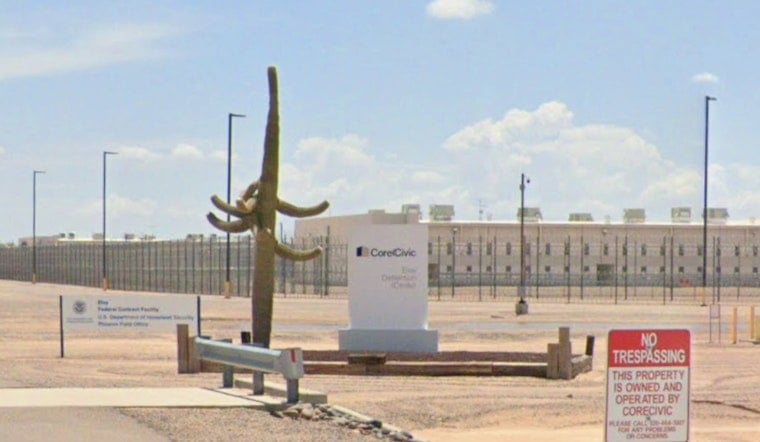
From AROCC, Gaspar-Da Silva was moved by transfer van to the Eloy Detention Center, then spent most of his seven months at the Florence Correctional Center. Both facilities in Pinal County are owned and operated by private prison company CoreCivic under federal contracts — Eloy holds roughly 1,550 beds, while Florence has about 1,824 beds, with roughly 550 set aside for ICE detainees. At Florence, he described a motel area that held more than 150 people, with 13 crammed into single motel rooms and two to a room in the facility's Delta area, which had 20 rooms total.
Bad Soup, a Lockdown, and a Pulled Tooth
Food was a recurring complaint. Detention staff served detainees chicken soup with little meat, and detainees complained about leftover soup water being reused. Gaspar-Da Silva said he bought his own food when he could. Conditions reportedly improved briefly after detainees filed a complaint that triggered a facility lockdown, with staff serving better food for about a week before reverting to the earlier fare.
His dental care became a crisis of its own. Medical staff eventually pulled one of his teeth after an untreated toothache worsened over time. That echoes a case that drew congressional scrutiny at the same facility: in March, oversight intensified at Florence following the death of Emmanuel Damas, a 56-year-old Haitian asylum seeker who reportedly died after being denied timely care for a severe toothache, according to The Copper Courier. Sending a single text from inside Florence cost detainees 30 cents.
Advocacy and a Congresswoman's Visit
Elizabeth Lee, a nurse who advocated for Gaspar-Da Silva's release, said other ICE detainees remain separated from their families even as his case resolved. Lee is currently running for Arizona's 5th Congressional District seat against former Pinal County Sheriff Mark Lamb; she won the Democratic primary on July 21 and faces Lamb in the November 3 general election, according to Ballotpedia. U.S. Representative Yassamin Ansari met with Gaspar-Da Silva during one of her oversight visits to Arizona ICE facilities. Ansari's office says she has conducted at least seven such visits between late 2025 and mid-2026 to investigate reports of medical neglect, overcrowding, and mistreatment of detainees.
Those visits fit a broader pattern of scrutiny at Eloy, which recorded 15 detainee deaths between 2003 and 2016 — nearly 9% of all nationwide ICE detainee deaths during that period, according to the National Immigrant Justice Center. Hoodline previously reported on Ansari's obstruction fight over Eloy and on a separate case involving CoreCivic transfers between Florence and Eloy.
Woken at 3:30 a.m. for Court
Gaspar-Da Silva's hearing unfolded fast once it finally arrived. Detention staff woke him at 3:30 a.m. on August 12, and he arrived at the immigration courtroom — located at the Eloy Detention Center — just after 6 a.m. Judge Levin ordered his release from ICE custody per the court paperwork that same day, and he was released the following day, August 13, at Iglesia Cristiana El Buen Pastor in Mesa.
The Spanish Wesleyan church has served since at least 2018 as a hub where federal authorities drop off released migrants, offering emergency meals, clothing, showers, and travel help, according to USA Today. ICE released Gaspar-Da Silva there without his phone or driver's license, leaving the church and volunteers to fill the gap left by the government. Elizabeth Lee and Gaspar-Da Silva picked up his wife, Alessia, at Phoenix Sky Harbor International Airport after she flew in; she had traveled ahead of him and later flew back to Maine together with her husband.
After his release, Gaspar-Da Silva received clean drinking water, nutritious food, and a Pepsi. He said he is free now and needs to eat slowly, a small, physical marker of the seven months he had just endured. He has an 11-year-old daughter and plans to seek psychological counseling. Alessia Gaspar-Da Silva said the family still does not feel 100% protected. U.S. Citizenship and Immigration Services must still take his biometrics before his green card can be issued. ICE did not respond to Phoenix New Times' request for comment on his case.
It remains unclear why ICE held a lawful adjustment applicant across multiple facilities for seven months before his case reached a judge, or whether federal officials will formally address the hold-time overruns advocacy groups have documented at AROCC. Those questions remain open even as Gaspar-Da Silva begins rebuilding his life back in Maine.





