

























































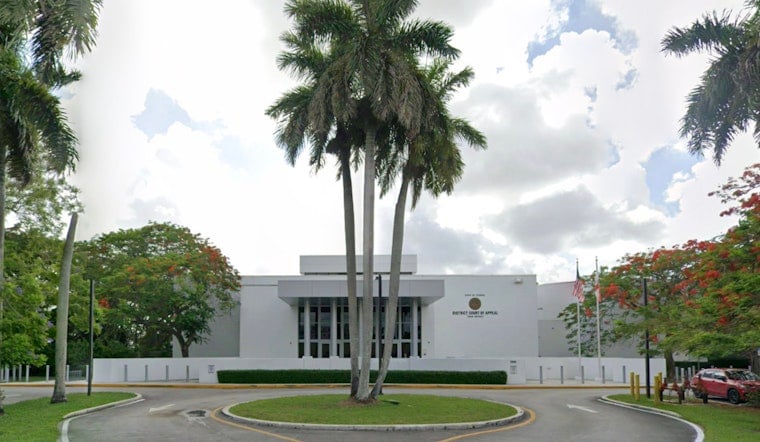
A Miami-Dade man serving an upward-departure life sentence for a 1991 sexual battery has lost his latest bid to have that sentence thrown out, after Florida's Third District Court of Appeal ruled that a recent shift in state law closed off the legal path he was relying on. Robert Alan McCartney was convicted in 2022 of sexual battery with a deadly weapon or force likely to cause serious injury, tied to an attack that happened decades before DNA technology ever caught up to it.
The underlying crime dates back to August 12, 1991, when a victim was beaten and assaulted in her bedroom in Miami-Dade County, with evidence collected at Jackson Memorial Hospital's Roxcy Bolton Rape Treatment Center, according to FindLaw. The case sat cold for nearly three decades until Miami-Dade Police Department cold case detective William Nadramia obtained an arrest warrant in 2019, leading to McCartney's arrest in Georgia that September and his extradition back to Florida later that month. DNA evidence collected during the original 1991 medical exam was finally analyzed in early 2020 by Bode Technology Group, Inc., and a March 2020 report confirmed a match to McCartney, per the same account.
A Judge's Finding Pushes the Sentence Beyond Guidelines
Following McCartney's trial on June 21, 2022, Miami-Dade Circuit Judge Alberto Milian imposed a life sentence that exceeded standard state sentencing guidelines, finding that McCartney had engaged in what the court called an escalating pattern of conduct demonstrated by increasingly violent offenses. Higher courts had already upheld McCartney's conviction and sentence once before, when Florida's Third District Court of Appeal rejected his direct appeal in October 2024, ruling that COVID-19 court suspensions justified the trial delays and did not violate his constitutional speedy trial rights, as reported by Justia.
McCartney later turned to a different legal argument, filing a post-conviction motion under Florida Rule of Criminal Procedure 3.800(a) and claiming his sentence was illegal under the U.S. Supreme Court's 2000 ruling in Apprendi v. New Jersey. That precedent generally requires a jury, not a judge, to decide any fact that increases a criminal penalty beyond the statutory maximum, according to the Tampa Free Press. McCartney did not object at trial to the judge finding the facts used to increase his penalty, but he argued afterward that the process itself was unconstitutional.
A Legal Shortcut Disappears Mid-Case
When McCartney first filed his motion, he had a real basis for hope. The 2014 Florida Supreme Court decision in Plott v. State had allowed defendants to use Rule 3.800(a) motions to challenge sentences increased through judicial fact-finding, according to CaseMine. That changed in May while McCartney's case was still pending. Judge Alberto Milian had already denied McCartney's post-conviction request in September 2025, but the ground shifted further beneath the appeal when the Florida Supreme Court decided Maye v. State on May 14, 2026, ruling that Apprendi claims are not cognizable under Rule 3.800(a) because such errors are subject to harmless-error review and do not amount to an illegal sentence, per the same commentary. The court explicitly receded from Plott in that ruling.
Rule 3.800(a) allows a court to correct an illegal sentence at any time based on the face of the record, while a separate mechanism, Rule 3.850, covers broader post-conviction claims but generally carries a strict two-year deadline from when a conviction becomes final, according to Rier Jordan P.A. With Maye foreclosing his Rule 3.800(a) argument, McCartney conceded that the new precedent applied to his case and that the denial of his request had to stand.
Appeals Panel Leaves the Door Open on a Future Motion
The Third District Court of Appeal's decision, issued Wednesday, affirmed the lower court's denial but dismissed McCartney's appeal without prejudice rather than closing the case outright. Chief Judge Edwin A. Scales III wrote the panel's opinion, with Judges Ivan F. Fernandez and Sheryl J. Bokor concurring, as detailed by the Tampa Free Press. The panel expressed no opinion on whether a Rule 3.850 motion would succeed, but noted that McCartney may still file that separate post-conviction challenge.
Assistant Public Defender Susan S. Lerner represented McCartney in the appeal, while Senior Assistant Attorney General David Llanes represented the state, according to the same report. For now, McCartney remains locked into the life sentence handed down in 2022, with his fate resting on whether a future Rule 3.850 filing can navigate the same harsh-error standards that just sank his last attempt.




