

























































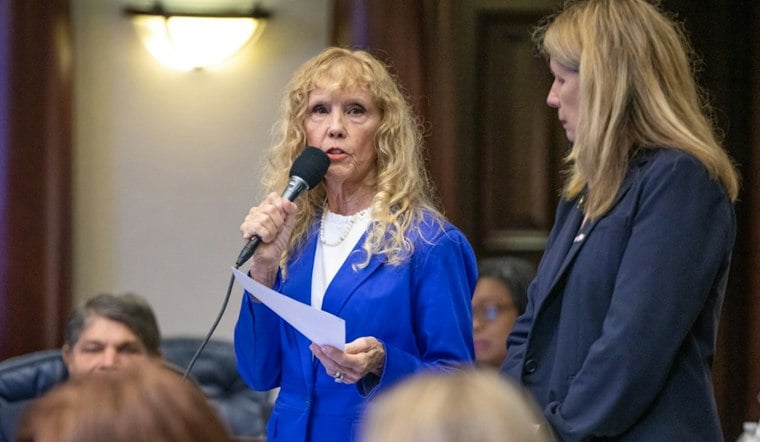
A Boca Raton man is being held without bond after police say he left a string of threatening voicemails for Florida state Rep. Peggy Gossett-Seidman, including one in which he vowed to slit her throat if her office sent him another piece of mail. Luke Schlauder appeared before a judge Friday morning on two charges stemming from the alleged threats against the Palm Beach County Republican.
According to a police report cited by WPBF, Schlauder left several threatening voicemails for Gossett-Seidman, telling her to stop sending mail and to die, and using a racial slur in the messages. Gossett-Seidman told officials she was extremely upset and feared Schlauder might try to harm her or her staff at either her home or her office, the report states. She contacted Boca Raton police, who brought in the Florida Capitol Police, and that agency referred the investigation to the Florida Department of Law Enforcement, which has accused Schlauder of making death threats against the lawmaker.
Police say Schlauder admitted to leaving the voicemails because he was tired of receiving mailers from Gossett-Seidman's office and wanted them to stop. He now faces a charge of written threats to kill or do bodily harm, a second-degree felony that under Florida Statute § 836.10 carries a maximum of 15 years in state prison, 15 years of probation, and a $10,000 fine, according to attorney Richard Hornsby.
Defense Challenges Whether Voicemails Count as Written Threats
At Friday's hearing, defense attorney Scott Simmons argued that the written-threats charge should not apply because the alleged threats were left as voicemails, not written or electronic text. That argument touches on a real statutory wrinkle: Florida's law defines electronic records to include digital text, graphics, video, and audio, but specifically excludes standard telephone calls, according to the Pumphrey Law Firm. Whether a voicemail falls on one side of that line or the other could become a central issue as the case moves forward.
Florida courts have also set a separate bar prosecutors must clear regardless of the format question. Under case law interpreting the state's threat statutes, prosecutors must prove a true threat — showing the accused communicated knowingly and that the statement would cause alarm in a reasonable person, per Hussein & Webber, PL. Schlauder remains held without bond while the case proceeds.
Who Is Rep. Peggy Gossett-Seidman
Gossett-Seidman, a Republican, was elected to the Florida House of Representatives in 2022 to represent District 91 in Palm Beach County, after previously serving on the Highland Beach Town Commission from 2018 to 2022, according to the Florida House of Representatives. During her first term in Tallahassee, she sponsored and passed eight bills, including 2024 legislation authorizing the public release of the Jeffrey Epstein grand jury files. Hoodline previously reported on her push for stronger condo elevator oversight in Palm Beach County earlier this year.
Public university records show Schlauder completed a master's thesis at Florida Atlantic University in 2024 focused on local housing issues before working in independent media. Attempts to reach Gossett-Seidman's office for comment were unsuccessful, WPBF reported.
Part of a Wider Surge in Threats Against Officials
The case lands amid a documented nationwide rise in hostility toward elected leaders. The U.S. Capitol Police Threat Assessment Section logged a record 14,938 threat cases in 2025, a nearly 58 percent increase over 2024, Hoodline has reported. Florida has seen its own string of prosecutions this year, including a Massachusetts man sentenced in September to nearly a decade in federal prison for threatening Rep. Randy Fine's sons, and an Ohio man charged in August with emailing a death threat against a Florida congressman and his family.
The multi-agency response in Schlauder's case reflects how seriously state authorities now treat threats against lawmakers. The Florida Capitol Police operate as a division within the Florida Department of Law Enforcement, providing executive protection and Capitol complex security statewide, according to FDLE. That infrastructure extends beyond Tallahassee: FDLE also coordinates seven Regional Domestic Security Task Forces that evaluated more than 6,500 suspicious activity reports in 2024 to help identify and disrupt potential violent threats across the state.




