

























































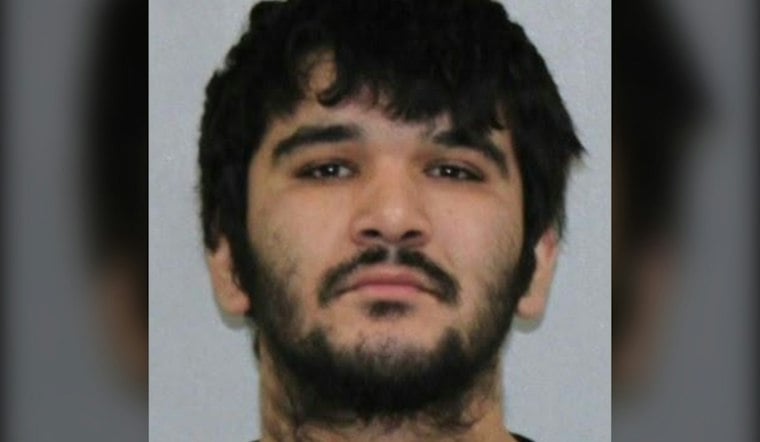
A West Palm Beach jury found 26-year-old Yoel Paredes guilty of first-degree murder on Thursday in the stabbing death of 49-year-old Jorge Mobilla Menendez, whose body turned up inside a dumpster at a senior living community in April 2022. The verdict came two months after Paredes' 56-year-old uncle, Reynaldo Paredes, was convicted of the lesser charge of manslaughter in the same killing — a split outcome that leaves the two relatives facing dramatically different futures for the same crime.
According to WPBF 25 News, Menendez's body was discovered at the Southridge Senior Community, located off Southern Boulevard and east of Interstate 95, after a resident found it while taking out the trash. West Palm Beach Police Department spokesman Mike Jachles told the station that Menendez had been stabbed multiple times before his body was dumped there. Trial evidence cited by the Palm Beach County State Attorney's Office
places the actual stabbing at Reynaldo Paredes' suburban West Palm Beach home, with the body transported and discarded in the dumpster a few miles away afterward.
Detectives traced Menendez's last known location to Las Brisas, a sports bar on Georgia Avenue, per Jachles' account to the station. Business directory records show Las Brisas operated as a Mexican restaurant and sports bar at 5201 Georgia Avenue, according to Florida.com. Surveillance video captured Menendez leaving the bar with two men, and police said all three left the area together in Yoel Paredes' car — a white four-door Mercury that was later spotted on video near the dumpster site.
A Two-Year Trail Goes Cold Before DNA Breaks It Open
Police could not make an arrest for nearly two years, struggling to find any connection between Menendez and the Paredes family, the station's report notes. The case finally moved after investigators obtained additional DNA evidence. A Spanish-speaking resident of the senior community had placed the initial 911 call at 8:49 a.m. on April 3, 2022, after discovering the body in the 3900 block of Southridge Court, according to FOX 32 Chicago, and investigators had separately pinpointed the 2003 Mercury through security footage near the dumpster.
The arrests, when they finally came in 2024, unfolded across state lines within hours of each other. The U.S. Marshals Service arrested Yoel Paredes in Freeport, Illinois, where he had relocated, while West Palm Beach police arrested Reynaldo Paredes at his Palm Beach County home three hours later, per the same Chicago television report.
Juries Reached Sharply Different Verdicts on Premeditation
Reynaldo Paredes was convicted of manslaughter on August 27, 2026, roughly two months before a separate jury found his nephew guilty of first-degree murder. That gap in verdicts carries enormous legal weight: under Florida Statute § 782.04, first-degree murder is a capital felony that, absent the death penalty, mandates life imprisonment without the possibility of parole, according to the Florida Senate. Manslaughter, by contrast, is a second-degree felony under Florida Statute § 782.07 carrying a maximum of 15 years behind bars — a statutory chasm separating the two men's exposure despite their involvement in the same death.
Circuit Court Judge Sarah Willis has set sentencing for Yoel Paredes for November 5 at 1:30 p.m. in West Palm Beach, WPBF 25 News reports, and the Palm Beach County State Attorney's Office has confirmed that Reynaldo Paredes' manslaughter sentencing is scheduled for that identical date. Assistant State Attorneys Mathri Thannikkotu and Jo Wilensky served as prosecutors.
Technology and Forensics Shaped the Investigation
The years-long gap between the killing and the arrests reflects the broader challenges investigators face in complex homicide cases even with modern tools. West Palm Beach police have since expanded their investigative capabilities, deploying a Real Time Crime Center and acoustic gunshot detection technology that contributed to a 29 percent drop in city homicides during its first full year of operation, according to SoundThinking. In the Menendez case, investigators obtained additional DNA evidence, and surveillance footage showed the Mercury; the arrests followed in early 2024.
With both relatives now awaiting sentencing on the same November day before the same judge, the case stands as a stark illustration of how two juries can reach starkly different conclusions about culpability in a single death — one man facing a mandatory life sentence, the other a maximum of 15 years.





