

























































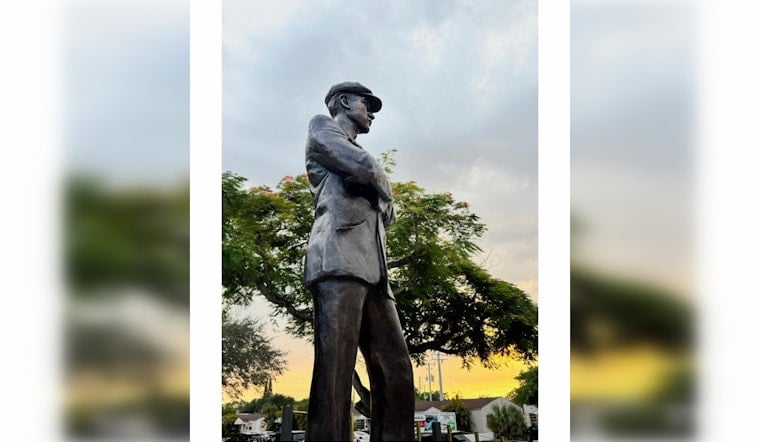
A bronze likeness of Glenn Curtiss now greets drivers entering Miami Springs, standing more than six feet tall on a pedestal at the entrance to the city he founded a century ago. The Glenn Curtiss & June Bug Legacy Memorial was unveiled on August 22, a monument built entirely with private money and shaped by a sculptor with her own roots in the neighborhood Curtiss left behind.
The memorial sits on Curtiss Parkway and pairs the 6-foot-3-inch statue with a walk-through structure spanning 42 feet 6 inches wide and 12 feet tall, dimensions chosen to echo the wingspan of Curtiss's June Bug biplane, according to Curtiss Mansion. The structure incorporates a living timeline and includes a highly stylized version of the biplane itself, per seed facts tied to the project. The entire installation, funded through roughly $300,000 in donations, sponsorships and community fundraising, was managed by the nonprofit Curtiss Mansion organization without a dollar of municipal tax money, as reported by the River Cities Gazette.
The sculptor behind the bronze figure is Natalie Plasencia, a Cuban-American artist born in Hialeah and raised in Miami Springs, according to the Miami Herald. Plasencia proposed a full monument rather than a typical public bust, and worked with her husband, architect Juan Calvo of Studio Plasencia, to integrate the design into the entry landscape along Curtiss Parkway. Calvo, who also sits on the Miami Springs Historic Preservation Board, served as the memorial's site architect, per MiamiSprings 100.
A Sculptor Whose Faith Shapes Her Work
Plasencia did not always see herself as an artist. She spent 41 years before she considered herself one, and worked as a social worker helping foster families and victims of domestic violence before dedicating herself full-time to art, according to the Miami Herald. She created her first bronze piece after the birth of her third child.
Her faith runs through how she talks about the craft. “Art for me has developed as a form of prayer,” Plasencia has said, and she has described the process in similarly personal terms: “Every sculpture I make transforms me.” Her portfolio beyond the Curtiss memorial includes a cross for Blessed Trinity Cross Church in Miami Springs, a 2021 sculpture called The Fisherman for Saint Peter the Fisherman Catholic Church in Big Pine Key, and a 2024 piece, Stella Maris, for the Basilica of Saint Mary Star of the Sea in Key West.
Plasencia has also carried her activism into bronze. She began following the activism of the Ladies in White, described as mothers and wives of political prisoners in Cuba, in 2013, and later joined activist groups in Miami advocating for democracy in Cuba. She volunteered with Cuba Decide, an organization founded by Rosa María Payá, and in 2024 created a bronze relief of Oswaldo Payá Sardiñas — a Cuban dissident described as killed by the dictatorship — for a memorial monument at Patria y Vida Square at Walker Park in Hialeah. When she is not sculpting, Plasencia practices windfoiling at Virginia Key.
Four Faces of a City Founder
The pedestal's four sides carry custom bronze relief panels depicting distinct chapters of Curtiss's life: Aviation Pioneer, Military Innovator described as the “father of naval aviation,” City Builder, and Motorcycling Legend, according to MiamiSprings.com. Long before he took to the sky, Curtiss earned a reputation as the “fastest man on earth” on January 24, 1907, riding a self-designed V8-powered motorcycle to an unofficial 136.3 miles per hour on the beach at Ormond Beach, Florida, per the Motorsports Hall of Fame. That land-speed mark reportedly stood as the fastest by any motor vehicle until 1911 and held as a motorcycle record until 1930.
Curtiss's aviation breakthrough came on July 4, 1908, when he flew the June Bug 1.6 kilometers at four miles per hour in Hammondsport, New York — a flight credited as the first public flight in the United States, per the seed facts underlying this account. That flight won the Scientific American Trophy from the Aero Club of America, which subsequently issued Curtiss U.S. Aviator License No. 1, according to Britannica. The June Bug itself had been built by the Aerial Experiment Association, an early aeronautics group founded by Alexander Graham Bell.
From Speed Records to South Florida Real Estate
Curtiss, who was born in Hammondsport, New York, and held roughly 400 patents, went on to found Hialeah in 1925 and Miami Springs in 1926, and co-founded Opa-locka in 1926 as well. Miami Springs itself was originally incorporated on August 23, 1926, when 75 registered voters gathered to establish the “Town of Country Club Estates,” before the municipality took its current name in 1930 following the discovery of freshwater springs beneath the local golf course, according to the City of Miami Springs.
Curtiss chose Southwest-inspired Pueblo Revival architecture — thick stucco walls, flat roofs, decorative vigas — as the town's defining style, drawing on his travels through the American Southwest during early aviation tours, per Miami-History. His own residence, the two-story Glenn Curtiss Mansion built in 1925, carries that same Pueblo Revival design. His wife Lena named it Dar-Err-Aha, meaning House of Happiness, and it was added to the National Register of Historic Places in 2001, according to the U.S. National Park Service. The mansion now operates as a public event venue and historic site.
Plasencia has spoken admiringly of Curtiss's restless approach to his many pursuits. “Curtiss enjoyed every project so much that it became successful,” she has said. Curtiss died on July 23, 1930, in Buffalo, New York, at age 52.
A Regional Spotlight During the Centennial Year
The unveiling capped months of regional attention on Curtiss's legacy. Miami International Airport displayed a scaled model of Plasencia's memorial in Terminal J from March 25 through August 31 as part of a centennial exhibition titled Master of the Air, Builder of Dreams: Glenn Curtiss in South Florida, according to Miami International Airport. That exhibition honored Curtiss's role in shaping three adjacent Miami-Dade municipalities — Hialeah, Opa-locka and Miami Springs — all traced back to his development work a century ago.





