

























































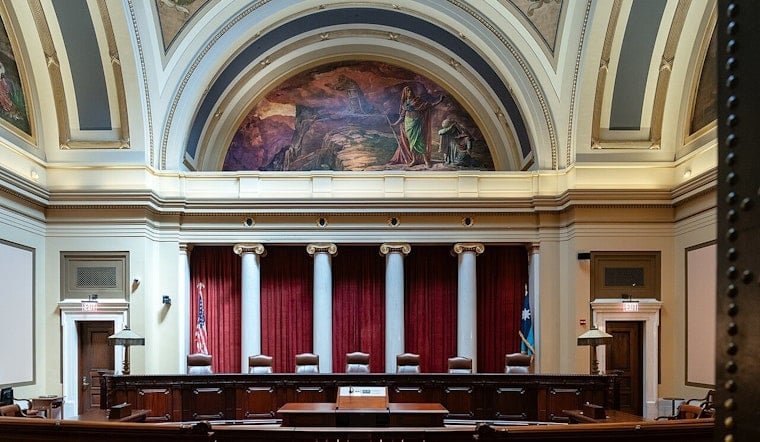
Minnesota's Supreme Court has ordered Minneapolis to staff its early voting locations with party-balanced election judges, a ruling that upends how the city planned to run its polling sites just weeks before the 2026 general election. The order, issued August 14 following oral arguments on August 4, directs the city and City Clerk Casey Carl to appoint judges affiliated with different major political parties at early voting locations rather than relying on nonpartisan municipal staff.
The case, Minnesota Voters Alliance et al. v. City of Minneapolis et al., was filed under the state's election error and omission statute, according to LAWS.com. The Minnesota Voters Alliance, represented by the Upper Midwest Law Center, argued that Minneapolis had improperly attempted to use nonpartisan city clerks and staff to run early voting sites, as reported by the Minnesota Star Tribune. The court rejected arguments from Minneapolis and the Secretary of State's Office that nonpartisan local employees could legally administer the early voting system.
What the Court Says Election Judges Must Do
The Star Tribune reports that Minnesota law assigns election judges specific duties, including checking in voters and handling ballots. The Supreme Court's order pinpointed four exact tasks the law requires election judges — not municipal staff — to perform during early voting: resolving voter status challenges under Minn. Stat. § 204C.12, administering registration vouching under Minn. Stat. § 201.061, providing ballot-marking assistance under Minn. Stat. § 204C.15, subd. 1, and delivering curbside voting services under the same statute's subdivision 2, according to Democracy Docket. The court found that the law's plain, unambiguous language requires election judges to perform these duties during early voting.
Minnesota Statutes §§ 204B.19 and 204B.21 require polling places and ballot-counting locations to maintain party balance, meaning at least two election judges affiliated with different major parties must serve at each site, with no single major party allowed to hold more than half the total judges, per the Minnesota Secretary of State. Judges who don't affiliate with a major party can still serve, but they cannot satisfy the balance requirement on their own.
A New Voting System Meets an Old Statute
Minnesota's 18-day early voting system, distinct from the state's existing in-person absentee voting method, is a product of a 2023 DFL-sponsored law intended to expand ballot access. It became fully operational statewide during the 2026 summer primary, following the Secretary of State's certification of the statewide voter registration system on May 15, per LAWS.com. Under the new system, voters can insert ballots directly into tabulators up to 18 days before an election, functioning much like Election Day voting — a sharp contrast to traditional in-person absentee voting, which begins 46 days out and requires sealing ballots in envelopes for later verification by a ballot board, according to Secretary of State guidance.
The Secretary of State's Office has said the existing in-person absentee program is administered by government staff in smaller jurisdictions, and city and state officials argued the 2023 law allowed local governments to use nonpartisan staff as early voting officials, per the Star Tribune. Emma Greenman, who helped shape the 2023 legislation, said lawmakers did not intend to require election judges for early voting and acknowledged the bill's language may not have been clear enough. DFL lawmakers behind the law said it was intended to make voting easier and more accessible, and Minneapolis and state officials argued that legislators would not have imposed a judge requirement while trying to expand ballot access.
Minneapolis Faces a Recruiting Crunch
The practical challenge now facing Minneapolis is steep. The city has historically struggled to find enough Republicans to serve as Election Day judges, and it must now hire and deploy hundreds of party-balanced judges across its early voting locations in a city where Republicans make up a small minority of registered voters, according to Democracy Docket. Minneapolis officials had warned that finding the necessary election judges would be very difficult and potentially not possible, and the city raised the possibility of closing early voting sites if it couldn't comply, per the Star Tribune.
Despite that warning, city spokesperson Jess Olstad said Minneapolis will staff its early voting locations in accordance with the ruling and has contingency plans in place, as it does for every election. The city expects to keep its planned early voting locations open and has previously recruited election judges from outside city limits to meet demand. Under Minn. Stat. § 204B.21, major political parties must submit lists of prospective judges by May 1 of an election year, and municipal city councils must formally appoint judges at least 25 days before an election — a compressed timeline that leaves little room for error once party-provided lists run dry, per the MN Revisor's Office.
Smaller Counties Say They're Ready
Not every jurisdiction is bracing for chaos. Blue Earth County, Ramsey County, Beltrami County, Morrison County, and Kandiyohi County all said they expected to be able to comply with the ruling, according to the Star Tribune. Still, the Secretary of State's Office argued that smaller jurisdictions would certainly struggle to implement the election judge requirement, and impacts across Minnesota's local jurisdictions remain unclear. Cities and counties broadly face greater difficulty offering multiple in-person early voting sites under the ruling.
Minnesota's election infrastructure has drawn national praise even amid the legal turmoil. A 2026 report from the Minnesota Office of the Legislative Auditor confirmed the Secretary of State's Office effectively maintains the statewide voter registration system, and the MIT Election Performance Index ranked Minnesota first in the nation for overall election administration, a point Hennepin County Elections Director Ginny Gelms presented to the county board.
Conservative Groups Signal More Challenges Ahead
The Minneapolis ruling is not the Minnesota Voters Alliance's only active fight this election cycle. Two days before the court's order, the group and the Upper Midwest Law Center filed an emergency petition alleging Hennepin County, Anoka County, and the City of Plymouth failed to maintain statutory party balance on absentee ballot boards, according to the Minnesota Voters Alliance. The Upper Midwest Law Center has signaled it will pursue cases against other jurisdictions that don't follow the Minneapolis precedent.
Upper Midwest Law Center's Doug Seaton said the group is very glad the court is prepared to enforce the law, telling the Star Tribune its primary intention was to enforce state law and ensure a fair process. Seaton added that if compliance requires contracting the number of locations or days for early voting, then so be it — reflecting the group's broader belief, expressed to the Star Tribune, that voting days and locations should be more concentrated. Greenman offered a starkly different view, predicting the lawsuit will curb access, especially in smaller counties with limited resources, and telling the Star Tribune the litigation is not in the interest of free and fair elections or democracy.
The dispute follows a pattern for the Minnesota Voters Alliance, which previously sued in Anoka County District Court in December 2023 in an unsuccessful bid to overturn the state's law restoring voting rights to formerly incarcerated felons — a case Hoodline covered at the time. As Minnesota's early voting system continues rolling out following Coon Rapids' tabulator rollout, cities and counties statewide now face a compressed window to sort out whether their early voting sites can meet the court's new mandate before ballots start dropping in October.





.jpg)