

























































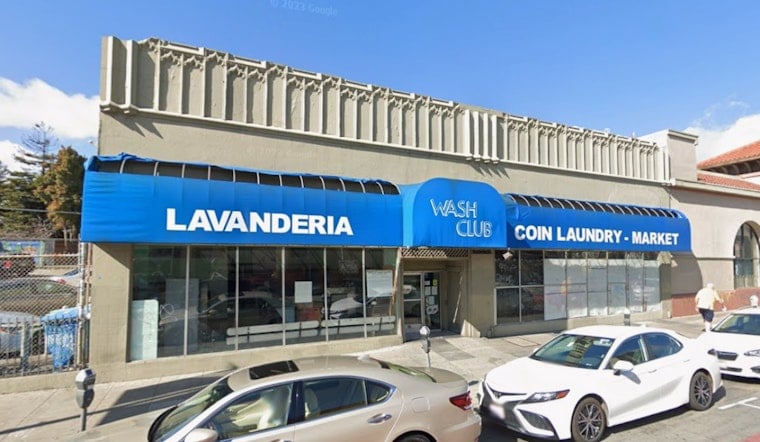
Foundation work is finally underway at 2918 Mission Street, the site of a former laundromat that spent more than a decade tangled in one of San Francisco's most notorious housing fights. Cresleigh Homes has started site preparation and foundation work for what will become a 75-unit, eight-story rental complex, with vertical construction expected to begin next year.
The property's path to this point stretches back to 2005 and 2006, when developer Richard Tillman bought the laundromat parcel for $1.75 million, according to the San Francisco Chronicle. Tillman went on to sue San Francisco over delays to the project, and told the paper his goal from the start was simply to get the property entitled so it could be sold at a higher value. He said he was willing to sue the city and challenge its political process to get there — and as the Mission Local reported at the time, that August 2018 abuse-of-discretion lawsuit against the city led the Planning Commission to approve the project's entitlements two months later during closed-door settlement talks.
By the time the city signed off on the project in 2018, Tillman had spent roughly $1 million in legal and planning costs over five years, per the San Francisco Standard. He sold the entitled site to Cresleigh Homes in April 2019 for $13.5 million — about $180,000 per buildable unit — and told the Chronicle he figured the sale price was probably twice what the property would have been worth without the entitlements. Cresleigh Homes acquired the site that same month, and the company's leader, Lawrence Lui, told the paper the project can help San Francisco build its way out of the housing crunch, according to Patrick Hannon.
A Building Tied Up in Shadows, History and Politics
The delays that made 2918 Mission a citywide flashpoint were not simple bureaucratic hiccups. In 2018, San Francisco required Tillman to pay for a 137-page, $23,000 historic evaluation of the building, which ultimately found it was not a historic landmark despite its use as a hub for Mission District organizing in the 1970s. The former Wash Club laundromat had been home to the Mission Child Care Consortium, the Mission Housing Corporation and the Mission Hiring Hall, and it operated as a center for Latino community organizing between 1971 and 1985.
Even after the historic-status question was resolved, the Board of Supervisors voted 11-0 in June 2018 to indefinitely delay the project, demanding a specialized study of shadows the building might cast on the playground at Zaida T. Rodriguez Early Education School — this despite the Planning Department's own determination that the shadows were not legally significant under state environmental law. Opposition to the project was led by groups including the Calle 24 Latino Cultural District Council and the Plaza 16 Coalition, which filed environmental appeals arguing that market-rate development like this one accelerates gentrification and displacement of Latino residents in the Mission.
State Law Broke the Stalemate
Tillman ultimately prevailed by leaning on state housing law rather than local goodwill. He used California's State Density Bonus Law and the Housing Accountability Act to bypass local discretionary review, allowing the project to add height and units while setting aside eight units, or about 10.6%, as affordable housing under statutory rules, according to Mission Local's earlier reporting on the case. The fight became prominent enough that California Attorney General Rob Bonta cited the multi-year 2918 Mission permitting saga in 2022 as an example of San Francisco's bureaucratic housing dysfunction, as the state investigated the city's land-use practices, the Standard reported.
The original laundromat building was demolished in spring 2022 after the city issued a demolition permit that April, The Real Deal reported, but the lot then sat vacant for years before any vertical construction began. As designed by architecture firm Gould Evans, the approved building will stand 84 feet tall at 67,070 square feet, with 75 apartments, 6,960 square feet of ground-floor retail, a second-level communal deck, 76 bicycle parking spaces and a public mural space on the north facade facing 24th Street BART, according to SF YIMBY.
Part of a Broader Wave of Mission Housing
Cresleigh's Lawrence Lui has built more than a dozen hotels and roughly 3,000 housing units, and he told the Chronicle he hopes this project can help San Francisco build its way out of its housing shortage. The company is redeveloping the former laundromat site as part of a broader push of Mission District housing activity: the first phase of a 382-unit affordable project is underway at the 16th and Mission BART station, a site that was originally proposed for about 300 luxury condos.
Elsewhere in the neighborhood, San Francisco acquired 1515 South Van Ness for $19 million and revised that project's plan from 160 mostly market-rate units to 168 affordable apartments, with construction breaking ground last year. Tillman told the Chronicle he hopes the 2918 Mission project will ultimately be built and help transform the neighborhood. The Mission has lost 8,000 families since the late 1990s, but the paper notes the district will also see more than 1,200 affordable units built since Tillman first filed his application back in 2014.
San Francisco is under a state mandate to plan for 82,069 new housing units in the current Regional Housing Needs Allocation cycle running through 2031, including more than 46,000 units for low- and moderate-income residents, according to the City of San Francisco. Against that backdrop, the 75 apartments finally rising at 2918 Mission Street represent a small but symbolically loaded piece of a much larger, state-driven push to get housing built across the city.





