

























































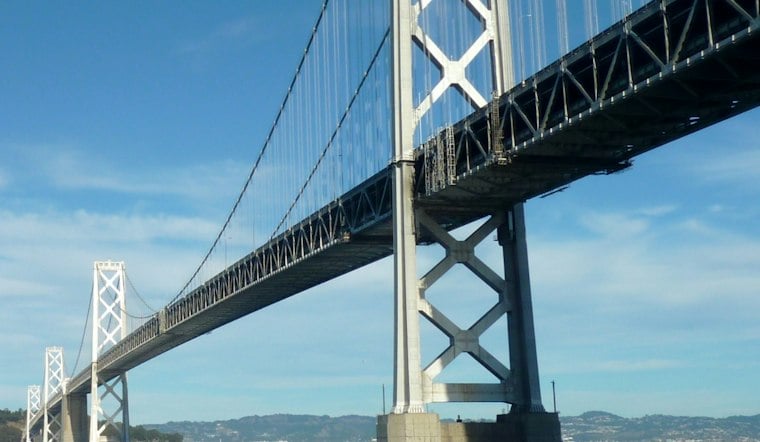
Drivers approaching the Bay Bridge from the MacArthur Maze have a habit of ducking into the lane reserved for buses, and this month the California Highway Patrol decided to do something more concentrated about it. Working with Caltrans and the Bay Area Toll Authority, CHP has resumed a focused enforcement campaign on the bridge approach, aiming to stop motorists who treat the bus-only lane like a personal shortcut around the rest of the traffic.
The lane in question, which can be reached from Interstate 80, Interstate 880 or West Grand Avenue, is not a free-for-all even during commute hours, according to a statement carried by PR Newswire. Buses, motorcycles and carpools with three or more occupants may legally use it between 5 a.m. and 10 a.m. and again from 3 p.m. to 7 p.m. on weekdays. Outside those windows — including all day Saturday and Sunday — only buses are allowed in, with signs at the access points reading simply Buses Only. Solo drivers hoping to coast through on an old clean-air vehicle decal are also out of luck, since that carpool-lane privilege expired the previous year, according to the San Francisco Chronicle.
Get caught breaking the rule outside commute hours and the fine starts at $490, per the same PR Newswire statement. The Bay Area Toll Authority is partially funding CHP officer overtime for the operation, the Chronicle reports, a detail that underscores how much institutional weight is behind this particular squeeze on the MacArthur Maze bottleneck, where Interstates 580, 80 and 880 all funnel into one toll plaza.
One Officer, Five Stops, a Flood of No-Shows
How thin that enforcement actually stretches became clear in reporting from the San Francisco Chronicle, where reporter Rachel Swan described CHP Officer Jorge Rodriguez pulling over five drivers during a 50-minute detail on the bridge approach — while roughly 100 other motorists slipped past him and evaded enforcement entirely. Rodriguez reportedly observed a scofflaw entering the bus-only ramp about every 20 seconds, a pace no single officer can realistically intercept, especially since each traffic stop can eat up more than 10 minutes.
That math is not lost on the people who study these lanes for a living. Andrew Barclay has said that for every driver an officer manages to stop, many more simply drive past while that stop is happening. Nick Josefowitz has criticized the broader strategy of leaning on individual officers to chase down HOV lane cheaters, arguing the approach cannot keep pace with the volume of violators. Not everyone wants the crackdown softened, though — Jose Contreras has said there should be real consequences for drivers who simply refuse to follow the rules, and Steve Jarquin said he noticed patrol vehicles stationed in the bus lane while crossing the Bay Bridge on a recent Saturday.
Behind the Numbers: A Familiar Bay Area Problem
This is not the first time regional officials have tried to measure just how many drivers are cheating. A 2016 study by the Metropolitan Transportation Commission found that 24% of vehicles in Bay Area carpool and bus lanes lacked the required number of passengers during the morning commute, and 19% fell short during the evening rush, according to SFGate. Caltrans has separately estimated that cheaters could make up as much as 39% of vehicles in a diamond lane during peak hours, while local transportation experts put the average closer to 19% to 24%, per the Mercury News.
Regional agencies have spent years trying to find a technological fix. MTC tested passenger-counting camera equipment in 2018, then decided it was not ready for broad rollout, and in 2023 it enrolled 500 volunteers in a pilot of a facial-geometry app designed to confirm how many people were actually in a car, with plans to delete each trip's data afterward, according to the same Mercury News reporting. Systems from vendors including Indra, Conduent and TransCore were also tested on Interstate 880, correctly identifying vehicles between 78% and 88% of the time but generating false positives 5% to 6% of the time — accurate enough to raise interest, but shaky enough to raise doubts.
Cost, Legal Hurdles Keep Cameras on the Sidelines
Money has been as much of an obstacle as accuracy. MTC estimated that manually reviewing flagged images before mailing out citations would cost the commission roughly $3 million a year, and each camera installation was pegged at $1.5 million for a single location, not counting other infrastructure or maintenance, per Mercury News figures. John Goodwin has said any technology deployed for this purpose needs to be effective, cost-effective and anonymous, while still protecting driver privacy — a high bar that has so far kept cameras from replacing officers on Bay Area freeways. California law may also need to change before any automated system could issue a citation without an officer present.
For now, the fallback remains people in patrol cars. The California Highway Patrol is broadly tasked with enforcing HOV lanes statewide, with a stated goal of keeping violation rates below 10%, according to Caltrans. MTC has committed up to $25,000 in bridge toll revenue specifically to fund CHP overtime for this operation, which is focused on Friday afternoons and weekends and is scheduled to run through October 4, though CHP has said it may extend the effort beyond that date. The agency has not disclosed a detailed official enforcement schedule beyond that window, and officers continue to cite carpool lane violators during their regular daily patrols in the meantime.
What Drivers Can and Cannot Do Legally
State law does carve out some room for drivers who find themselves in the restricted lane unintentionally. Under California Vehicle Code section 21655, the lane restriction does not apply to a driver who is preparing for a left- or right-hand turn, entering or exiting the highway, or who must use another lane to continue toward their intended route, according to the California Legislative Information site. CHP's stated aim with the current push, per the PR Newswire release, is not just to hand out tickets but to change driver behavior over time through greater visibility and consistent citations along the Bay Bridge approach.


