

























































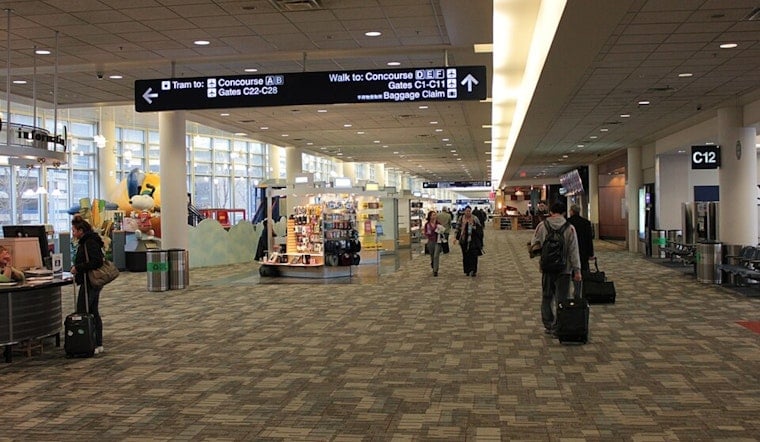
All departures from Minneapolis-St. Paul International Airport were halted Thursday afternoon after a regional Federal Aviation Administration equipment outage knocked out air traffic control capacity, with the ground stop taking effect around 2 p.m. and stretching until 4:15 p.m. Arriving flights were also limited during the disruption, leaving travelers stranded at gates across the country as the Twin Cities hub ground to a standstill.
An airport spokesperson said the shutdown stemmed from a "regional FAA air traffic center equipment outage," a detail confirmed as officials worked to explain the sudden halt, according to CBS Minnesota. Aviation news site Bring Me The News reported that Thrifty Traveler traced the failure not to MSP itself but to the Minneapolis Air Route Traffic Control Center, known as ZMP, roughly 20 miles south in Farmington, Minnesota.
That distinction matters because ZMP does not manage MSP's runways directly — it oversees high-altitude, en-route airspace across a much wider swath of the Midwest. The facility is one of 22 FAA Area Control Centers nationwide, responsible for 330,000 square miles of airspace spanning nine Midwest states and staffed by nearly 300 air traffic controllers, according to background compiled by Wikipedia. When a facility that large stumbles, the fallout doesn't stay local.
Ripple Effects Reached All the Way to D.C.
Passengers on social media reported that the outage forced ground holds on MSP-bound flights at airports far outside Minnesota, including Reagan National Airport in Washington, D.C., per the same Bring Me The News account. That kind of distant ripple effect is a hallmark of en-route control center failures, since a single facility like ZMP can influence flight paths well beyond its home state's borders.
The scale of potential disruption at MSP is significant on an ordinary day, let alone during an outage. The airport handled more than 36 million passengers and 342,673 aircraft movements in 2025, according to Wikipedia's entry on the airport. Delta Air Lines and its regional affiliate Endeavor Air account for roughly 65% of all passenger traffic at MSP, running approximately 330 peak daily departures from the hub, per data cited by Skyscanner — meaning any halt at MSP disproportionately hits Delta's schedule.
Not the First Time an FAA System Has Buckled
Thursday's outage echoes a broader pattern of technical vulnerabilities across the national airspace system. During a nationwide FAA NOTAM system failure in January 2023, MSP experienced dozens of delayed flights before workarounds were put in place. And the disruption isn't unique to Minnesota's control infrastructure — an equipment failure at the Potomac Consolidated TRACON in March 2026 triggered similar departure holds across multiple major airports in the Washington, D.C. metro area, as Hoodline reported at the time.
Thursday's shutdown stands apart from MSP's more routine disruptions. An earlier ground stop hit the airport in April 2026 due to severe morning thunderstorms moving through the Twin Cities metro area — a weather-driven halt of the kind aviation officials consider a standard safety measure. Under FAA protocols, a ground stop is an immediate traffic-management tool that holds inbound aircraft at their origin airports once destination airspace capacity drops to zero, a mechanism designed to prevent dangerous oversaturation rather than to punish travelers.
What remains unclear is how quickly the FAA will restore full system redundancy at the Farmington center and whether the backlog from Thursday's halted departures and limited arrivals will linger into Friday's schedule. For now, travelers moving through MSP are left watching departure boards and hoping the fix holds.





