

























































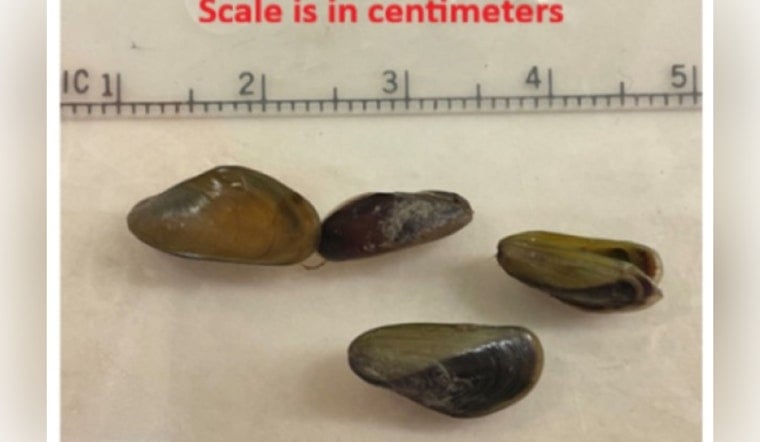
A boat covered in invasive golden mussels was stopped before it could ever touch the water at Folsom Lake, one of Northern California's busiest recreation spots with more than 2 million visitors a year. The vessel had come from the Sacramento-San Joaquin Delta and was headed north to Oregon, but its stop at a decontamination site outside Folsom put those plans on hold.
The boat arrived at Mello Marine in Folsom, where workers found clusters of golden mussels clinging to the underside of the hull, according to the New York Post. Sally Mello, whose team runs the site, said mussels covered the bottom of the boat and that her crew was encountering the species for the first time this year. Mello Marine has decontaminated roughly 6,000 boats since 2025, and this was the one that finally tested positive.
Under district orders from California State Parks enacted in 2025, every trailered or motorized boat launching at Folsom Lake or Lake Clementine must carry either a red quarantine seal, showing it sat unused for 30 days, or a green seal proving it underwent certified hot-water decontamination. Mello said the boat had followed the mandatory inspection and decontamination protocols on its way through, but the mussel-covered hull still triggered mandatory decontamination and tagging before any launch could happen. The vessel now faces a full decontamination and a 30-day quarantine before it can return to any waterway.
A Species California Has Never Seen Before 2024
Golden mussels, scientifically known as Limnoperna fortunei, are an inedible invasive species that attach to hard surfaces such as pipes, pumps, and other infrastructure. They were first detected in North America at the Port of Stockton in October 2024, when California Department of Water Resources staff spotted adult specimens clinging to water-monitoring equipment in the Sacramento-San Joaquin Delta, according to the California Department of Fish and Wildlife. The species had never before been documented in North American waterways.
Since that discovery, the mussels have pushed steadily north through the Delta. State wildlife officials logged the northernmost detection yet on June 25, 2026, after genetic testing confirmed specimens gathered near the Port of West Sacramento and Washington Lake, the department reported. That location sits directly along the river corridor connecting the Delta to Sacramento-area reservoirs, putting Folsom Lake squarely in the path of the infestation. A golden mussel was also found on a boat at Folsom Lake last year, according to the Post, meaning this is not the reservoir's first close call.
Why This Species Worries Water Managers More Than Others
Golden mussels raise concerns about damage to water delivery systems, agriculture, and the surrounding environment. Once established in a waterway, they are nearly impossible to eradicate, and they build up pollutants, toxins, and dangerous bacteria in their tissues. Unlike zebra and quagga mussels, golden mussels tolerate broader temperature ranges, lower calcium levels, and even brackish water, and their intensive filter-feeding promotes toxic Microcystis blue-green algal blooms that can compromise drinking water and harm sport fisheries, per the Department of Fish and Wildlife.
The species is native to freshwater rivers in China and Southeast Asia and was accidentally introduced to South America in the 1990s through international ship ballast water. It quickly encrusted hydroelectric turbines and municipal pipelines across the Paraná and Uruguay river basins, according to the North American Invasive Species Management Association. South American utility operators suffered severe power generation losses and pipe blockages once the mussels took hold, a warning sign for California officials watching the Delta.
Regional Governments Scramble as Colonies Spread
The alarm has already reached local government chambers. San Joaquin County declared a local emergency in April 2026, Sacramento County followed in June, and Yolo County did the same in July, as golden mussel colonies began clogging municipal and agricultural water intake screens across the Delta, Hoodline reported. Those emergency declarations let the counties bypass standard procurement rules to clear fouled infrastructure faster.
Part of what makes the mussels so hard to contain is that they spread through microscopic, free-swimming larvae called veligers, which can drift in the water column for weeks and survive undetected in boat bilges, bait buckets, and ballast tanks. Because they are invisible to the naked eye, boater compliance with drain-plug and inspection rules has become critical to slowing the spread. The California Department of Fish and Wildlife was notified of the boat's contamination at Mello Marine and is likely to inspect the vessel this week.
Lawmakers Widen Enforcement as Checkpoints Multiply
Sacramento is also moving on the legal front. The California Legislature passed AB 149 in 2025 to expand statutory invasive mussel enforcement laws beyond zebra and quagga species to include golden mussels, and in June 2026 the California State Senate Judiciary Committee considered legislation to fund a statewide vessel tracking database and standardized inspection checkpoints. Existing Fish and Game codes had originally only referenced quagga and zebra mussels, leaving a gap that lawmakers are now trying to close.
The Folsom interception is not an isolated success. Aquatic inspectors at the Meyers checkpoint near Lake Tahoe intercepted a trailered vessel from infected waters carrying four live golden mussels in June, subjecting it to hot-water decontamination before allowing entry, Hoodline reported at the time. Authorities have also fined a boater $5,000 at Lake Tahoe for tampering with an inspection seal, underscoring how seriously officials are treating the tagging system meant to keep contaminated vessels out.
Mello said golden mussels are not yet in Folsom Lake but would cause a serious problem if they ever get there, echoing the concerns driving emergency declarations across the region. The Department of Water Resources, Department of Fish and Wildlife, and State Parks published a joint Golden Mussel Response Framework in April 2025 to coordinate interagency monitoring, facility protection, and reciprocal vessel-banding protocols across the State Water Project, an effort meant to standardize inspections at public and private marinas statewide. For now, the boat that almost reached Folsom Lake sits under quarantine, a reminder of how much recreational boat traffic between the Delta and inland reservoirs continues to test that system.


