

























































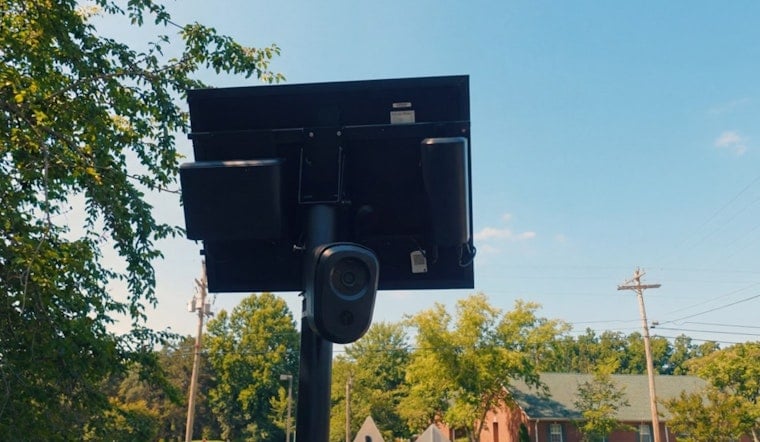
While Metro Nashville spent years arguing over whether police should get automatic license plate readers at all, Nashville International Airport quietly installed at least 10 of the AI-powered cameras and plugged them into a nationwide surveillance network that has been searched hundreds of thousands of times this year alone. The cameras capture the plates and other details of thousands of cars passing through the airport every day, and the data has flowed far beyond airport property.
According to the Nashville Banner, the Metropolitan Nashville Airport Authority contracted with Flock Safety to install the cameras, and the resulting data is accessible to airport Department of Public Safety officers as well as, through Flock's broader network, thousands of law enforcement agencies across the country. The Banner reports that Tennessee police departments and sheriff's offices alone conducted more than 75,000 searches of Nashville airport LPR data, while airport police themselves conducted nearly 2,500 searches. That volume stands in sharp contrast to the yearslong public fight over letting Metro Nashville Police Department use the technology at all — a fight the airport authority never had to wage because it operates its own independent police department, per the Banner's reporting.
An Airport Authority That Answers To No Council Vote
Metro Nashville's own path to license plate readers was slow and contentious by design. Metropolitan Nashville Code Section 13.08.080 requires that any new electronic surveillance technology deployed on public rights-of-way get explicit Metro Council approval, and the council took that seriously: members voted 22-14 in February 2022 just to launch a pilot program, then spent more than 15 months debating before voting in August 2023 to grant full implementation, according to the Nashville Scene. That six-month pilot, run between February 2022 and July 2023, verified 1,316 system hits, led to 79 traffic stops, and helped recover 80 stolen vehicles with 63 arrests, numbers supporters cited while pushing for the technology's expansion.
The airport authority, by contrast, signed its Flock Safety contract without that same layer of council deliberation, since it operates as its own governmental entity with an independently operating police department. Metro police still lack a contract with Flock Safety altogether and, per the Banner, do not have direct access to Flock's LPR network — though the department has used LPRs from private owners or neighboring counties to assist investigations, and Kris Mumford told the outlet that MNPD has rarely asked airport police to search the network on its behalf.
Tens Of Thousands Of Outside Searches
The reach of the airport's cameras extends well beyond Nashville. The Banner's review of audit logs found searches from agencies including the University of Tennessee Police Department, which logged a search labeled alcohol offenses in June, and Murfreesboro police, who searched the network in May for a person wanted on an arrest warrant — a search that included the name of a Nashville police sergeant. Officers in White County, Hendersonville, and Memphis all logged queries labeled disturbing public peace/riot and disorderly conduct in June, while airport police themselves searched a case labeled alcohol offenses/non-DUI in June and another labeled welfare check back in February.
Some of the logged searches were tied to immigration cases, including one in Sevierville, even though Flock Safety has said it does not directly share LPR data with Immigration and Customs Enforcement. As reported by 404 Media, local law enforcement agencies effectively act as a side door into Flock's nationwide network, a dynamic that lets far-flung agencies tap into cameras like the ones at BNA without needing their own contract with the company.
Researcher Warns Of A Democracy Problem
Ed Vogel, a researcher and advocate involved in the nationwide Deflock movement, reviews public records to map how license plate readers are deployed and used. He told the Banner that ALPR contracts are often signed with little public disclosure, and argued the fights over the technology are fundamentally about democracy. Vogel said Flock's tools — including a lookup feature that shows a plate's recent location history from nationwide camera readings and a freeform search that lets users describe a vehicle in plain language, down to a white sports car with a racing stripe or a red pickup with a dog in the bed — can reveal people's daily habits and patterns. He said meaningful guardrails may simply be impossible for a surveillance network of this scale.
Those concerns aren't hypothetical. Officers around the country have been charged or accused of abusing Flock network access to stalk or spy on women, according to the Washington Post. Flock's custom hot list feature, which lets users add a suspect's plate to a list and receive alerts when it passes a camera, adds another layer of tracking capability to a system that already operates at enormous scale — Flock Safety runs cameras across more than 5,000 communities in 49 states and processes over 20 billion vehicle scans per month nationwide, according to Wikipedia. The company closed a $207.92 million funding round in March, reaching an $8.4 billion valuation.
Airport Officials Defend Their Safeguards
Airport officials maintain their policies are strict. Nashville airport policy limits LPR use to the furtherance of criminal investigations and prohibits officers from using the equipment or database records for any other reason, per the Banner's report. DPS members gain access only through supervisor approval, after which a system administrator creates their login, and training covers login procedures, two-factor authentication, system capabilities, search parameters, query specificity, and the Flock Safety interface itself. Users must enter an offense type and case number before running a network search. Charlotte Weatherington said the airport's strict data rules block improper searches.
Even so, the retention practices diverge sharply from state baseline law. Tennessee Code Annotated § 55-10-302 caps routine ALPR data retention at 90 days for governmental entities unless the data is tied to an ongoing criminal investigation, and Flock Safety itself stores cloud data for just 30 days before deletion. Nashville airport policy instead requires officers to transfer each shift's captured data to internal servers, where it is stored for a minimum of three years — a policy the same state statute does not appear to constrain in the way it does routine public retention. Separately, Tennessee Code Annotated § 10-7-504(a) classifies captured license plate data, including GPS coordinates and photographs, as confidential, exempting it from public records requests and limiting outside oversight of exactly how the data is used.
Part Of A Wider Regional And National Debate
Nashville's airport cameras are hardly the first in Middle Tennessee. Suburban departments in Mt. Juliet, Brentwood, and Belle Meade deployed license plate readers years before Metro Nashville even began its pilot, according to The Vanderbilt Hustler, creating a regional surveillance footprint that crosses county lines well before the city itself joined in. That patchwork has drawn scrutiny beyond Tennessee: federal Representative Thomas Massie introduced legislation in July that would block federal grant funds from going to police departments or municipalities that use Flock Safety camera networks, as Hoodline reported in its earlier coverage of the bill.
The airport's traffic volume alone helps explain the scale of data involved. Nashville International Airport handled a record 24.7 million travelers in Fiscal Year 2025 and hit a single-day record of 110,000 passengers on June 22, 2025, according to the Metropolitan Nashville Airport Authority. With that much vehicular traffic funneling past the cameras daily, the debate over who can search the resulting data — and for how long it's kept — is likely far from settled.





