

























































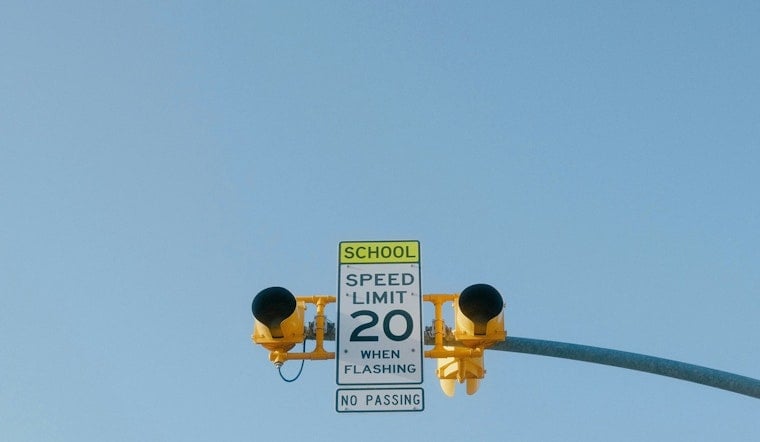
Jill Monk has stood at the crosswalk at 11th Street and Bryan Street for Dupont Elementary for 20 years, and she says the biggest danger to the kids she guides across the street isn't a lack of stop signs or flashing lights — it's drivers who simply won't slow down. Some vehicles blow through the school zone at speeds between 25 and 50 miles per hour, even with children crossing.
Monk's post is one of more than 100 crossing guard positions Metro Nashville Public Schools stations at crosswalks across Davidson County, according to WSMV. But the district is currently working to fill 33 unfilled crossing guard positions, a shortage that has forced some guards to work double shifts covering both elementary and middle schools, per the same report.
Sgt. Edward Holden, who leads the Metro Nashville Police Department's School Crossing Guard Section, said that in a perfect world, every elementary and middle school crossing guard post would be staffed. Holden was appointed to the role in May after longtime section head Sgt. Mark Denton retired, and he has urged drivers to remain patient in school zones rather than risk hurting someone. His message to motorists running behind schedule: accept being late instead of rushing and possibly injuring a child.
A Job With Deep Roots and Modest Pay
The crossing guard section Holden now supervises traces back to 1951, giving Metro Nashville Police roughly 75 years of experience managing student crosswalk safety, according to Nashville.gov. Starting pay for the civilian MNPD employees is $21.79 per hour for 15 hours a week, with a guaranteed minimum of three hours per working day, plus end-of-year bonuses and paid snow days, the city notes.
Despite the pay and benefits, the district is still short-staffed as it works to fill those 33 open positions across the county. Monk, for her part, said more students this year are using the crosswalks and following guards' directions, even as she reported that some drivers still are not paying attention to school-zone safety warnings.
What's at Stake for Drivers Who Ignore the Rules
Tennessee law gives officers real teeth to enforce school-zone caution. Under the state's Hands-Free Law, drivers caught holding a mobile device while driving through an active school zone face an enhanced $200 fine and three points on their license, according to The Higgins Firm. Excessive speeding through a school zone can go further still, potentially triggering reckless driving charges punishable by up to six months in jail, a $500 fine, and six points on a license, per Stillman & Friedland.
Students at Dupont Elementary already know the drill: don't cross until the guard has stopped traffic on both sides. That layer of human judgment matters, because national research from the Safe Routes to School Program shows more children are struck by motor vehicles near schools than in any other location, according to the Clarksville Police Department.
Infrastructure Upgrades Meet a Persistent Behavior Problem
Nashville has poured resources into the physical side of school zone safety in recent years. Between summer 2024 and mid-2025, the Nashville Department of Transportation installed standardized upgrades — radar speed feedback signs, flashing beacons, and “SLOW SCHOOL ZONE” pavement markings — across 31 Metro schools, prioritizing corridors identified under the city's Vision Zero high-injury street program, per Nashville.gov. Those additions join the existing mix of cones, stop signs, flashing lights, and crossing guards already deployed at school zones.
The stakes for young pedestrians remain significant even as the infrastructure expands. Davidson County recorded 4,629 motor vehicle crashes involving people under 18 in 2024, with peak collision times falling between 5 p.m. and 9 p.m., according to the city's Safe Routes to School data. Citywide, overall pedestrian fatalities dropped to 17 in late 2025, a 34% decline from 26 in 2024, reflecting broader progress under Vision Zero, per footage reported by WSMV.
Metro Nashville Public Schools is now in its second week of the 2026-2027 school year, which began August 6 with newly approved start times — 8:10 a.m. for elementary schools and 7:25 a.m. for high schools. With traffic patterns shifting around those new schedules, Monk and her colleagues remain, for now, the one line of defense that can look a driver in the eye and ask them to stop.





