

























































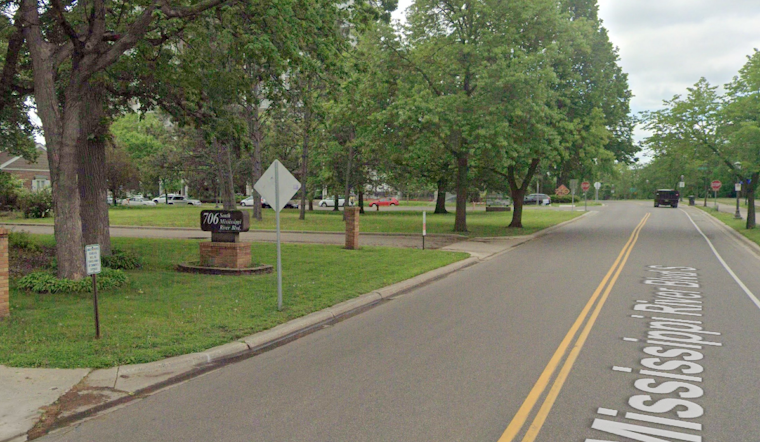
A plan to build a 91-unit apartment complex on Mississippi River Boulevard in Highland Park is now in the hands of the Saint Paul City Council after neighbors appealed the city's approval, arguing the four-story building is too big for the site and that the developer timed its filing to dodge stricter new height rules along the river gorge.
The appeal, filed by Kurt Klussendorf, challenges Saint Paul's approval of Paster Properties' site plan for 706 S. Mississippi River Blvd., where a church and an 18-unit apartment building once stood. As reported by the Villager, the church has already been torn down, and the proposed building would rise 50 feet and stretch more than 200 feet long on a site that abuts the National Park Service's Mississippi National River & Recreation Area reserve along its entire western border.
Klussendorf's appeal argues the site plan is inconsistent with the city's required plan-approval factors, which include preservation of unique geologic and historically significant city characteristics, protection of environmentally sensitive areas, preservation of views, light and air, and sound and sight buffers, according to the Villager's account of the filing. Appellants say the development would have an outsize impact on neighboring parklands, their uses, and the views from the Mississippi River Gorge Regional Park, which they describe as a unique, well-preserved and heavily used green space within Saint Paul.
A Years-Long Fight Over Size and Timing
The project is not new to the neighborhood. Paster Properties first presented the multi-unit housing proposal to the Highland District Council's Community Development Committee back in July 2022, telling neighbors at the time that the 91-unit project would require no zoning variances. Neighborhood advocates were already raising alarms that fall, pointing to the project as an example of developers replacing older, relatively affordable housing with new luxury units to sidestep exemptions built into Saint Paul's 3% rent control ordinance, according to a Saint Paul Pioneer Press report cited by GeneForPeople.org.
Appellants say the developer had ample time to begin work under a previously approved site plan, since Saint Paul site plan approvals expire after two years. Instead, appellants contend Paster Properties filed a second, similar site plan just before new Mississippi River Corridor Critical Area height limits took effect. The city adopted its updated MRCCA regulations in January 2026, and appellants argue Saint Paul's 2040 comprehensive plan had predicted the update would occur back in 2021.
Why the Ordinance Timing Matters
Saint Paul's delay in adopting the new rules was substantial. The city council did not officially approve its updated MRCCA ordinance until December 10, 2025, making Saint Paul the last of 25 metro-area Mississippi River municipalities to finalize the state-mandated regulations, according to Friends of the Mississippi River. That nearly five-year gap between the state deadline and the city's action is central to the appellants' argument that the developer took advantage of regulatory delay to lock in older, less restrictive height standards.
Minnesota's MRCCA rules set customized height limits by river district, keeping buildings shorter along the Mississippi River Gorge specifically to protect scenic views, while leaving downtown height limits unrestricted, per Friends of the Mississippi River. Klussendorf has said the development's size and scale are incompatible with the characteristics of the Mississippi River corridor, and appellants have criticized the city's late adoption of the new MRCCA regulations as the reason the older, more permissive standards were still on the books when the developer filed.
What Happens Next
Under Section 61.702 of the Saint Paul Legislative Code, the city council has the authority to hear and decide appeals alleging errors in fact, procedure, or findings made by the Planning Commission, provided the appeal is filed within 10 days of the commission's decision. The Saint Paul Planning Commission is set to hear the appeal on August 28 at City Hall, after which the matter would move to the full council for a final vote.
Because Minnesota Statute § 462.354 and the city's zoning code place final authority over land-use site plan appeals exclusively with the city council, the mayor holds no veto power over whatever the council decides. Friends of the Mississippi River has noted that the council's upcoming decision will set a notable precedent for how Saint Paul balances grandfathered site plans against its newly enacted critical area riverfront protections.
The stakes extend beyond one Highland Park lot. Saint Paul contains 17 miles of the Mississippi River and 26 miles of shoreline within city limits — the longest stretch of any municipality in the Critical Area — and shares boundaries with the federal Mississippi National River and Recreation Area established by Congress in 1988. Regional conservation groups estimate that up to 50 million migratory birds pass through Ramsey County each season, a statistic that has pushed groups like Friends of the Mississippi River and Audubon Minnesota to push for bird-safe building designs and height limits near the river corridor.
Paster Properties, the developer behind the proposal, has also been active elsewhere in the Twin Cities, having acquired the 70-year-old Golden Valley Shopping Center for roughly $17.5 million in 2025, a deal Hoodline previously covered when new tenants moved into the repositioned center. Whether the company's Highland Park plans survive the council appeal now depends on how far the city is willing to stretch its old rules for a project that predates them.



