

























































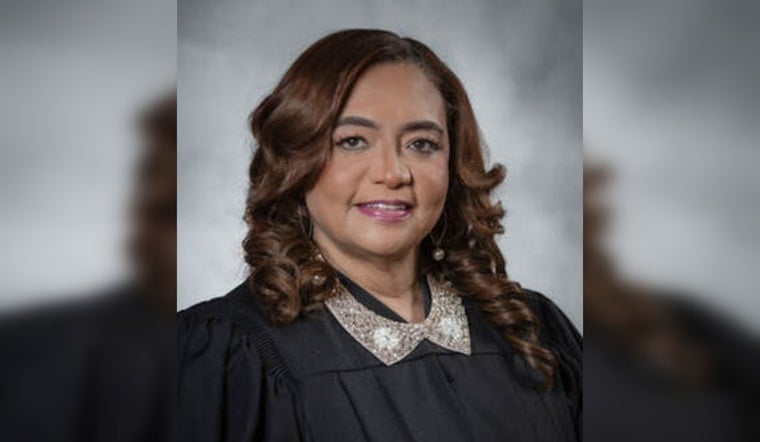
New Orleans Criminal District Court's chief judge, Juana Marine Lombard, is fighting to stay on the ballot after a fellow candidate for magistrate judge filed a legal challenge claiming she falsely certified that she filed her state tax returns for the past five years. The challenge centers on a Louisiana Department of Revenue letter, dated August 11, that reported no record of Lombard filing a state return for the 2023 tax year.
The case was filed by New Orleans attorney Chanel Robinson DeBose, who appears to be making her first run for public office, according to NOLA.com. DeBose qualified near the end of the three-day qualifying period to run against Lombard, then filed the challenge claiming Lombard falsely certified on her candidacy paperwork that she had filed state tax returns for each of the previous five years. New Orleans policy advisor Jackson Voss, who works in government affairs for the Alliance for Affordable Energy, joined the challenge as a co-plaintiff.
Under Louisiana Revised Statute 18:492(A)(7), a candidacy can be challenged if a candidate falsely certifies on their notice of candidacy that they filed state and federal income tax returns, or filed for extensions, for each of the previous five tax years, according to the Louisiana State Legislature. The candidate qualifying form requires that exact certification, and if a trial court sustains such an objection under R.S. 18:494(A), the resulting judgment legally disqualifies the candidate from appearing on the primary ballot for that office — a statute that leaves judges no room for a lesser penalty if a certification is found false.
A Familiar Legal Fight in New Orleans
DeBose asked the judge to hold a hearing on the matter within four days of filing, per the same NOLA.com account. The lawsuit seeking Lombard's disqualification was assigned to Civil District Judge Sidney Cates IV, who is among three civil judges retiring this year under mandatory judicial age limits, as WWL-TV has reported. Attorney John Adcock has issued notice that he intends to depose Lombard about her tax filings at his uptown law office on Sunday.
This is not the first time an Orleans Parish tax-filing certification has landed in court this year. In March, the Louisiana Fourth Circuit Court of Appeal affirmed a district court ruling in *Towbin v. Fuller* disqualifying judicial candidate John T. Fuller from running for Criminal District Court Section J after Department of Revenue records showed missing state tax filings, according to the Court of Appeal of Louisiana, Fourth Circuit. Notably, the Louisiana Supreme Court separately allowed Fuller to run for criminal court judge after he said he watched his assistant mail his questioned tax returns, with the court finding that the law was ambiguous as applied to the unique facts and circumstances of that matter — while also holding that the state needed to receive a candidate's tax filings for the certification to satisfy legal requirements, per the same NOLA.com report. It is unclear how that split outcome will inform Cates's handling of Lombard's case.
Lombard's Path to the Magistrate Bench
Lombard is the incumbent New Orleans magistrate judge and the criminal court's chief judge, a role she has held since being elected in 2020. That year, she won the seat outright in the primary with 61.5% of the vote — 92,258 ballots — against challenger Stephen Singer's 38.5%, according to Ballotpedia, sparing her a runoff. Before that campaign, she served as an appointed magistrate commissioner in Orleans Parish and, prior to that, as state Commissioner of the Louisiana Office of Alcohol and Tobacco Control under former Gov. John Bel Edwards, resigning that cabinet post in July 2020 to launch her first judicial bid, per state resignation records.
The New Orleans magistrate judge oversees the signing of warrants and the setting of bonds for felony arrestees, a role that makes Orleans Parish Magistrate Court the primary entry point for felony arrests in the city. Magistrate rulings there directly shape pretrial detention levels and bail practices parishwide, as The Lens has detailed, underscoring why control of the seat carries outsized public-safety stakes beyond a typical judicial race.
A Court System Already in Flux
The challenge lands amid broader upheaval in Orleans Parish's court system. State lawmakers eliminated several judgeships across the criminal, civil, and juvenile courts earlier this year as part of a legislative restructuring, intensifying competition for the divisions that remain, according to WWL-TV's reporting on the court shakeup. Cates, the judge now weighing whether Lombard's tax certification holds up, is among the judges departing this year under the state's mandatory retirement age.
Lombard's family ties within the courthouse add another layer to the case: her husband, Darren Lombard, serves as the elected Clerk of Criminal District Court in Orleans Parish, overseeing filings and administrative operations for the same court system where she presides as chief magistrate, according to the New Orleans chapter of the Democratic Socialists of America. Separately, during her tenure atop the state's alcohol and tobacco agency, Lombard was the lead named defendant in *Doe v. Marine-Lombard*, a federal lawsuit reviewed by the U.S. Fifth Circuit Court of Appeals in which adult entertainers challenged state age restrictions on licensed premises, according to FindLaw.
Whether Lombard's certification survives scrutiny now rests with Cates, who must weigh the Department of Revenue's letter against whatever evidence Lombard presents at the upcoming deposition and any hearing DeBose is granted. With the Fuller precedent cutting in more than one direction, the outcome remains genuinely uncertain, and neither this article nor the dossier resolves how Cates will rule.





