

























































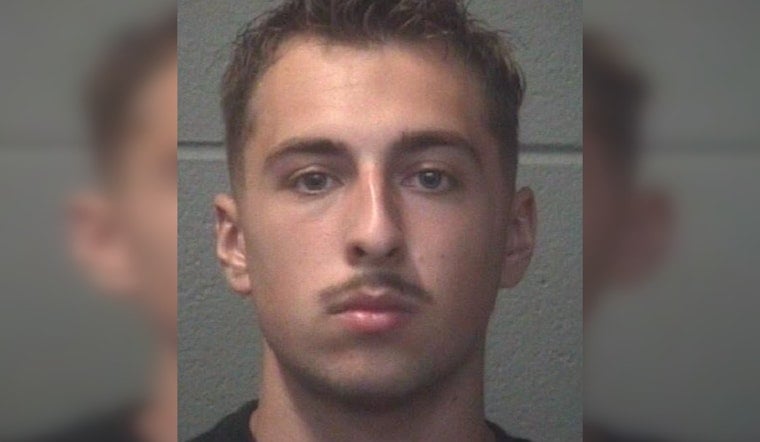
A 20-year-old New York man is facing a felony charge after Onslow County deputies say he outfitted his personal pickup truck with flashing blue and white lights and used them to make another driver pull over near Camp Lejeune. Matthew Cuccia was arrested Thursday and booked into the Onslow County Detention Center on a charge of felony unlawful use of blue lights on a motor vehicle.
According to WNCT, deputies responded Thursday to a report of a suspicious vehicle displaying apparent emergency lights in the 1000 block of Yorktown Lane in Midway Park. The report stemmed from a caller who said a black Ram 1500 approached from behind with flashing blue and white lights near Piney Green Road and N.C. Highway 24, prompting the caller to move to the side of the roadway to let the truck pass. The caller told authorities the truck did not appear to be a law enforcement vehicle.
Piney Green Road and N.C. 24 form a heavily traveled corridor connecting Jacksonville directly to the Piney Green Gate of Marine Corps Base Camp Lejeune, according to background from the U.S. Marine Corps. Deputies say Cuccia was ultimately located at the Liberty Point Apartments in Onslow County. The station's report notes his truck was equipped with multiple emergency-style lights mounted on the grille, front bumper, rear bumper, and rear glass.
Why the Charge Is a Felony, Not a Ticket
Under North Carolina General Statute § 20-130.1, only sworn law enforcement officers are legally permitted to possess, install, activate, or operate blue lights on a vehicle in the state, a baseline that makes non-police blue light equipment illegal outright on public roads, per the North Carolina General Assembly. But the case against Cuccia escalated well beyond a simple equipment violation. Using a blue emergency light to command another motorist to yield or stop constitutes a Class H felony under North Carolina General Statute § 14-277.8(b), which carries up to 39 months in prison under state structured sentencing guidelines depending on a defendant's prior criminal history, according to Jetton & Meredith PLLC.
The felony threshold exists in part because North Carolina law obligates drivers to comply. State statute § 20-157 requires motorists to immediately pull to the right side of the road upon seeing activated blue lights and hearing sirens from an approaching emergency vehicle, per Jetton & Meredith PLLC. That same instinct to yield is exactly what deputies say the Midway Park caller followed before realizing the truck behind them wasn't actually a police vehicle.
A Pattern Across the State
Cuccia's arrest isn't an isolated case in North Carolina this year. In January, Wake County authorities arrested a man and charged him under the same statute after he allegedly used a blue-light-equipped Dodge Charger to conduct an unauthorized traffic stop, according to a Facebook post from law enforcement at the time. The trend extends beyond state lines, too — in a Florida case in June, a driver was arrested for impersonating a law enforcement officer after activating red-and-blue emergency lights to try to pull over an undercover sheriff's vehicle.
Part of what makes unauthorized blue lights so effective — and so dangerous — is how thoroughly North Carolina drivers have been trained to trust them. Major departments across the state, including in Charlotte and Wilmington, run steady blue “Heartbeat” cruiser lights during routine patrols specifically to reinforce public recognition of blue lights as a symbol of police presence, a strategy Hoodline detailed in coverage of Charlotte's initiative. That same conditioning is precisely what deputies say Cuccia's setup exploited on Piney Green Road.
Bond and What Happens Next
Cuccia was held under a $10,000 unsecured bond following his arrest. Under North Carolina Criminal Procedure Statute § 15A-534, an unsecured bond allows a defendant to be released from custody without paying money upfront, but it creates a civil money judgment for the full amount if the defendant fails to appear for scheduled court dates, according to the North Carolina Judicial Branch. It remains unclear whether Cuccia attempted additional unauthorized stops in Onslow County or possessed any other law enforcement-style gear, as that detail has not been disclosed.
The Onslow County Detention Center, where felony arrestees in unincorporated Onslow County are processed and held, is located at 717 Court Street in Jacksonville. The facility has factored into other recent Onslow County cases, including a woman held without bond and a separate case involving felony charges tied to an assault at Onslow Memorial Hospital.



