

























































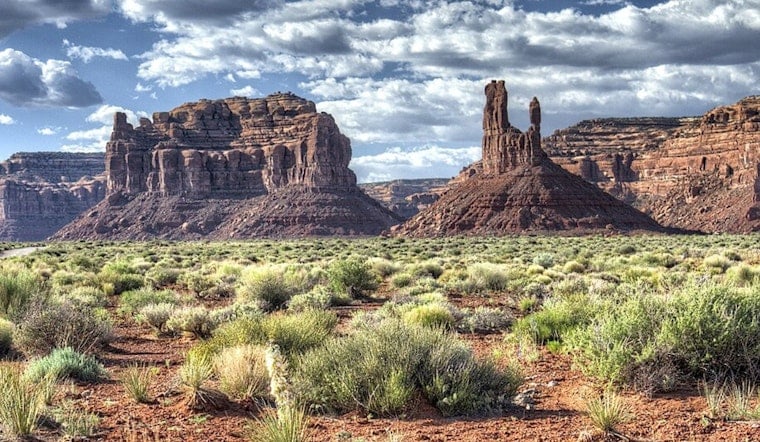
A stretch of unpaved road in southern Utah with no water spigots, no power hookups, and no shade structures has just been named the best campsite in the United States. Valley of the Gods Road, a collection of dispersed camping sites scattered along a red-rock loop in San Juan County, topped The Dyrt's 2026 ranking of the country's best places to camp — beating out developed, paid campgrounds from coast to coast.
The Dyrt, a camping app and review platform, chose its top sites based on camper reviews, and Valley of the Gods came out on top for 2026, as first reported by The Salt Lake Tribune. The site is managed by the Bureau of Land Management and spans a 17-mile unpaved dirt and clay loop known as San Juan County Road #242, which connects Utah Highways 163 and 261 near the town of Mexican Hat, according to the Bureau of Land Management.
Dispersed camping sites made up half of The Dyrt's top 10 list this year, per the same rankings. It wasn't just Valley of the Gods, either — the second- and third-place finishers, Scoria Pit in North Dakota and The Wall in South Dakota, were also completely free dispersed camping spots on public land, meaning fee-free sites swept the top three spots on the national list.
A Free Ranking That Reflects a Bigger Trend
The sweep isn't a fluke. The Dyrt's 2026 Camping Report found that 59.8% of surveyed campers camped for free at least once during 2025, and 79.1% of those budget-conscious travelers specifically sought out dispersed camping on public lands. That data helps explain why undeveloped, no-cost sites like Valley of the Gods are climbing camper ratings even as traditional paid campgrounds grapple with rising costs and crowded reservation systems.
Not everything on the list was free, though. The Dyrt's top 10 also included established, paid facilities such as California's Jedediah Smith Redwoods State Park Campground at No. 4, Washington's Elkamp Eastcreek at No. 5, and Minnesota's Split Rock Lighthouse State Park Cart-in Campground at No. 9 — showing that primitive public lands and developed state parks are now competing directly for the same camper attention.
No Water, No Power, No Trash Pickup
Camping at Valley of the Gods is free and requires no reservations, but it comes with real restrictions. BLM rules cap stays at 14 days within any 28 days and require campers to use only previously disturbed areas within 150 feet of designated routes, according to the agency's guidelines.
There's no potable water, no restroom facilities, and no trash collection anywhere along the loop, and cell service is limited, according to guidance highlighted by the Town of Bluff. Visitors are expected to bring in everything they need and pack out all of their garbage — and their human waste — when they leave.
Road conditions add another layer of self-sufficiency to the trip. The 17-mile loop is passable for passenger cars in dry weather, but four-wheel drive becomes necessary after heavy rain, and RVs longer than 25 to 30 feet are discouraged because of steep washes and tight turns, per guidance from RVshare.
Inside Bears Ears, Near a Uranium-Era Road
Valley of the Gods sits within the boundary of Bears Ears National Monument, a 1.3-million-acre protected landscape in San Juan County that's managed in collaboration with a coalition of five Native American tribes, according to the Access Fund. That co-management status places the newly crowned top campsite squarely inside one of the country's more contested public lands designations.
The western end of Valley of the Gods Road connects directly to Highway 261 near the base of the Moki Dugway, a 3-mile unpaved switchback carved into a 1,200-foot cliff face on Cedar Mesa that was built in the 1950s to haul uranium ore, according to the Town of Bluff. The route ties the campsite's scenic loop to a piece of regional mining history that predates its current fame among campers.
Valley of the Gods has earned a nickname among visitors — “Miniature Monument Valley” — for its red rock sandstone monoliths, which echo the more famous formations just south of the Utah-Arizona border. But the comparison highlights a key difference: neighboring Monument Valley requires paid Navajo tribal permits and hired guides for backcountry access, according to Utah.com, while Valley of the Gods offers similar scenery on federal BLM land without entrance fees or guide requirements.



