

























































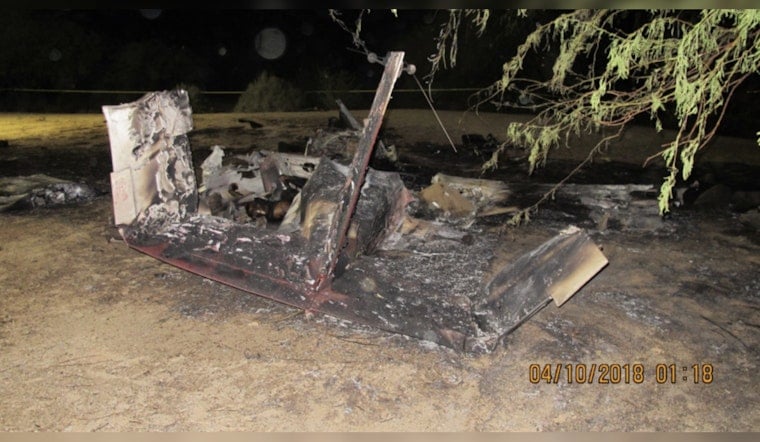
A Piper Comanche carrying six people crashed into the TPC Scottsdale Champions Golf Course roughly 70 seconds after taking off from Scottsdale Airport in April 2018, killing everyone on board. Federal investigators later determined the single-engine plane had been loaded 135 pounds over its maximum gross weight and was so far out of balance toward the tail that the pilot lost the ability to keep it under control during the climb.
A Vegas-Bound Flight That Never Made It Off the Ground Safely
The National Transportation Safety Board's final report found the probable cause of the crash was the flight instructor's failure to maintain control of the airplane during initial climb, a failure rooted in how the aircraft had been loaded, according to the National Transportation Safety Board. Investigators calculated the plane's actual weight at 3,335 pounds against a certified maximum of 3,200 pounds, and found its center of gravity sitting 2.22 inches behind the aircraft's aft limit — a combination that, per the NTSB, severely reduces pitch stability and can make a stall impossible to recover from. As detailed by aviation outlet Fear of Landing, the Comanche was designed as a four-seat aircraft that could technically be extended to six seats, but only with strict luggage limits and less than full fuel — conditions this flight did not meet.
The plane was headed from Scottsdale to Las Vegas, carrying six people and full fuel, per the same account. The trip's organizer, an Instagram user known for jet-setting content who had roughly 12,000 followers at the time, had planned to fly friends between the two cities and had estimated his passengers as three small girls and two medium guys, plus himself, according to Fear of Landing's reporting. He occupied the front-left seat, while the qualified pilot who agreed to serve as pilot in command sat in the right-hand seat.
A First-Time Aircraft, a Rushed Turnaround
The pilot in command had roughly 200 hours of flight time in Comanche-type aircraft, the outlet reports, but the leg from Las Vegas to Scottsdale immediately before the crash was his first time ever flying that specific airplane, according to an analysis by the Aircraft Owners and Pilots Association. The crew spent only about 26 minutes on the ground in Scottsdale loading passengers before departing again, the analysis found. A separate flight instructor had originally been slated to fly but backed out of the planned trip, per Fear of Landing, leaving the qualified pilot to take on the flight as pilot in command — a role that under federal aviation regulations carries sole legal responsibility for calculating weight and balance before takeoff, according to the Federal Aviation Administration.
The instagrammer had misstated the aircraft's maximum gross weight as 1,200 pounds and estimated the group's luggage as small and light, carried on passengers' laps, Fear of Landing reports. The Comanche's actual empty weight was 2,007 pounds, with capacity to carry 1,193 pounds beyond that figure — a margin the fully loaded flight blew past. A previous flight in the same aircraft had carried four people and 100 pounds of luggage while maintaining a 700-foot-per-minute climb rate, the outlet notes, a performance benchmark the overloaded flight never came close to matching.
Warning Signs Before the Plane Ever Left the Runway
Ground personnel noticed trouble even before takeoff. A ramp worker observed that the engine required several attempts to start, and an airport operations technician later reported that the engine sounded below full power, though the technician also noted no sputtering, roughness, smoke, fire, or vapors at the time, according to Fear of Landing. A tower controller noticed the engine did not sound to be producing enough power and asked the flight crew whether they were experiencing difficulty; the crew responded, “We're good. We're just in training mode,” per the outlet's reporting — a statement a qualified pilot later said could not be considered accurate, since the flight did not meet the standard for instructional flying.
NTSB investigators later found a fracture in the engine, tracing it to a preexisting broken intake valve spring in the No. 3 cylinder with fatigued fracture surfaces, a defect that went undetected during routine maintenance and further degraded the aircraft's already-compromised climb capability, the NTSB's report states. That reduced engine power became critical once the plane was fully loaded, according to Fear of Landing. A traffic camera recorded the aircraft entering an increasingly steep left turn as it struggled to climb, reaching only about 200 feet above the ground before it began to fall during the turn, descending with its wings almost vertical when it struck the ground and burst into flames.
Investigators Rule Out Drug Impairment as a Factor
Toxicology testing on the student pilot detected cocaine and MDMA metabolites at low concentration, but NTSB toxicologists concluded the levels reflected past recreational use rather than active impairment during the flight, per the federal report. The lead pilot's own toxicology screen came back negative for alcohol, carbon monoxide, and all tested illicit drugs. Fear of Landing's reporting frames the finding plainly: toxicology was considered not a factor in the crash, shifting the investigative focus squarely onto the aircraft's weight and balance and its mechanical condition.
The crash killed flight instructor Erik Valente, student pilot James Pedroza, and passengers Mariah Coogan, Anand “Happy” Patel, Helena Lagos and Iris Carolina Rodriguez Garcia, according to CBS News. The group had been returning to Las Vegas after attending the Phoenix Lights music festival, and cabin video recorded moments before taxi showed passengers celebrating with captions like “off to Vegas.” One passenger aboard had roughly 28,000 Instagram followers, and another influencer connected to the group had almost 44,000, according to Fear of Landing's reporting. A friend of the trip's organizer said afterward, “I am sad that he is gone, but loved how he lived life to the fullest.”
Inside the Cabin as the Plane Went Down
Investigators found that the four occupants seated in the rear had not fastened their seatbelts, while the two male occupants up front were belted in, per Fear of Landing. Passengers were observed staring at their phones during taxi just before the aircraft departed. The aircraft's seats detached during the impact, and one passenger was thrown clear of the wreckage. A couple living near the airport called 911 after witnessing the crash. There were no survivors.
A Recurring Risk at a Busy Regional Airport
Scottsdale Airport remains one of the busiest general aviation hubs in the Phoenix metro area, supporting heavy corporate and charter traffic that now includes a $36 million Flexjet private terminal and maintenance hangar project launched in 2025, Hoodline has previously reported. It is not the only fatal general aviation accident to strike the airport in recent years: in February 2025, a Learjet flown by a 78-year-old pilot suffered landing gear failure and swerved to avoid the runway, colliding with a parked Gulfstream jet, in an incident Hoodline covered in its report on pilot Joie Vitosky.
Aviation safety research cited in the federal case file explains why an aft-loaded aircraft like this Comanche becomes so hazardous: pushing weight rearward beyond the certified limit pulls the tail down, forcing the nose to pitch up prematurely during takeoff and cutting into a pilot's ability to recover from a stall. In this case, the excessive aft center of gravity caused the aircraft to lift off before it had reached sufficient speed, according to Fear of Landing's account of the investigation, leaving the crew with an aircraft that had, in effect, no margin left to work with once trouble began.





