

























































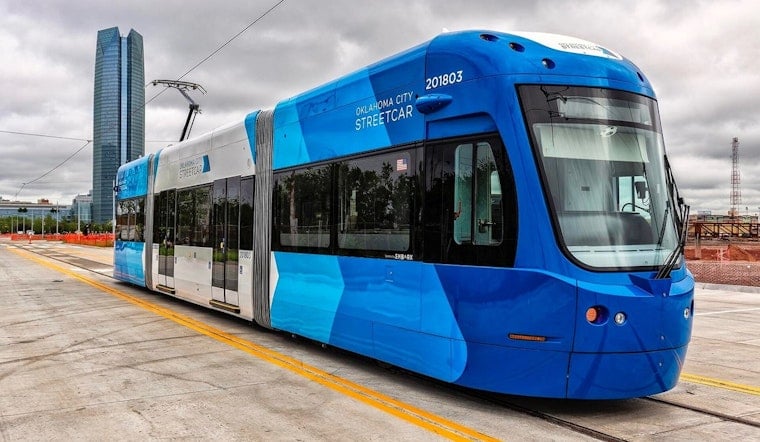
Oklahoma City's downtown streetcar is now permanently free to ride, after transit officials voted to make a temporary fare-free pilot a lasting policy. The Central Oklahoma Transportation and Parking Authority board adopted the resolution removing streetcar fares on Thursday, capping months of testing that saw ridership climb sharply once the $1 fare disappeared.
The decision, first reported by KOKH, follows a six-month pilot program that EMBARK launched on January 5, according to the Oklahoma City Free Press. The pilot was originally set to run through the summer but was extended through August 20 after early data showed strong gains in passenger traffic, the outlet reported. Streetcar usage rose 71 percent during that stretch, per an EMBARK analysis cited in the KOKH report.
From Pilot Program to Permanent Policy
Jesse Rush, who leads Oklahoma City's Public Transportation and Parking Department, said EMBARK is pleased with the ridership analysis results and the creation of a zero-fare OKC streetcar system, according to the station's report. Rush previously served as the streetcar's project manager starting in 2017, overseeing its initial testing and its December 2018 launch, before being named department director in September 2024, as Hoodline reported in a story about his appointment to the role.
The system now operating fare-free includes seven streetcars running two loops across 22 stops, seven days a week, per the same account. City officials have pointed to the streetcar's ability to ease traffic congestion, improve downtown circulation, and boost economic activity for downtown businesses as reasons behind the permanent fare removal.
What Riders Used to Pay
Before Thursday's vote, standard adult fares ran $1 for a single ride and $3 for a 24-hour pass, while seniors 65 and older, Medicare cardholders, and riders with qualifying disabilities paid a reduced $0.50 per ride, according to fare information published by EMBARK. Those fees are now gone entirely for every rider, regardless of age or eligibility status.
In weighing the permanent switch, EMBARK officials evaluated peer Midwestern cities operating zero-fare downtown streetcars — including Kansas City, Milwaukee, and Cincinnati — before recommending the change to COTPA trustees, according to The Journal Record. The comparison suggested that removing even a small fare barrier could meaningfully increase ridership on downtown circulators, a pattern that Oklahoma City's own 71 percent surge appears to confirm.
A System Built Debt-Free
The streetcar network was constructed for roughly $135 million, funded entirely through MAPS 3, the temporary one-cent sales tax Oklahoma City voters approved in December 2009 and that collected revenue from April 2010 through December 2017, according to the City of Oklahoma City. Because the capital project carried no debt, fare revenue represented a relatively small share of the system's overall operating picture compared to the broader downtown economic goals officials cite.
That economic rationale traces back to the years before the streetcar even opened. Between 2011 and 2018, the three-block impact zone along the planned route attracted more than $1.6 billion in public and private investment, including 21 residential developments, seven hotels, and 1.54 million square feet of net office space growth, according to the Greater Oklahoma City Chamber. The streetcar itself began carrying passengers on December 14, 2018, bringing rail transit back to downtown streets for the first time in decades.
Record Ridership Before the Fare Even Dropped
The zero-fare pilot did not launch from a standing start. During the fiscal year ending June 30, 2025 — before fares were removed — the streetcar had already logged a record 288,517 annual riders, according to Metro Magazine. That baseline growth helps explain why the subsequent 71 percent jump during the pilot registered as such a significant shift for planners.
The fleet itself was built by Pennsylvania-based Brookville Equipment Corporation under a $33.7 million contract for seven off-wire capable Liberty Modern Streetcars, each 66 feet long with onboard battery storage and room for up to 104 passengers, according to Brookville's project page. That capacity gives EMBARK room to absorb the ridership increase without adding vehicles to the two-loop, 22-stop system.
Free Fares Beyond the Streetcar
The streetcar's permanent fare elimination sits alongside other free-ride efforts EMBARK already runs. The agency's Third Friday Free promotion offers no-cost rides across its bus, streetcar, and river cruise lines from May through September, supported in 2026 through a sponsorship with Allegiance Credit Union, Metro Magazine reported. Open questions remain about whether the zero-fare model will eventually extend to EMBARK's fixed-route bus lines or its RAPID BRT network, and how the agency will balance operating costs amid major upcoming projects, including construction tied to the new downtown arena that has already forced temporary streetcar service pauses, as Hoodline has reported.





.jpg)