

























































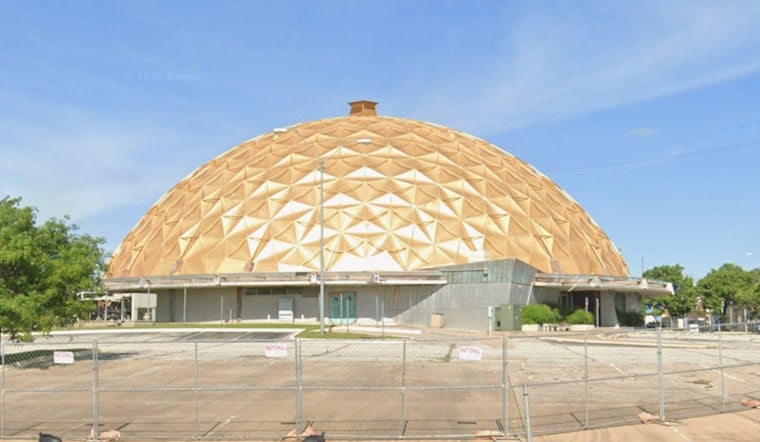
Oklahoma City's iconic Gold Dome is once again fighting for survival, this time facing a sheriff's auction after its owner defaulted on a mortgage, even as city officials stand one vote away from approving $3 million to help rescue the property. The geodesic landmark at NW 23rd Street and North Classen Boulevard has dodged the wrecking ball twice before, and now a foreclosure case is testing whether a long-discussed concert venue conversion can still happen.
Chickasaw Community Bank, which is owned by the Chickasaw Nation, filed to foreclose on developer Jonathan Russell in November 2025, according to The Oklahoman. The bank's filing accuses Russell of defaulting on a mortgage issued in 2017, and the paper reports he owed $1,163,195 including interest as of 2025. With the sheriff's auction looming, a music venue operator is reportedly one vote away from receiving the $3 million the city may grant for the Gold Dome's redevelopment.
Russell, who runs Land Run Development, purchased the Gold Dome in 2015 for $1.1 million, following years of ownership turnover and a previous owner's legal troubles, according to Abandoned Oklahoma. That purchase came after the building had already survived two separate brushes with demolition, first in 2001 when Citizens Bank sought to flatten it for a Walgreens, and again in 2013 when developer David Box bought the property for $800,000 and applied for a permit to replace it with a gas station. Public protests halted both plans, according to the same account.
A $3 Million Bet On A Concert Venue
The current rescue attempt traces back to January 2025, when the Oklahoma City Council voted 7-1 to approve $3 million in Tax Increment Financing loan funds for Tulsa-based Kismet Koncerts to convert the vacant building into a concert venue, part of an estimated $10 million project, as reported by Route 66 News. Under the redevelopment proposal advanced in late 2024, Kismet Koncerts pledged at least $7 million in private capital to build a 2,500-capacity venue hosting roughly 65 events a year, while guaranteeing a minimum annual tax payment of $120,000, per the Oklahoma City Free Press. Kismet Koncerts also operates other regional venues, including The Odeon in Cleveland and the Crown Uptown Theater in Wichita.
That momentum hit a snag almost immediately. Also in January 2025, the National Park Service rejected an application for federal historic tax credits on the project because the developer planned to remove a second-floor interior wall to build concert suites, the Free Press reported. Federal historic preservation tax credits can cover up to 20% of qualified rehabilitation costs for certified historic structures, making the denial a significant financial setback for a project already leaning on public financing.
A Building Built To Outlast Its Owners
Completed in 1958 as Citizens State Bank, the Gold Dome was designed by architecture firm Bailey, Bozalis, Dickinson & Roloff using Buckminster Fuller's geodesic principles, making it the fifth geodesic dome built in the world and the first ever built for a bank, according to Wikipedia. The 145-foot-diameter structure is made up of 625 gold-anodized aluminum panels, each weighing 60 to 70 pounds, and cost roughly $1 million to build, per TravelOK. It remains one of the few surviving Kaiser Aluminum geodesic structures still standing, and its column-free interior spans approximately 27,000 square feet.
The dome earned a spot on the National Register of Historic Places on September 4, 2003, cementing its status as a landmark along historic Route 66 near the southern entrance of Oklahoma City's Asian District. In 2019, the Oklahoma City Urban Design Commission approved demolition of the building's original drive-thru canopy, which Midwest Wrecking Co. removed to make the property more attractive to buyers, according to Abandoned Oklahoma, though the primary dome structure itself was left untouched.
Municipal Tools Still In Play
The Gold Dome sits within both Oklahoma City's Classen Corridor Tax Increment Financing District and the Uptown 23rd Business Improvement District, giving local officials targeted incentive tools to help make the adaptive-reuse project financially viable, according to LoopNet. Tax increment financing captures projected future growth in property taxes within a district to help fund developer costs or infrastructure, a tool Hoodline has flagged before in downtown TIF deals tied to the Gold Dome's revival efforts.
Whether that financing arrives in time to head off the sheriff's auction remains the open question hanging over the property. The city's potential $3 million commitment now serves as a high-stakes bid to keep a nationally recognized architectural landmark out of foreclosure while still trying to land an operator capable of maintaining it for the long haul.





