

























































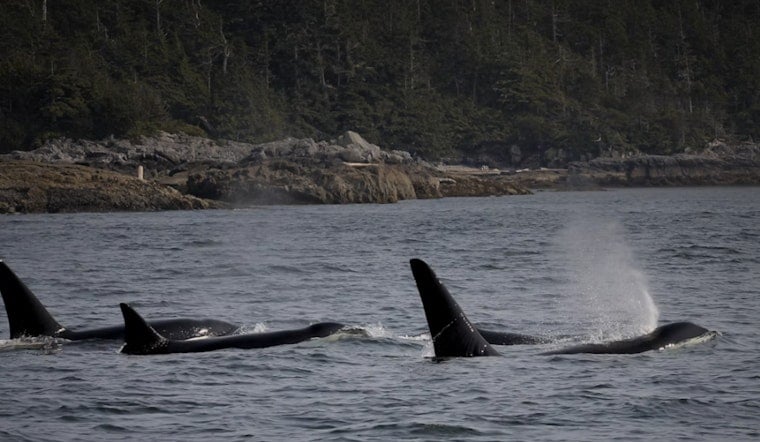
A pod of orcas swam north past West Seattle on Tuesday, passing directly by Colman Pool before continuing on toward Lincoln Park, giving shoreline watchers another close-up look at killer whales in the urban waterway. The whales were tracked moving up the Sound, staying close to the West Seattle side of the water as they went.
According to West Seattle Blog, the orcas were first seen passing Colman Pool before naturalist Kersti Muul reported them off Lincoln Park, noting the pod was close to the West Seattle side of the sound as it moved north. Muul has become a familiar name in these reports; she's the urban wildlife biologist who founded Salish Wildlife Watch in 2022, a WhatsApp-based sighting network that now connects more than 6,000 subscribers tracking marine mammal movement along Seattle's urban waterfront, according to The Urban Activist.
Colman Pool itself sits inside Lincoln Park's 135 acres on Point Williams, and it's no ordinary swimming hole — it's Seattle's oldest public pool and its only heated saltwater facility, drawing its water directly from three beach intake wells into a 500,000-gallon basin, per Seattle Met. The shoreline paths around the pool double as some of the best land-based whale-watching spots in the region, part of what's known as the Whale Trail.
A Record Year for Transient Orcas in the Sound
Tuesday's pass is the latest in a string of West Seattle orca sightings this year, following a July sighting near Alki Avenue, an appearance in the Fauntleroy ferry lanes in May, and orcas swimming close to the container wharves in Elliott Bay back in March. These sightings are part of a broader trend: the Orca Behavior Institute recorded a record 1,860 unique sightings of Bigg's transient killer whales across the Salish Sea in 2025, up from just 385 the year before and a mere 38 back in 2001, reflecting a population boom tied to abundant regional harbor seal and sea lion prey.
It's not just the mammal-hunting transients having a good stretch. The Center for Whale Research's July 2026 census counted 76 living Southern Resident killer whales, the highest total for the endangered fish-eating population since 2017, following two calf births earlier in the year, according to Salish Sea Currents. NOAA Fisheries formally recognized Bigg's and Southern Resident killer whales as two distinct species in March 2024, based on differences in genetics, diet, and social structure — a distinction that matters both for science and for boaters trying to figure out how far back to stay.
Know the Buffer Before You Head Out on the Water
Washington state law, effective since January 2025, requires all boaters — motorized or not — to keep at least 1,000 yards from endangered Southern Resident killer whales to protect their ability to hunt using echolocation without vessel noise interference. Bigg's, or transient, killer whales carry a lighter but still mandatory buffer: a minimum 200 yards, with boats required to stay 400 yards out of the whales' direct path, under federal and state rules updated for 2025, according to NOAA Fisheries.
State wildlife officials recommend that boaters who can't tell the two ecotypes apart on the water simply default to the larger 1,000-yard buffer, a point Hoodline has covered before in reporting on stricter orca buffer enforcement. With sightings running at record highs and pods regularly threading through Elliott Bay and the East Passage, that guidance is increasingly relevant for anyone heading out on the Sound this summer.
West Seattle's shoreline has quietly become one of the best places in the region to watch orcas without needing a boat at all. Lincoln Park is one of four official Whale Trail sites in West Seattle, part of a network of more than 100 designated land-based viewing spots up and down the West Coast maintained by the West Seattle-headquartered nonprofit. For now, no further details on the pod's size or exact travel path beyond the Colman Pool and Lincoln Park sightings have been reported.




