

























































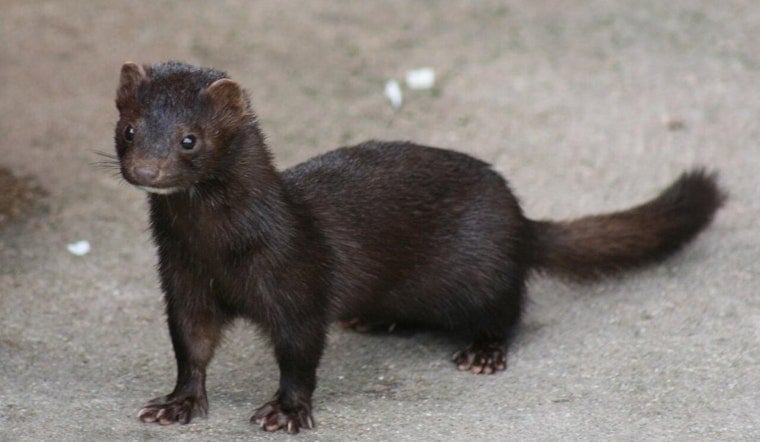
A break-in at Cascade Farms of Oregon in Turner released approximately 1,500 mink into the wild on August 13, and by Thursday morning farm workers and supporters had recaptured only about 80% of them, leaving hundreds of animals still missing and facing serious risks from starvation, thirst, and predators during the critical days after their escape.
The Animal Liberation Front claimed responsibility for the break-in in a press release, according to KOIN.com, though the Marion County Sheriff's Office said it has no information indicating ALF involvement and has made no arrests in the case. The FBI's Portland office has declined to comment on whether it is investigating the break-in. Cascade Farms was established by John Lucas in Oregon in 1980 and is now owned by Randy Lucas; the farm previously closed its meat business but its mink ranch remains in operation. Recovery efforts intensified in the roughly 24 to 48 hours after the fences were cut, a window that the The Cool Down notes carries the highest mortality risk for animals unaccustomed to fending for themselves outdoors.
An Activist Predicts More Raids Before Pelting Season
Joseph Buddenberg, who pleaded guilty in 2016 to conspiracy to violate the Animal Enterprise Terrorism Act and has since completed his sentence, told KOIN.com the Cascade Farms break-in is consistent with an ALF action and said fur farmers should expect more mink raids before November, when farmed mink are typically harvested for their pelts. Buddenberg has reported that more than 100 fur farm raids have occurred in the United States since the 1990s. Jerry Vlasak also said the break-in fits the pattern of an ALF action, though he told the outlet he had not personally received an anonymous communique claiming it.
The Animal Liberation Front has historically used tactics such as cutting fences, opening cages, and destroying breeding records, per the same account. Thomas Zeitzoff, who has researched political violence and radical environmental activism through more than 150 interviews and a database of 1,300 incidents, said the ALF remains active today despite lacking any formal leadership or membership lists. He noted that radical environmental activism peaked in the 1990s before slowing by the 2000s.
Oregon's Mink Industry Has Shrunk for Decades
Oregon had 37 mink farms in 1978, 30 in 1998, and 18 by 2006; today, some estimates put the number at around 11, and Buddenberg estimated only about five mink farms remain in the state, according to the article. Nationally, the Fur Commission USA estimates roughly 275 mink farms still operate across 23 states, and the group has said that released mink often do not survive in the wild — a claim that aligns with wildlife ecology research showing escaped domestic mink face catastrophic mortality rates from a lack of wild survival skills, even as any survivors can become destructive generalist predators on native waterfowl, fish, and small mammals in wetland ecosystems, per Clemson OPEN research.
The mink industry generated $28.1 million in pelts in 2024, though comprehensive federal tracking of that figure is growing harder to come by. The USDA's National Agricultural Statistics Service discontinued its annual national Mink Survey in August 2025 under the Paperwork Reduction Act, citing a lack of statutory requirement, which Hoodline previously reported ended annual data and left the quinquennial Census of Agriculture as the primary remaining federal source. The final full USDA Mink Report, issued in July 2024, had put 2023 national pelt production at 973,510 pelts worth $33.1 million, a 28 percent drop in volume from the prior year, with Wisconsin and Utah leading production.
Turner Break-In Echoes Past Oregon Raids
Oregon has seen this before. In 2008, fencing was cut and mink were released into the wild at Ylipelto's Fur Farm in Astoria, Jefferson Mink Farm in Jefferson, and S&N Fur Farm in Scio, with the Animal Liberation Front claiming responsibility for multiple Oregon mink farm break-ins that year. Ylipelto's later had roughly 300 more mink released on October 4, 2009, before the operation ceased mink farming around December of that year; the farm was then targeted by multiple fires in July 2010, which the ALF also claimed. Both Jefferson Mink Farm and S&N Fur Farm have since closed.
Legal consequences for this kind of direct action can be severe. Under the federal Animal Enterprise Terrorism Act, individuals who cause physical damage or economic loss to commercial animal enterprises face up to five years in federal prison for losses between $10,000 and $100,000, and up to 10 years for losses exceeding $100,000, according to the federal statute compiled by GovInfo. In a separate case tied to environmental activism, a North Dakota judge ordered Greenpeace to pay $345 million to Energy Transfer in February over protests against the Dakota Access Pipeline. Federal authorities have pursued similar mink-release cases elsewhere: in October 2024, two people were arrested on felony charges including agricultural vandalism and burglary after security cameras caught them releasing 200 mink at a Pennsylvania farm that had suffered a much larger release of 6,000 to 8,000 mink the previous year, according to CBS News. In May 2023, the FBI's Cleveland office appealed for public information on a string of five overnight ALF-claimed raids across Ohio and Michigan, including a November 2022 release of 10,000 mink in Van Wert, Ohio, that forced one farm to close permanently, per WTOL.
The FBI's response to this kind of activism in Oregon stretches back decades. Between 1996 and 2001, ALF and ELF activists carried out 17 arsons and acts of eco-sabotage across Oregon and the Pacific Northwest, prompting the multi-agency federal investigation known as Operation Backfire, which resulted in convictions and domestic terrorism sentence enhancements for 15 individuals by 2012, according to the FBI. Oregon lawmakers have also tried to curb mink farming through legislation rather than direct action; State Senator Floyd Prozanski introduced Senate Bill 832 in February 2021 to permanently phase out commercial mink farming statewide while offering transitional assistance to remaining producers. That followed a July 2021 emergency rule from the Oregon Department of Agriculture requiring captive mink operators to vaccinate their herds against COVID-19, a biosecurity measure enacted after farm quarantines in Marion County late in 2020.





