

























































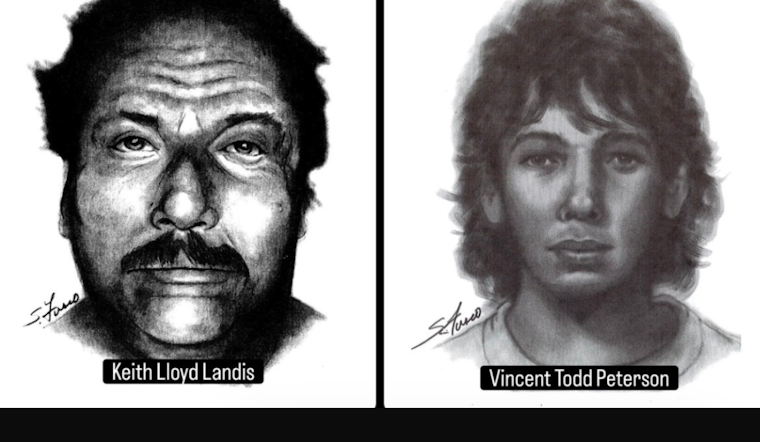
Two names have finally been attached to remains that sat unidentified in Orlando for decades. The Orlando Police Department's Cold Case Unit says it has identified Vincent Todd Peterson, who died in 1982 at the age of 16 at a construction site, and Keith Lloyd Landis, who was 49 when his case went unresolved starting in 1996.
According to a post from Orlando Police, detectives used forensic genetic genealogy to identify Peterson, a case that had shown no signs of foul play. Landis's identity, by contrast, was confirmed through a more direct method: DNA comparison with his sister. Both cases were resolved through collaboration between the Cold Case Unit and the District Nine Medical Examiner's Office, which oversees medicolegal death investigations for Orange and Osceola counties.
Cold Case Unit Resolves Decades-Old Unidentified Remains Cases
— Orlando Police (@OrlandoPolice) August 17, 2026
After decades of unanswered questions, detectives with the Orlando Police Department’s Cold Case Unit have identified two men whose deaths had remained unresolved since 1982 and 1996.
In the 1982 case, detectives… pic.twitter.com/mr79RLgjds
Landis is reported to have died of natural causes, closing out a case that had gone unresolved for roughly 30 years. Peterson's case, older and more complex, required the kind of advanced DNA testing that has become central to how Orlando's detectives now approach their oldest files. The Cold Case Unit has said its identifications reflect a broader commitment to using advances in forensic science and DNA technology to identify unknown people and bring closure to families.
A Unit Built to Clear a Backlog
The Orlando Police Department's Cold Case Unit was officially established in March 2021 to systematically organize and re-examine a backlog of more than 250 unsolved homicides and missing person cases, according to FOX 35 Orlando. Before the unit's creation, case files were reportedly stored in hundreds of unorganized boxes. The squad notched its first cold case win in February 2022, when modern DNA re-testing connected a convicted armed robber to two fatal 1987 downtown beatings that had gone unresolved for 34 years, with the suspect accused of striking sleeping or isolated victims with steel rebar.
That track record has continued. Just last month, Orlando Police used long-preserved DNA evidence and a CODIS match to arrest a suspect in the 1988 murder of Diane Matthews, nearly 38 years after her death, a case Hoodline covered in its report on the Matthews arrest. The Peterson and Landis identifications add two more names to a growing list of cases the unit has managed to close using DNA-driven investigative work.
Where the Science Comes From
Cases like Peterson's, which lacked the direct family comparison available in the Landis investigation, often depend on forensic-grade genome sequencing built to work with heavily degraded remains. Othram Inc., a Texas-based lab, uses proprietary sequencing to construct detailed DNA profiles from samples that fail standard CODIS short-tandem repeat testing, according to reporting from Forensic Magazine. That kind of genetic genealogy pipeline becomes essential when traditional criminal database searches turn up nothing.
Orange County has already seen this method work before. In July 2024, the Orange County Sheriff's Office teamed with Othram to identify the skeletal remains of Gregory Patrick Carpenter, a 1993 homicide victim originally found by a passerby near Highway 50 and Highway 408 in Orlando, resolving that case after 31 years, per Othram's own case documentation on DNASolves. The Peterson identification follows that same regional pattern of local agencies turning to private genetic genealogy labs when standard testing hits a wall.
The Backlog That Remains
The scale of Florida's unidentified remains problem helps explain why cases like these can take decades to resolve. The District Nine Medical Examiner's Office maintains a registry of more than 50 unidentified decedents dating back over 20 years, and the office is the only medical examiner facility in the state equipped with an in-house postmortem CT imaging scanner for non-invasive skeletal evaluation, according to research from Florida Gulf Coast University. Statewide, a Florida Department of Law Enforcement report referencing federal NamUs data documented 905 unresolved unidentified person cases as of August 2022, with more than 500 of those already containing complete DNA profiles still awaiting a familial match.
Florida law requires agencies to keep trying. Under Florida Statute 406.145, law enforcement agencies and medical examiners must complete and submit formal unidentified person reports to state and national databases whenever a decedent cannot be immediately identified, a mandate that standardizes data entry across the state's 24 medical examiner districts, as Hoodline reported in its coverage of skeletal remains found near I-Drive. To help pay for the DNA sequencing that cases like Peterson's require, Florida also operates a state-funded Forensic Investigative Genetic Genealogy Grant Fund, administered by the Florida Department of Law Enforcement, that helps local police departments and medical examiners cover the cost of advanced testing through private labs.
Whether family reference DNA or full genetic genealogy sequencing is used, the outcome for the Cold Case Unit is the same goal: matching names to remains that have waited years, sometimes decades, for answers. Peterson's and Landis's cases join a growing list of Central Florida identifications made possible by that evolving forensic toolkit, one that detectives across the region continue to lean on as they work through backlogs that once seemed permanently unsolvable.





